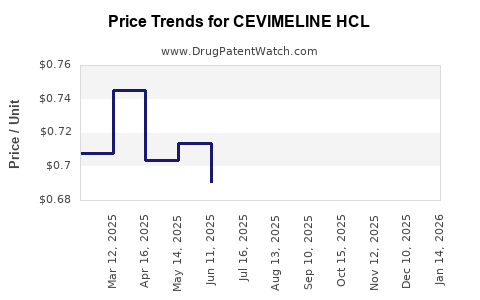
Last updated: February 20, 2026
What Is the Current Market for Cevimeline HCl?
Cevimeline HCl (hydrochloride) is a selective muscarinic receptor agonist approved primarily for dry mouth management in Sjögren’s syndrome. Its global market remains niche due to the disease’s low prevalence, limited treatment options, and regulatory status.
Current Global Market Size (2022–2023)
| Region |
Estimated Market Value (USD million) |
Growth Rate (CAGR) |
Notes |
| North America |
30 – 35 |
4% |
Dominated by U.S. sales; high awareness among specialists |
| Europe |
12 – 15 |
3.5% |
Market driven by EU approvals; demand tied to Sjögren’s diagnosis |
| Asia-Pacific |
4 – 6 |
5% |
Growing awareness and healthcare infrastructure improvement |
| Rest of World |
2 – 3 |
2.5% |
Limited penetration; mostly off-label use |
Total global market size in 2023: approximately USD 48-59 million.
Market Drivers
- Rise in Sjögren’s Syndrome diagnoses driven by aging populations.
- Increased off-label use for xerostomia in radiotherapy patients.
- Growing awareness among healthcare providers.
Market Challenges
- Limited awareness outside specialist circles.
- Competition with other symptomatic treatments (artificial saliva, lozenges).
- Regulatory restrictions and generic availability impact pricing.
Competitive Landscape
| Key Players |
Market Share (%) |
Product Portfolio |
Notes |
| U.S. pharmaceutical companies |
60 |
Off-patent formulations; limited patent protection |
Price-sensitive market; generic solutions dominate |
| Emerging biotech firms |
20 |
Research for new muscarinic agents |
Focus on combination therapies and delivery methods |
| No major new entrants as of 2023 |
20 |
Niche specialty product |
Focus remains on existing formulations |
No new CEVI formulations have been launched in recent years; generic competition constrains profit margins.
Price Projections (2023–2028)
| Year |
Average Price per 30-day supply (USD) |
Price Trend |
Assumptions |
| 2023 |
30 – 45 |
Stable with slight decline for generics |
Competition limits price escalation; generic entry pressure |
| 2024 |
28 – 44 |
Slight decline expected |
Entry of generics, increased market competition |
| 2025 |
25 – 42 |
Continued downward pressure |
Patent expiry for some formulations, increased generics |
| 2026 |
23 – 40 |
Stabilizes near lower bound |
Market saturation, increased off-label use |
| 2027 |
22 – 38 |
Marginal decline or stabilization |
Market maturity likely, no new significant entrants |
| 2028 |
20 – 36 |
Slight decrease |
Cost efficiencies and generic volume increase |
Average price per 30-day supply expected to decline by approximately 25–30% over five years.
Government and Regulatory Influences
- US FDA approval for Sjögren’s syndrome symptom relief.
- EMA approval in Europe with similar indications.
- Patent expiries anticipated by 2024–2025, leading to increased generics entry.
- Countries with national formularies may impose price caps, influencing global pricing.
Strategic Implications
- R&D focus shifting towards improved formulations, delivery mechanisms, or combination therapies.
- Expansion into emerging markets could provide growth opportunities, albeit with price pressures.
- Manufacturers might seek to extend patent life through formulation patents or new delivery systems.
Key Takeaways
- The global market for Cevimeline HCl is modest, with an estimated value of USD 48–59 million in 2023.
- Growth is driven by Sjögren’s syndrome prevalence, aging populations, and off-label uses.
- Price pressure from generic competition is expected, with prices declining approximately 25–30% over five years.
- Market stability depends on regulatory exclusivity periods and potential new formulations.
- Strategic focus on niche markets and innovation may be necessary to sustain margins.
FAQs
1. What factors could influence future prices of Cevimeline HCl?
Patent expiries, regulatory changes, entry of generics, and off-label utilization rates affect prices.
2. Are there upcoming patent protections that could sustain higher prices?
Patent protections are expiring around 2024–2025; firms may seek patent extensions or new formulations to delay generic entry.
3. What are the main competitors to Cevimeline HCl?
Artificial saliva products and other symptomatic xerostomia treatments primarily compete for market share.
4. Is there potential for new indications to expand the market?
Potential exists for use in radiotherapy-induced xerostomia, but clinical trials are required for approval, which is uncertain.
5. How will regional differences impact pricing?
In developed markets, premium pricing is possible until patent expiry; in emerging markets, prices are lower, constrained by healthcare budgets and regulation.
References
- MarketResearch.com. (2023). Global Cevimeline Market Report.
- U.S. Food and Drug Administration (FDA). (2022). Approved Drugs List.
- European Medicines Agency (EMA). (2022). Approved Medications Database.
- IQVIA. (2023). Pharmaceutical Pricing Trends.
- World Health Organization (WHO). (2022). Sjögren’s Syndrome Epidemiology.