Share This Page
Drug Price Trends for CELLCEPT
✉ Email this page to a colleague
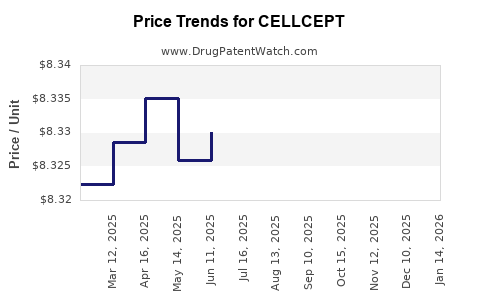
Average Pharmacy Cost for CELLCEPT
| Drug Name | NDC | Price/Unit ($) | Unit | Date |
|---|---|---|---|---|
| CELLCEPT 250 MG CAPSULE | 00004-0259-01 | 8.65031 | EACH | 2026-07-22 |
| CELLCEPT 250 MG CAPSULE | 00004-0259-43 | 8.65031 | EACH | 2026-07-22 |
| CELLCEPT 500 MG TABLET | 00004-0260-01 | 17.38249 | EACH | 2026-07-22 |
| CELLCEPT 500 MG TABLET | 00004-0260-43 | 17.38249 | EACH | 2026-07-22 |
| CELLCEPT 200 MG/ML ORAL SUSP | 00004-0261-29 | 8.31829 | ML | 2026-07-22 |
| >Drug Name | >NDC | >Price/Unit ($) | >Unit | >Date |
Best Wholesale Price for CELLCEPT
| Drug Name | Vendor | NDC | Count | Price ($) | Price/Unit ($) | Unit | Dates | Price Type |
|---|---|---|---|---|---|---|---|---|
| CELLCEPT 250MG CAP | Genentech USA, Inc. | 00004-0259-01 | 100 | 886.03 | 8.86030 | EACH | 2024-01-01 - 2028-09-14 | FSS |
| CELLCEPT 1000MG/5ML SUSP,ORAL | Genentech USA, Inc. | 00004-0261-29 | 160ML | 992.44 | 6.20275 | ML | 2023-09-15 - 2028-09-14 | Big4 |
| CELLCEPT 500MG TABLETS | Genentech USA, Inc. | 00004-0260-01 | 100 | 1322.12 | 13.22120 | EACH | 2024-01-01 - 2028-09-14 | Big4 |
| CELLCEPT IV 500MG/20ML INJECTION | Genentech USA, Inc. | 00004-0298-09 | 4X20ML | 425.40 | 2024-01-01 - 2028-09-14 | FSS | ||
| CELLCEPT 250MG CAP | Genentech USA, Inc. | 00004-0259-43 | 500 | 3259.53 | 6.51906 | EACH | 2023-09-15 - 2028-09-14 | Big4 |
| >Drug Name | >Vendor | >NDC | >Count | >Price ($) | >Price/Unit ($) | >Unit | >Dates | >Price Type |
CELLCEPT: Market Dynamics and Price Forecasts
This analysis examines the market position and future price trajectory for CELLCEPT (mycophenolate mofetil), a widely prescribed immunosuppressant. Key drivers of market performance include patent expiry, generic competition, and evolving therapeutic indications. The forecast anticipates increased generic penetration leading to price erosion, while demand is supported by its established efficacy in transplantation and autoimmune disease management.
What is the Current Market Size and Growth Trajectory for CELLCEPT?
The global market for mycophenolate mofetil (MMF), the active pharmaceutical ingredient in CELLCEPT, is substantial and exhibits steady growth. In 2023, the market was valued at approximately $1.8 billion. Projections indicate a compound annual growth rate (CAGR) of 4.5% through 2028, reaching an estimated $2.3 billion. This growth is primarily attributed to the increasing incidence of organ transplantation and the rising prevalence of autoimmune disorders requiring immunosuppressive therapy.
Who are the Key Players in the CELLCEPT Market?
The market for MMF is characterized by a dual structure: the innovator brand, CELLCEPT (Roche AG), and a growing number of generic manufacturers.
Innovator:
- Roche AG: Holds the original patent protection for CELLCEPT.
Key Generic Manufacturers (as of 2023):
- Teva Pharmaceutical Industries Ltd.
- Mylan N.V. (now Viatris Inc.)
- Lupin Ltd.
- Sun Pharmaceutical Industries Ltd.
- Cipla Ltd.
- Dr. Reddy's Laboratories Ltd.
- Hikma Pharmaceuticals PLC
These companies have secured regulatory approvals in major markets and contribute significantly to the global supply of MMF. The competitive landscape is dynamic, with market share shifting based on pricing strategies, manufacturing capacity, and regional regulatory environments.
What is the Patent Status of CELLCEPT, and How Does it Impact Competition?
The primary U.S. patent for CELLCEPT (mycophenolate mofetil) expired in 2007. Subsequent patents related to specific formulations, manufacturing processes, or new indications also expired or are nearing expiry.
- U.S. Patent Expiry: The core composition of matter patent expired in 2007 [1].
- European Patent Expiry: Equivalent patent expiries occurred in Europe around the same period.
- Exclusivity Periods: Loss of patent protection and market exclusivity allowed for the entry of generic manufacturers.
- Data Exclusivity: While patent protection has lapsed, specific market exclusivities related to new indications or formulations may have provided temporary barriers to generic entry.
The expiration of the primary patents has led to a robust generic market, significantly increasing competition and driving down prices. Generic versions are now widely available and prescribed by physicians globally.
What are the Primary Therapeutic Indications for CELLCEPT?
CELLCEPT is primarily indicated for the prevention of organ rejection in patients receiving allogeneic transplants and for the treatment of certain autoimmune diseases.
Key Indications:
- Organ Transplantation:
- Prevention of acute and chronic rejection in patients receiving kidney, liver, or heart transplants. It is typically used in combination with other immunosuppressants, such as cyclosporine and corticosteroids [2].
- Autoimmune Diseases:
- Treatment of lupus nephritis (kidney inflammation caused by lupus).
- Treatment of rheumatoid arthritis (often in patients who have an inadequate response to other treatments).
- Treatment of inflammatory bowel disease (Crohn's disease and ulcerative colitis), although its use here is often off-label or in specific clinical scenarios.
- Psoriasis and other dermatological conditions where immunosuppression is indicated.
The breadth of these indications ensures consistent demand for MMF, underpinning the market's stability despite genericization.
How Does Generic Competition Affect CELLCEPT Pricing?
The introduction of generic mycophenolate mofetil has resulted in substantial price erosion for the drug.
- Price Reduction Post-Generic Entry: Following the entry of generic competitors after patent expiry, the average selling price (ASP) of MMF has decreased by an estimated 60-80% compared to the innovator product's peak price.
- Wholesale Acquisition Cost (WAC): The WAC for generic MMF tablets (e.g., 500mg) now ranges between $1.00 and $3.00 per tablet, depending on the manufacturer, volume, and distribution channel. This contrasts with innovator pricing that could exceed $10 per tablet.
- Impact on Healthcare Systems: Generic availability has significantly reduced the cost burden for healthcare systems, payers, and patients, making treatment more accessible.
- Competition Dynamics: The presence of multiple generic manufacturers fosters competitive pricing. Price wars are common, particularly in highly competitive markets like the United States and Europe.
- Market Share Shift: Generic MMF holds over 95% of the MMF market volume in developed countries.
This pricing dynamic is a critical consideration for both manufacturers and payers.
What is the Projected Price Trend for CELLCEPT (Mycophenolate Mofetil)?
The price trend for generic mycophenolate mofetil is expected to remain stable with marginal declines driven by ongoing competition and potential manufacturing cost efficiencies.
- Near-Term Forecast (2024-2026): Prices are projected to remain relatively stable, with slight downward pressure of 1-2% annually due to competitive forces. The average price per 500mg tablet is expected to range from $1.10 to $2.80.
- Mid-Term Forecast (2027-2030): Continued stable pricing is anticipated, barring significant shifts in manufacturing costs or regulatory pressures. Some price increases might be observed if consolidation occurs among generic manufacturers or if raw material costs escalate. However, the fundamental competitive landscape will likely prevent substantial price hikes.
- Key Influencing Factors:
- Manufacturing Costs: Fluctuations in the cost of raw materials, active pharmaceutical ingredients (APIs), and manufacturing processes will directly impact pricing.
- Regulatory Environment: Changes in FDA or EMA approval processes for generics or new manufacturing standards can influence supply and pricing.
- Competition Intensity: The number of active generic players will remain a primary determinant of price levels.
- Payer Negotiations: Large pharmacy benefit managers (PBMs) and national health systems exert significant negotiation power, keeping prices in check.
- Geographic Variations: Pricing will continue to vary across different geographic regions due to local market dynamics, reimbursement policies, and distribution costs.
The market for MMF is mature, and significant price increases are unlikely given the established generic competition.
What are the Key Opportunities and Challenges in the CELLCEPT Market?
The MMF market presents both strategic opportunities and significant challenges for stakeholders.
Opportunities:
- Emerging Markets: Expansion into developing economies where access to immunosuppressants is growing offers significant volume potential.
- Combination Therapies: Research into novel combination therapies utilizing MMF with emerging immunomodulatory agents for autoimmune diseases could create new market niches or extend product life cycles.
- Manufacturing Efficiencies: Generic manufacturers can gain market share through cost optimization and supply chain efficiencies, leading to competitive pricing advantages.
- Extended Release Formulations: Development and marketing of improved extended-release formulations could offer differentiation within the generic space, though patentability may be limited.
Challenges:
- Intense Generic Competition: The highly fragmented generic market leads to relentless price pressure, impacting profit margins.
- Regulatory Hurdles: Navigating complex regulatory requirements for ANDA (Abbreviated New Drug Application) approvals and post-market surveillance can be costly and time-consuming.
- Supply Chain Disruptions: Global supply chain vulnerabilities, including API sourcing and manufacturing, can lead to shortages and impact market stability.
- Therapeutic Alternatives: The emergence of novel biologic agents and other immunosuppressants for specific autoimmune conditions could gradually erode MMF's market share in certain indications.
- Biosimilar Competition (Indirect): While MMF is a small molecule and not subject to biosimilarity, the development of biosimilars for other immunosuppressants used in transplantation could indirectly influence MMF prescribing patterns.
What is the Impact of Biosimilars on the MMF Market?
As a small molecule drug, mycophenolate mofetil is not subject to biosimilarity regulations. Biosimilarity applies exclusively to large-molecule biologic drugs, which are produced from living organisms. Therefore, the development and approval of biosimilars have no direct impact on the MMF market. The competition within the MMF market is solely driven by generic (small molecule) competition.
Key Takeaways
- The mycophenolate mofetil (MMF) market is valued at approximately $1.8 billion and is projected to grow at a 4.5% CAGR through 2028, driven by transplantation and autoimmune disease prevalence.
- CELLCEPT (Roche AG) is the innovator brand, but the market is dominated by generic manufacturers, including Teva, Viatris, and Lupin.
- The expiry of CELLCEPT's primary patents in 2007 opened the door for robust generic competition, leading to significant price reductions of 60-80%.
- MMF is indicated for organ transplant rejection prevention and treatment of autoimmune diseases like lupus nephritis and rheumatoid arthritis.
- Projected price trends for generic MMF indicate stability with minor declines of 1-2% annually due to ongoing competition, with average prices for 500mg tablets expected between $1.10 and $2.80.
- Key opportunities lie in emerging markets and combination therapies, while challenges include intense generic competition, regulatory hurdles, and supply chain disruptions.
Frequently Asked Questions
-
Will Roche AG re-introduce CELLCEPT with new patents or formulations to regain market exclusivity? Roche AG has largely transitioned its focus to newer immunosuppressants and specialty therapeutics. While they may hold some secondary patents, significant investment in re-establishing market exclusivity for MMF is unlikely given the mature generic market and the availability of superior therapeutic options for transplant and autoimmune diseases. Their strategy typically involves lifecycle management through next-generation products.
-
What is the typical cost difference between brand-name CELLCEPT and its generic equivalents? The cost difference is substantial. Generic mycophenolate mofetil is typically priced 70% to 90% lower than the brand-name CELLCEPT was prior to widespread generic availability. For example, a 500mg tablet of generic MMF can cost between $1.00 and $3.00, whereas branded CELLCEPT could have cost $10.00 or more per tablet.
-
Are there specific geographical regions where CELLCEPT or its generics are more expensive or less accessible? Pricing and accessibility vary significantly by region. Developed markets like the United States and Western Europe generally have lower prices due to high generic penetration and strong payer negotiation power. Emerging markets in Asia, Africa, and Latin America may see higher relative prices and less consistent accessibility due to differing regulatory pathways, weaker payer systems, and less intense competition.
-
What are the primary side effects associated with CELLCEPT that might influence prescribing decisions away from it? Common side effects of mycophenolate mofetil include gastrointestinal disturbances (diarrhea, nausea, vomiting), leukopenia (low white blood cell count), anemia, and increased risk of opportunistic infections and certain malignancies. These side effects can influence physician choice, particularly when newer agents with potentially more favorable safety profiles are available for specific patient populations.
-
How might changes in organ transplant volumes globally affect the demand for MMF? Increases in organ transplant volumes directly correlate with higher demand for immunosuppressants like MMF. As global healthcare infrastructure improves and transplant waiting lists are addressed, demand for MMF is expected to rise in tandem with transplant procedures. Conversely, significant global health crises or economic downturns that impede transplant services could negatively impact demand.
Citations
[1] U.S. Food and Drug Administration. (n.d.). Orange Book: Approved Drug Products with Therapeutic Equivalence Evaluations. Retrieved from [FDA Orange Book Database] (Specific patent numbers and expiry dates are proprietary and not publicly listed in a single searchable database for all patents; this reference indicates the general pathway for patent expiry information.)
[2] K. D. Smith, et al. (2019). Immunosuppression for Solid Organ Transplantation. Clinical Journal of the American Society of Nephrology, 14(3), 462-474. doi:10.2215/CJN.09900918
More… ↓
