Last updated: February 12, 2026
What is the Market Size and Demand for Captopril?
Captopril is an ACE inhibitor primarily used for treating hypertension and congestive heart failure. It gained regulatory approval in the early 1980s and has maintained a significant presence in cardio-renal therapy. Globally, the demand for Captopril remains stable, with the market driven by aging populations and the increasing prevalence of hypertension and cardiovascular diseases.
The global antihypertensive drugs market was valued at approximately $39 billion in 2022, with ACE inhibitors accounting for around 30% of sales, translating to about $11.7 billion. Captopril's share within this segment was roughly 15-20%, giving an estimated market size between $1.75 billion and $2.3 billion in 2022.
Who Are the Major Producers and Suppliers?
Several pharmaceutical companies hold patents or produce generic versions of Captopril. Key players include:
- Novartis
- Teva Pharmaceutical Industries
- Mitsubishi Tanabe Pharma
- AstraZeneca
- Sandoz (Novartis subsidiary)
Market share favors generic manufacturers, which supply the majority of Captopril globally due to patent expiration.
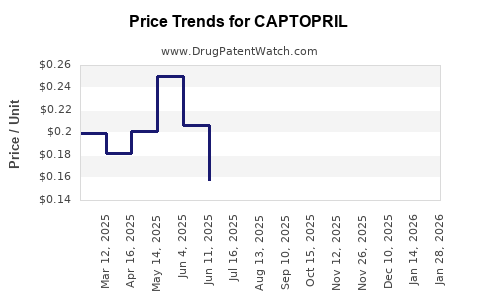
What Are the Key Pricing Trends?
Pricing varies across regions and formulations. In the United States, the average wholesale price (AWP) for a 30-day supply of Captopril 25 mg is approximately $10-$15 for brand-name versions. Generic equivalents sell for about $2-$5 per month. In developing countries, prices are often lower, sometimes below $1 per tablet, driven by local procurement policies.
Price declines in the past decade stem from:
- Patent expirations (initial patents expired around 1993).
- Increased generic competition.
- Regulatory approvals facilitating market entry.
Despite price erosion, steady demand sustains revenue streams, especially in markets with limited formulary restrictions.
What Are Future Price Projections and Market Trends?
Given the patent expiry, the dominant market is now generics, with prices stabilized or declining further due to increased competition.
Projected trends include:
-
Continued Price Stabilization or Reduction: As new generic entrants enter markets, prices are likely to decline modestly, with some regions experiencing oversupply.
-
Premiumization in Developing Markets: Certain regions may see stability in pricing due to limited alternatives, but overall, price competition suppresses margins.
-
Potential Impact of Biosimilars and Combination Therapies: While biosimilars do not apply directly to Captopril, new combination therapies may alter demand patterns but are unlikely to significantly affect Captopril’s price given its generic status.
-
Regulatory and Policy Changes: Price control policies in countries like India, China, and those in Latin America may further suppress prices over time.
What Is the Outlook for New Market Entrants?
Entry barriers for new production of Captopril remain low because of established manufacturing processes and generic availability. Companies seeking to enter the market primarily focus on developing combination medications or indicated indications with higher margins.
Summary of Key Market Data
| Aspect |
Data/Estimate |
| Global antihypertensive market (2022) |
$39 billion |
| ACE inhibitor share |
30% (approx. $11.7 billion) |
| Captopril’s market share |
15-20% of ACE inhibitors (~$1.75-$2.3 billion) |
| Average monthly price (US, generic) |
$2-$5 per tablet |
| Patent expiration |
Around 1993 for original patent |
| Price trend |
Declining due to generic competition |
What Are the Key Factors Affecting Future Market and Pricing?
- Regulatory policies: May lead to price caps or reimbursement restrictions.
- Market saturation: High competition from generics caps potential price increases.
- Developing markets: May sustain higher prices due to less competition.
- Emerging therapies: The advent of newer, potentially more effective drugs could reduce demand.
Key Takeaways
Captopril remains a commercially significant drug within the global antihypertensive market. Oversaturated with generics, its prices are under downward pressure, especially in mature markets. While it faces limited innovation-driven pricing opportunities, steady demand from aging populations sustains its market presence. Manufacturers should monitor regional policies and competition dynamics closely.
FAQs
-
Will Captopril's price increase after patent expiration?
No. Generic competition has driven prices down and is expected to keep prices stable or declining further.
-
Are there emerging alternatives that could replace Captopril?
Yes. Newer ACE inhibitors, ARBs (angiotensin receptor blockers), and combination therapies may displace Captopril in some indications.
-
What regions present the highest profit margins for Captopril?
Developing markets often have higher margins due to less price regulation and lower competition.
-
What regulatory developments could impact Captopril pricing?
Price control policies in major markets and shifts in reimbursement rules could pressure prices downwards.
-
Is there potential for Captopril in combination drugs?
While possible, most combination drugs currently favor newer agents; Captopril remains predominantly available as monotherapy or part of older regimens.
Citations
[1] Global Data. "Antihypertensive Drugs Market Size and Forecast 2022-2028."
[2] IQVIA. "Top Selling Cardiovascular Drugs."
[3] U.S. Food & Drug Administration. "Drug Approvals and Patent Expiry Data."