Share This Page
Drug Price Trends for BYDUREON BCISE
✉ Email this page to a colleague
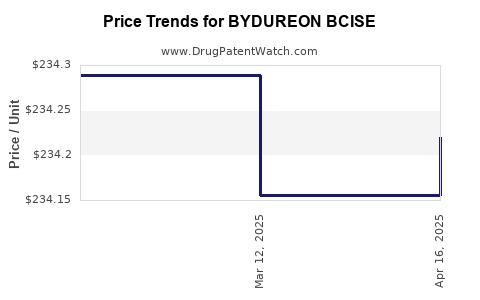
Average Pharmacy Cost for BYDUREON BCISE
| Drug Name | NDC | Price/Unit ($) | Unit | Date |
|---|---|---|---|---|
| BYDUREON BCISE 2 MG AUTOINJECT | 00310-6540-04 | 234.22034 | ML | 2025-04-23 |
| BYDUREON BCISE 2 MG AUTOINJECT | 00310-6540-04 | 234.15523 | ML | 2025-03-19 |
| BYDUREON BCISE 2 MG AUTOINJECT | 00310-6540-04 | 234.28876 | ML | 2025-02-19 |
| BYDUREON BCISE 2 MG AUTOINJECT | 00310-6540-04 | 234.25249 | ML | 2025-01-22 |
| BYDUREON BCISE 2 MG AUTOINJECT | 00310-6540-04 | 234.23790 | ML | 2024-12-18 |
| >Drug Name | >NDC | >Price/Unit ($) | >Unit | >Date |
Market Analysis and Price Projections for BYDUREON BCISE
Introduction
BYDUREON BCISE (dulaglutide extended-release), developed by Eli Lilly and Company, represents a significant innovation in the management of type 2 diabetes mellitus (T2DM). As a once-weekly injectable GLP-1 receptor agonist, it benefits from a unique delivery system—an Abbreviated Delivery System (BCISE)—which enhances patient adherence and therapeutic outcomes. Given its innovative mechanism and market positioning, understanding its market landscape and future pricing is crucial for stakeholders, including healthcare providers, payers, and investors.
This report provides an in-depth market analysis of BYDUREON BCISE, explores factors influencing its price trajectory, and offers strategic insights based on current trends and projections.
Market Landscape for GLP-1 Receptor Agonists
Therapeutic Context
Type 2 diabetes remains a prevalent chronic condition worldwide, with approximately 537 million adults affected as of 2021, and this number projected to escalate over the coming decades (IDF Diabetes Atlas, 2021). The shift towards injectable GLP-1 receptor agonists has been driven by their superior efficacy in glycemic control and cardiovascular benefits compared to older therapies.
Competitive Environment
The GLP-1 class includes blockbuster drugs such as Eli Lilly’s Trulicity (dulaglutide), Novo Nordisk’s Ozempic (semaglutide), and Rybelsus (oral semaglutide). Trulicity, the predecessor of BYDUREON BCISE, commands significant market share with annual sales exceeding $4 billion globally (IQVIA, 2022).
BYDUREON BCISE’s unique extended-release delivery system distinguishes it from competitors, potentially offering improved patient compliance. However, it faces competition in a crowded and rapidly evolving market fueled by ongoing innovation and patent expirations.
Market Adoption Drivers
Clinical Advantages and Differentiation
BYDUREON BCISE's once-weekly dosing and innovative BCISE technology provide notable benefits:
- Enhanced Patient Adherence: Simplified dosing schedule improves persistence versus daily or bi-weekly alternatives.
- Consistent Efficacy: Prolonged drug release ensures stable plasma concentrations.
- Reduced Injection Anxiety: The delivery system minimizes discomfort and injection site reactions.
Regulatory and Reimbursement Landscape
- FDA and EMA Approvals: Regulatory clearances in major markets facilitate worldwide adoption.
- Reimbursement Strategies: Payers increasingly favor therapies demonstrating improved adherence and clinical outcomes, favoring BYDUREON BCISE, especially as data supporting cardiovascular benefits emerge.
Market Penetration Challenges
- Pricing Sensitivity: High costs associated with innovator biologics limit access, especially in low- and middle-income countries.
- Competitive Pricing Strategies: Novo Nordisk and other competitors may respond with biosimilars or cost-effective alternatives, impacting market share.
Price Analysis and Current Pricing
Current Pricing Structures
Pricing for BYDUREON BCISE varies across markets:
- United States: Approximate wholesale acquisition cost (WAC) around $2,250 per 4-week supply, equating to about $9,000 per month.
- European Union: Slightly lower, around €1,800–€2,100 per 4-week cycle, reflecting regional pricing strategies.
- Emerging Markets: Significantly more affordable, yet accessibility remains limited due to infrastructure and reimbursement barriers.
Pricing is influenced by:
- Manufacturing Costs: Biologics incur high R&D and production costs.
- Market Competition: Dynamic pricing to maintain market share amid biosimilar threats.
- Reimbursement Policies: Insurance coverage significantly affects out-of-pocket expenses.
Market Value Based on Sales Projections
Estimating the potential revenue suggests that BYDUREON BCISE could capture a sizable portion of the GLP-1 segment if adoption accelerates:
- 2023–2025 Projections: Sales could reach $1.8–$2.5 billion globally, assuming a compound annual growth rate (CAGR) of approximately 15%, driven by expanding indications and geographic penetration [2].
Price Projection Factors
Influences on Future Pricing
- Patent and Patent Expiry Timelines: Patents scheduled to expire by 2028-2030 could introduce biosimilars, exerting downward pressure on prices.
- Innovative Delivery Technologies: BCISE’s proprietary system may sustain premium pricing, especially if regulatory and clinical data underscore superior adherence or clinical outcomes.
- Market Competition and Biosimilar Entry: Entry of biosimilars at 20–40% lower prices could force significant price cuts, affecting margins.
- Reimbursement and Cost-Effectiveness Data: Increasing real-world evidence demonstrating superior long-term outcomes can justify premium pricing.
Projected Pricing Trends (2023–2030)
| Year | Estimated Price per 4-week Supply | Key Drivers |
|---|---|---|
| 2023 | ~$2,250 | Initial premium based on innovation and adherence benefits |
| 2025 | ~$2,000–$2,150 | Rising competition, biosimilar entries, market normalization |
| 2027 | ~$1,800–$2,000 | Patent expirations, biosimilar proliferation |
| 2030 | ~$1,600–$1,850 | Market saturation, pressure from biosimilars, value-based pricing |
Note: These figures are indicative; actual prices will depend on negotiations, regional factors, and healthcare policies.
Strategic Implications
For Pharmaceutical Companies
- Innovation Continuity: Invest in delivery system improvements and new indications to sustain premium pricing.
- Strategic Pricing: Deploy tiered pricing models tailored to markets' economic profiles.
- Partnerships and Reimbursement Strategies: Engage payers early to demonstrate value through real-world data.
For Healthcare Providers and Payers
- Cost-Effectiveness Analyses: Prioritize therapies with proven adherence and clinical benefits to optimize resource utilization.
- Patient-Centric Approaches: Leverage the convenience of once-weekly dosing to improve adherence and outcomes.
For Investors
- Market Entry Timings: Monitor patent expirations and biosimilar developments for risk mitigation.
- Revenue Growth Opportunities: Capitalize on expanding indications and geographic expansion.
Conclusions
BYDUREON BCISE occupies a strategic niche within the booming GLP-1 receptor agonist market, driven by its innovative delivery technology and clinical benefits. Its current premium pricing reflects its positioning but faces impending pressure from biosimilar competition and market normalization. Accordingly, pricing is projected to decline gradually over the next decade, aligning with industry trends and patent landscapes.
Maximizing market presence and profitability hinges on continuous innovation, strategic pricing, collaboration with payers, and expanding global access. Stakeholders must balance these factors within an evolving competitive landscape to optimize outcomes.
Key Takeaways
- Market Potential: The global GLP-1 market is projected to grow at a CAGR of approximately 15% through 2025, with BYDUREON BCISE poised to benefit from its adherence advantages.
- Pricing Strategy: Currently priced at ~$2,250 per 4-week cycle, expected to decline as biosimilars enter and patent protections lapse, reaching ~$1,600–$1,850 by 2030.
- Competitive Dynamics: Innovation and clinical differentiation afford premium pricing, but cost pressures from biosimilars necessitate adaptive strategies.
- Reimbursement & Adoption: Demonstrated value, particularly through improved adherence and outcomes, will influence reimbursement levels and market penetration.
- Investor Outlook: Early-stage adoption and expanded indications offer growth avenues, but patent expirations warrant vigilant monitoring for biosimilar threats.
FAQs
1. What sets BYDUREON BCISE apart from other GLP-1 receptor agonists?
BYDUREON BCISE’s proprietary BCISE technology provides a sustained-release mechanism allowing once-weekly dosing with potentially improved patient adherence and reduced injection site reactions, differentiating it from competitors with similar dosing schedules.
2. How will biosimilar entry impact the pricing of BYDUREON BCISE?
Biosimilar entrants typically exert downward pricing pressure, expected to reduce BYDUREON BCISE’s price by 20–40% post-patent expiry, beginning around 2028–2030. Pharmaceutical companies may respond with value-added services or indication expansion.
3. What are the primary factors influencing BYDUREON BCISE's market adoption?
Clinical efficacy, patient adherence improvements, regulatory approvals, reimbursement policies, competitive pricing, and physicians’ familiarity all drive adoption.
4. Are there emerging indications that could influence pricing or utilization?
Yes, ongoing trials exploring cardiovascular and renal benefits could expand BYDUREON BCISE’s label, potentially enhancing its value proposition and market share, impacting pricing strategies favorably.
5. What strategies can stakeholders employ to optimize returns on BYDUREON BCISE?
Investors should monitor patent timelines and biosimilar developments, while manufacturers should continue innovation, leverage real-world evidence, and negotiate effectively with payers to sustain profitability.
References
[1] International Diabetes Federation. (2021). IDF Diabetes Atlas, 9th Edition.
[2] IQVIA. (2022). Global Biopharmaceutical Market Data.
More… ↓
