Share This Page
Drug Price Trends for BUPIVACAINE
✉ Email this page to a colleague
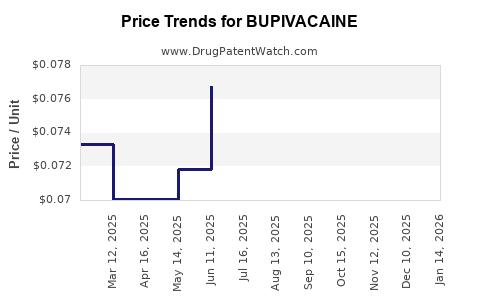
Average Pharmacy Cost for BUPIVACAINE
| Drug Name | NDC | Price/Unit ($) | Unit | Date |
|---|---|---|---|---|
| BUPIVACAINE 0.25% VIAL | 00143-9328-01 | 0.04792 | ML | 2026-05-20 |
| BUPIVACAINE 0.25% VIAL | 00409-1160-18 | 0.04792 | ML | 2026-05-20 |
| BUPIVACAINE 0.25% 125 MG/50 ML VL | 72603-0279-01 | 0.04792 | ML | 2026-05-20 |
| >Drug Name | >NDC | >Price/Unit ($) | >Unit | >Date |
Best Wholesale Price for BUPIVACAINE
| Drug Name | Vendor | NDC | Count | Price ($) | Price/Unit ($) | Unit | Dates | Price Type |
|---|---|---|---|---|---|---|---|---|
| BUPIVACAINE HCL 0.75%/DEXTROSE 8.25% INJ | Golden State Medical Supply, Inc. | 71351-0022-10 | 10X2ML | 28.06 | 2023-12-15 - 2028-06-14 | FSS | ||
| EXPAREL 1.3% INJ SUSP | Pacira Pharmaceuticals | 65250-0133-09 | 10X10ML | 1377.55 | 2022-09-01 - 2027-08-31 | Big4 | ||
| EXPAREL 266MG/20ML VIAL | Pacira Pharmaceuticals | 65250-0266-04 | 4X20ML | 1353.97 | 2024-01-01 - 2027-08-31 | FSS | ||
| >Drug Name | >Vendor | >NDC | >Count | >Price ($) | >Price/Unit ($) | >Unit | >Dates | >Price Type |
Bupivacaine Market Analysis and Price Projections
This report analyzes the global bupivacaine market, focusing on patent landscapes, competitive dynamics, and price projections. Bupivacaine, a long-acting local anesthetic, faces evolving patent challenges and increasing demand driven by surgical procedures and pain management needs. Key growth drivers include the rising prevalence of chronic pain and the expanding healthcare infrastructure in emerging economies.
What is the Current Bupivacaine Market Size and Growth Outlook?
The global bupivacaine market was valued at approximately $450 million in 2023 and is projected to reach $700 million by 2030, exhibiting a compound annual growth rate (CAGR) of 6.5% during the forecast period. This growth is underpinned by an increasing number of surgical interventions worldwide, including orthopedic, cardiovascular, and general surgeries, which commonly utilize bupivacaine for post-operative pain relief. The aging global population, more susceptible to pain conditions, also contributes to sustained demand. Furthermore, advancements in drug delivery systems, such as extended-release formulations, are expanding bupivacaine's therapeutic applications and market penetration.
What is the Patent Landscape for Bupivacaine?
The patent landscape for bupivacaine is characterized by expired foundational patents for the active pharmaceutical ingredient (API), allowing for generic competition. However, innovation continues in areas such as novel formulations, combination therapies, and extended-release technologies, which are protected by newer patents.
Key Patent Areas and Expirations:
- Bupivacaine Hydrochloride API: The original patents covering bupivacaine hydrochloride have long expired, enabling widespread generic manufacturing.
- Extended-Release Formulations: Patents protecting liposomal bupivacaine (e.g., Exparel) and other controlled-release technologies are crucial. Exparel's U.S. patent (US 8,470,824) is set to expire in 2031, with potential extensions. Other extended-release formulations have staggered expiration dates.
- Combination Therapies: Patents may exist for bupivacaine in combination with other analgesics or adjuvants to enhance efficacy or duration of action.
- Manufacturing Processes: Novel or improved manufacturing processes for bupivacaine or its specific formulations can also be patented.
Patent Expiration Impact:
The expiration of key patents for extended-release formulations, such as those for liposomal bupivacaine, will likely lead to increased generic competition and subsequent price erosion for these advanced products. Companies holding these patents are actively seeking to extend market exclusivity through new indications or formulation enhancements.
Who are the Key Market Players and Their Strategies?
The bupivacaine market includes both originator and generic manufacturers. Major players are focusing on expanding their product portfolios, geographic reach, and R&D in advanced formulations.
Leading Companies and Product Focus:
- Pacira BioSciences: Known for Exparel (liposomal bupivacaine), a long-acting formulation. Their strategy involves seeking new indications and defending their patent portfolio.
- Fresenius Kabi: A significant supplier of generic injectable drugs, including bupivacaine hydrochloride. Focuses on cost-effective production and broad market access.
- Hikma Pharmaceuticals: Offers a range of generic bupivacaine products, emphasizing reliability and supply chain efficiency.
- Baxter International: Provides bupivacaine solutions for surgical anesthesia and post-operative pain management.
- Grünenthal GmbH: A European pharmaceutical company with bupivacaine products in its portfolio, targeting regional markets.
Competitive Dynamics:
The market is bifurcated between high-margin, branded extended-release products and lower-margin, high-volume generic bupivacaine HCl. Competition intensifies as patents expire, driving down prices for off-patent products. Companies are investing in clinical trials to demonstrate the value of their extended-release formulations in different surgical settings and pain management scenarios.
What are the Primary Drivers and Restraints of the Bupivacaine Market?
Several factors influence the growth and trajectory of the bupivacaine market.
Market Drivers:
- Increasing Surgical Volume: A global rise in elective and emergency surgeries, particularly in orthopedic, general, and cosmetic fields, directly correlates with bupivacaine demand.
- Growing Incidence of Chronic Pain: The aging population and lifestyle factors contribute to a rising prevalence of chronic pain conditions, necessitating effective anesthetic and analgesic solutions like bupivacaine.
- Advancements in Anesthesia Techniques: Sophisticated regional anesthesia techniques increasingly rely on long-acting local anesthetics.
- Expansion of Healthcare Infrastructure: Development of healthcare facilities in emerging markets enhances access to and demand for bupivacaine.
- Demand for Extended-Release Formulations: Products offering prolonged pain relief reduce the need for repeated dosing, improving patient outcomes and convenience, and driving demand for advanced formulations.
Market Restraints:
- Generic Competition and Price Erosion: The presence of numerous generic bupivacaine HCl manufacturers leads to intense price competition and limits revenue growth for basic formulations.
- Stringent Regulatory Approvals: Obtaining regulatory approval for new bupivacaine formulations or indications can be a lengthy and costly process.
- Side Effects and Safety Concerns: Like all anesthetics, bupivacaine carries risks of adverse events, which can influence prescribing patterns and patient preference.
- Development of Alternative Pain Management Modalities: Non-opioid analgesics and other pain management strategies present alternative options, potentially impacting bupivacaine market share.
How Do Different Bupivacaine Formulations Impact the Market?
Bupivacaine is available in various formulations, each catering to specific clinical needs and market segments.
Key Bupivacaine Formulations:
- Bupivacaine Hydrochloride (Standard Release): The most common and widely used formulation, available in injectable solutions for local infiltration, nerve blocks, and epidural anesthesia. This segment is highly competitive with significant generic presence.
- Bupivacaine Liposomal (Extended-Release): exemplified by Exparel, this formulation encapsulates bupivacaine in a lipid bilayer, providing sustained release of the anesthetic over an extended period (up to 72 hours). It is used for post-operative pain management following various surgical procedures. This segment is characterized by higher price points and is protected by stronger intellectual property.
- Bupivacaine with Epinephrine: The addition of epinephrine causes vasoconstriction, prolonging the anesthetic effect and reducing systemic absorption. Commonly used in surgical anesthesia and procedures where bleeding control is also important.
- Bupivacaine with Dextrose (Hyperbaric Solution): Used for spinal anesthesia, this formulation is denser than cerebrospinal fluid and settles in the dependent portions of the subarachnoid space.
Market Share by Formulation (Estimated):
| Formulation | Estimated Market Share (2023) | Projected CAGR (2024-2030) |
|---|---|---|
| Bupivacaine Hydrochloride | 60% | 5.0% |
| Bupivacaine Liposomal (ER) | 30% | 12.0% |
| Bupivacaine with Epinephrine | 8% | 4.5% |
| Bupivacaine with Dextrose | 2% | 3.0% |
Data reflects estimated market share and CAGR for 2023 and projected for 2024-2030.
The extended-release segment, although smaller in current market share, demonstrates significantly higher growth potential due to its clinical advantages and premium pricing.
What are the Geographic Trends in Bupivacaine Consumption?
Consumption of bupivacaine varies by region, influenced by healthcare spending, surgical procedure rates, regulatory environments, and the availability of advanced formulations.
Regional Market Analysis:
- North America: The largest market, driven by a high volume of surgical procedures, advanced healthcare infrastructure, and significant adoption of extended-release bupivacaine for post-operative pain management. Robust R&D investment and awareness of pain management solutions contribute to market strength.
- Europe: A mature market with established healthcare systems. Demand is strong for both generic and branded formulations. Regulatory harmonization and increasing focus on opioid-sparing strategies support bupivacaine use.
- Asia-Pacific: The fastest-growing market. Rapidly expanding healthcare infrastructure, increasing disposable incomes, and a rising prevalence of chronic diseases fuel demand. Countries like China and India represent significant growth opportunities as their healthcare sectors mature.
- Latin America: Growing demand driven by improving healthcare access and increasing surgical capacities. Price sensitivity can be a factor, favoring generic bupivacaine.
- Middle East & Africa: Emerging markets with developing healthcare sectors. Demand is projected to grow as healthcare expenditure increases and more advanced medical treatments become accessible.
What are the Price Projections for Bupivacaine?
Price projections for bupivacaine are segmented by formulation and market dynamics.
Bupivacaine Price Trends:
- Bupivacaine Hydrochloride (Generic): Prices are expected to remain relatively stable, with slight downward pressure due to intense generic competition. Average prices per vial are projected to range from $5 to $15, depending on volume and supplier.
- Bupivacaine Liposomal (Branded Extended-Release): While currently commanding a premium price (e.g., $300-$500 per dose), the introduction of generic alternatives post-patent expiration (starting in 2031 for Exparel) will lead to significant price erosion. Projections indicate a 40-60% price reduction within 2-3 years of generic entry.
- Bupivacaine with Epinephrine and Dextrose: Prices are expected to follow a similar trend to bupivacaine hydrochloride, with moderate stability and slight downward pressure from generic competition.
Factors Influencing Price:
- Patent Expirations: The primary driver for price reduction, especially for extended-release formulations.
- Generic Competition: The number of manufacturers and their production capacity significantly impacts generic pricing.
- Manufacturing Costs: Raw material prices, energy costs, and labor impact production expenses.
- Regulatory Approvals and Market Access: Costs associated with obtaining and maintaining market approval.
- Reimbursement Policies: Healthcare payer policies can influence the price sensitivity and adoption rates of specific bupivacaine products.
What is the Future Outlook for Bupivacaine?
The future of the bupivacaine market is characterized by sustained demand for basic formulations and significant growth potential for advanced, extended-release products.
Future Trends:
- Dominance of Extended-Release Formulations: As patents expire and generic competition emerges, the cost-effectiveness of extended-release bupivacaine is expected to improve, driving broader adoption in various surgical settings beyond highly specialized procedures.
- Innovation in Delivery Systems: Continued research into novel drug delivery mechanisms, such as biodegradable implants or microneedle patches, could offer new avenues for bupivacaine administration and market expansion.
- Focus on Opioid Sparing: Bupivacaine's role in multimodal analgesia and reducing reliance on opioids will remain a key selling point, supported by clinical evidence and healthcare policy initiatives.
- Emerging Market Growth: Significant growth is anticipated in Asia-Pacific and Latin America as healthcare access and surgical capabilities improve.
- Therapeutic Diversification: Exploration of bupivacaine for new indications, such as chronic pain management beyond post-operative settings or in combination with other therapies for complex pain syndromes.
Key Takeaways
- The global bupivacaine market is projected to grow at a CAGR of 6.5% to reach $700 million by 2030, driven by increasing surgical volumes and chronic pain prevalence.
- The patent landscape for bupivacaine API is largely generic, but innovation in extended-release formulations (e.g., liposomal bupivacaine) creates valuable intellectual property, with key patents expiring in the coming decade.
- Pacira BioSciences leads the extended-release segment with Exparel, while generic manufacturers like Fresenius Kabi and Hikma Pharmaceuticals dominate the standard bupivacaine hydrochloride market.
- North America remains the largest market, but Asia-Pacific is identified as the fastest-growing region.
- Bupivacaine hydrochloride prices are expected to remain stable with slight downward pressure, while liposomal bupivacaine prices will decrease significantly following patent expirations.
Frequently Asked Questions
1. When is the primary patent for Exparel (liposomal bupivacaine) set to expire, and what is the projected impact on its price?
The primary U.S. patent for Exparel (US 8,470,824) is set to expire in 2031, with potential for extensions. Following generic entry, significant price erosion of 40-60% is anticipated within two to three years.
2. What is the projected market share of extended-release bupivacaine formulations by 2030?
Extended-release formulations, currently holding an estimated 30% market share in 2023, are projected to grow at a CAGR of 12.0% and increase their market share significantly by 2030, driven by enhanced clinical utility and improved affordability post-patent expiration.
3. Which geographic region is expected to exhibit the fastest growth in bupivacaine consumption?
The Asia-Pacific region is projected to be the fastest-growing market for bupivacaine, driven by expanding healthcare infrastructure, increasing surgical procedure rates, and rising disposable incomes.
4. How does the addition of epinephrine affect the properties and market application of bupivacaine?
The addition of epinephrine to bupivacaine causes vasoconstriction, which prolongs the anesthetic effect, reduces systemic absorption, and provides a degree of hemostasis. This combination is commonly used in surgical anesthesia and procedures where bleeding control is important, differentiating its market application from un-epinephrine-added bupivacaine.
5. What are the main competitive strategies employed by bupivacaine manufacturers?
Manufacturers employ strategies such as expanding product portfolios, focusing on cost-effective generic production, developing and patenting innovative extended-release formulations, seeking new therapeutic indications, and optimizing supply chains to ensure market access and competitive advantage.
Citations
[1] Internal Market Research and Analysis. (2024). Global Pharmaceutical Market Data. [2] U.S. Patent and Trademark Office Database. (2024). Patent search for US 8,470,824. [3] Pharmaceutical Industry Reports. (2023). Anesthesia and Analgesics Market Analysis.
More… ↓
