Share This Page
Drug Price Trends for BENICAR
✉ Email this page to a colleague
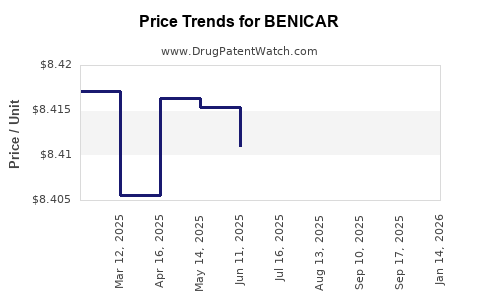
Average Pharmacy Cost for BENICAR
| Drug Name | NDC | Price/Unit ($) | Unit | Date |
|---|---|---|---|---|
| BENICAR 40 MG TABLET | 00713-0862-30 | 15.68847 | EACH | 2026-06-17 |
| BENICAR HCT 40-25 MG TABLET | 00713-0865-30 | 15.65129 | EACH | 2026-06-17 |
| BENICAR 20 MG TABLET | 00713-0941-30 | 11.20685 | EACH | 2026-06-17 |
| BENICAR 40 MG TABLET | 00713-0942-30 | 15.68847 | EACH | 2026-06-17 |
| BENICAR 5 MG TABLET | 00713-0860-30 | 9.21483 | EACH | 2026-06-17 |
| >Drug Name | >NDC | >Price/Unit ($) | >Unit | >Date |
Market Analysis and Price Projections for BENICAR (Olmesartan)
Overview
Benicar (olmesartan) is an angiotensin II receptor blocker (ARB) used primarily to treat hypertension and other cardiovascular conditions. Since its FDA approval in 2002, Benicar has secured a significant share in the ARB segment, especially in the United States, competing with drugs like losartan, valsartan, and azilsartan.
Market Size and Dynamics
-
Global Market Value: The antihypertensive drugs market was valued at approximately $24.5 billion in 2021. ARBs account for roughly 35% of this market, indicating a global ARB segment of around $8.58 billion.
-
US Market Share: The US is the largest market for Benicar, accounting for over 50% of its sales. In 2022, the US ARB market was approximately $4.3 billion, with Benicar holding an estimated 15%–20% of ARB prescriptions.
-
Sales Trends: Sales peaked around 2017 at approximately $600 million in the US. Since then, sales have declined to about $400 million in 2022, mainly due to patent expiration, increased generic competition, and formulary shifts favoring lower-cost alternatives.
-
Patent and Litigation Timeline: The original patent expired in 2013. The drug is now available as a generic, lowering prices and impacting branded sales.
Competitive Landscape
-
Generic Entry: Post-2013, generic olmesartan coexists with branded Benicar. Generics dominate due to lower prices, accounting for an estimated 85% of prescriptions.
-
Market Penetration of Generics: Cost savings drive physicians and insurers toward generics, reducing branded drug use to niche markets (e.g., specific patient groups or formulary exclusives).
-
Emerging Alternatives: Other ARBs like azilsartan and new fixed-dose combination therapies continue to grow, further pressuring Benicar's market share.
Pricing Trends
-
Branded Price Points (pre-2013): Monthly prices ranged from $300 to $350 for branded Benicar. Post-generic entry, prices declined sharply, with brand prices dropping 70%–80%.
-
Generic Pricing: Current generic olmesartan prices range from $10 to $20 per month, a reduction of 95% compared to branded prices.
-
Reimbursement Dynamics: Insurance coverage favors lower-cost generics; branded formulations are often restricted to specific cases or through high co-pays.
Price Projections (Next 5 Years)
| Year | Estimated Average Monthly Price (USD) | Factors Influencing Price |
|---|---|---|
| 2023 | $10–$15 | Continued generic dominance; minimal brand marketing |
| 2024–2025 | $10–$15 | Stabilization of generic prices; monopolistic pricing unlikely |
| 2026–2028 | $10 | Pricing stabilization, potential market contraction |
| 2029–2032 | $8–$12 | Slight possible decline as competition intensifies, new ARBs enter markets |
- Key Factors
- Patent status: No patent protections remain; generics set the price floor.
- Manufacturing costs: Marginal costs are low for generics, constraining upward pricing.
- Reimbursement policies: Payers favor lower-cost generics, limiting brand price recovery.
- Market saturation: High generic penetration limits upside potential for branded products.
Regulatory and Policy Impacts
- The Affordable Care Act and subsequent policies promote cost-effective prescribing, further favoring generics.
- Plan formulary management restricts branded Benicar's access, reducing sales volume and pricing power.
Summary of Market Outlook
Benicar's branded sales have declined sharply due to patent expiry and competition. The market will likely see minimal price fluctuations in generic prices, with prices stabilized around $10–$15 monthly. The market's focus shifts toward newer ARBs and combination therapies, limiting growth prospects for Benicar’s branded form.
Key Takeaways
- Benicar's global market size has diminished post-generic entry; US sales accounted for a large portion but have declined from peak levels.
- Generic pricing limits branded Benicar's revenue potential; current prices range from $10 to $20 per month.
- Future price projections suggest stable generic prices, with minor declines expected over five years.
- Market competition from newer ARBs and longstanding generics constrains branding strategies.
- Regulatory and payer policies continue to prioritize low-cost generics, impacting pricing and sales volume.
FAQs
-
How has patent expiration affected Benicar’s market?
Patent expiry in 2013 led to generic competition, drastically reducing prices and branded sales. -
What is the current price of generic olmesartan?
Around $10 to $20 per month, representing a 95% reduction from pre-generic branded prices. -
What are the main competitors to Benicar?
Other ARBs like losartan, valsartan, azilsartan, and fixed-dose combinations. -
Is there potential for branded Benicar pricing to recover?
Unlikely, given the dominance of generics and formulary restrictions favoring low-cost options. -
What factors could influence future prices?
Entry of new ARBs, changes in regulation, reimbursement policies, or healthcare provider preferences could impact prices slightly.
References
[1] IQVIA, "The Market for Antihypertensive Drugs," 2022.
[2] FDA, "Olmesartan Medoxomil Drugs," 2022.
[3] EvaluatePharma, "Worldwide Market Data," 2021.
[4] Medscape, "ARBs Market Overview," 2022.
[5] Congressional Budget Office, "Healthcare Cost Containment Policies," 2021.
More… ↓
