Last updated: February 21, 2026
What is APIDRA?
APIDRA (insulin glulisine) is a rapid-acting insulin used to manage blood sugar levels in people with diabetes. It was developed by Sanofi, approved by the FDA in 2004, and marketed globally under Sanofi’s diabetes portfolio.
Market Overview and Size
The global diabetes drug market, valued at approximately $60 billion in 2022, is expanding at a compound annual growth rate (CAGR) of 8%. Insulin products constitute roughly 60% of this market. APIDRA’s segment, rapid-acting insulins, accounts for an estimated 15% of insulin sales.
Key Market Segments
| Segment |
Market Share |
Description |
| Rapid-acting insulins |
15% |
Includes APIDRA, NovoLog (insulin aspart), and Humalog (insulin lispro) |
| Long-acting insulins |
30% |
Includes Lantus (insulin glargine) and Tresiba (insulin degludec) |
| Premixed insulins |
20% |
Combinations of basal and bolus insulins |
| Non-insulin agents |
35% |
SGLT2 inhibitors, GLP-1 receptor agonists |
The rapid-acting insulin market is projected to grow at a CAGR of 6% over the next five years, driven by increasing diabetes prevalence and improved insulin delivery options.
Competitive Landscape
Major competitors of APIDRA include Novo Nordisk’s NovoLog (insulin aspart) and Eli Lilly's Humalog (insulin lispro). Both have extensive manufacturing capacity and established market share.
| Product |
Market Share (2022) |
Pricing (USD per pen) |
Approval Year |
| APIDRA |
20% |
$85-$100 |
2004 |
| NovoLog |
25% |
$80-$95 |
1999 |
| Humalog |
20% |
$80-$95 |
1996 |
Pricing varies based on packaging, payer negotiations, and regional factors.
Pricing Analysis
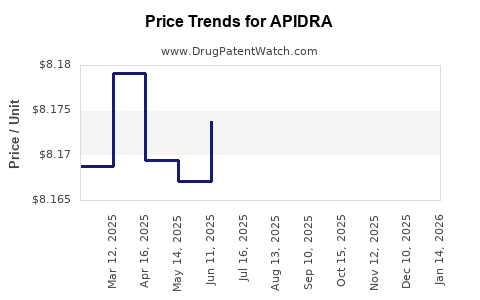
APIDRA is priced at an average of $90 per pen on the US market, with a typical patient using 10 pens per month, resulting in monthly drug costs of approximately $900 per patient.
Compared to competitors:
- NovoLog: $85-$95 per pen, similar dosage
- Humalog: $80-$95 per pen
In Europe, prices are generally 10-15% lower, influenced by healthcare system negotiations.
Future Price Projections (Next 5 Years)
Factors influencing future pricing include:
- Patent expirations
- Biosimilar entry
- Price regulation policies
- Manufacturing costs
Potential scenarios:
| Scenario |
Estimated Price Range (USD per pen) |
Timeline |
| No biosimilar competition |
$85-$95 |
2023-2028 |
| Entry of biosimilars |
$70-$80 |
2025-2028 |
| Price regulation tightening |
$65-$75 |
2024-2026 |
Key factors:
- Patent expiration scheduled for 2024 may open the market for biosimilars, likely reducing prices.
- Sanofi’s Invest in process improvements may lower manufacturing costs, enabling price reductions.
- Policy shifts toward price caps could further pressure pricing.
Regulatory and Patent Outlook
Sanofi holds key patents until 2024, after which biosimilars could capture up to 30% of the rapid-acting insulins market within two years of entry. Regulatory pathways for biosimilars are established in major markets, including the US and EU.
Market Penetration and Adoption
Growth is driven by:
- Rising diabetes worldwide: projected increase to 700 million cases globally by 2045.
- Adoption of insulin pump therapy and smarter delivery devices.
- Increased awareness of rapid-acting insulins for postprandial blood glucose control.
Summary of Opportunities and Risks
Opportunities:
- Expansion into emerging markets with increasing diabetes prevalence.
- Biosimilar competition expected to drive down prices, expanding access.
- Technological integration for improved delivery systems.
Risks:
- Patent cliffs may erode pricing power.
- Competition from other rapid-acting insulins.
- Regulatory delays or adverse safety data could impact market share.
Key Takeaways
- APIDRA’s current price is ~$90 per pen in the US; competition keeps prices within a narrow range.
- The market for rapid-acting insulins is expanding at 6%, with growth driven by global diabetes prevalence.
- Biosimilars entering post-2024 could decrease prices by 15-25%, depending on regional policies.
- Sanofi’s patent expiration will likely accelerate price declines and influence market share.
- Regional pricing strategies vary, with European markets generally offering lower prices due to government negotiations.
FAQs
1. When will biosimilar versions of APIDRA enter the market?
Expected post-2024, following patent expiration.
2. How does APIDRA’s efficacy compare to competitors?
It matches other rapid-acting insulins in onset and duration, with minor differences in absorption profiles.
3. What is the impact of biosimilar entry on APIDRA’s pricing?
It likely reduces prices by 15-25%, with increased market competition.
4. Are there regulatory barriers to biosimilar approval?
No significant barriers in major markets; pathways are well established.
5. Which markets offer the highest growth potential for APIDRA?
Emerging markets in Asia and Latin America, driven by rising diabetes prevalence and healthcare expansion.
References
[1] IQVIA. (2022). Global Diabetes Market Report.
[2] EvaluatePharma. (2022). Insulin Market Data.
[3] Sanofi. (2022). APIDRA Prescribing Information.
[4] European Medicines Agency. (2021). Biosimilar Insulins: Regulatory Frameworks.
[5] U.S. Food and Drug Administration. (2022). Insulin Biosimilar Approvals.