Share This Page
Drug Price Trends for AMPHETAMINE SULFATE
✉ Email this page to a colleague
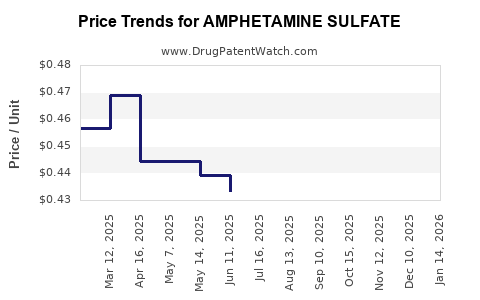
Average Pharmacy Cost for AMPHETAMINE SULFATE
| Drug Name | NDC | Price/Unit ($) | Unit | Date |
|---|---|---|---|---|
| AMPHETAMINE SULFATE 10 MG TAB | 00527-2525-37 | 0.41616 | EACH | 2026-07-22 |
| AMPHETAMINE SULFATE 10 MG TAB | 43547-0458-10 | 0.41616 | EACH | 2026-07-22 |
| AMPHETAMINE SULFATE 10 MG TAB | 43598-0898-01 | 0.41616 | EACH | 2026-07-22 |
| AMPHETAMINE SULFATE 10 MG TAB | 52536-0059-03 | 0.41616 | EACH | 2026-07-22 |
| AMPHETAMINE SULFATE 10 MG TAB | 69238-1564-01 | 0.41616 | EACH | 2026-07-22 |
| >Drug Name | >NDC | >Price/Unit ($) | >Unit | >Date |
Amphetamine Sulfate Market Analysis and Price Projections
Amphetamine sulfate maintains a stable market presence driven by established therapeutic applications and consistent demand. Current pricing reflects manufacturing costs, regulatory oversight, and established generic competition. Future price trajectory is contingent on evolving regulatory landscapes, potential new indications, and the cost-effectiveness of alternative treatments.
What are the Primary Therapeutic Uses of Amphetamine Sulfate?
Amphetamine sulfate is primarily prescribed for the treatment of Attention Deficit Hyperactivity Disorder (ADHD) and narcolepsy.
- Attention Deficit Hyperactivity Disorder (ADHD): Amphetamine sulfate is a central nervous system stimulant that increases the availability of neurotransmitters like dopamine and norepinephrine in the brain. This mechanism helps improve focus, attention span, and impulse control in individuals diagnosed with ADHD. It is available in both immediate-release and extended-release formulations.
- Narcolepsy: For narcolepsy, amphetamine sulfate is used to promote wakefulness and combat excessive daytime sleepiness. Its stimulant properties help regulate sleep-wake cycles in patients suffering from this chronic neurological disorder.
Who are the Major Manufacturers and Suppliers of Amphetamine Sulfate?
The market for amphetamine sulfate is characterized by a mix of established pharmaceutical manufacturers and specialized generic producers. Regulatory controls, particularly in the United States, influence the number of active manufacturing sites.
- Mallinckrodt Pharmaceuticals: A significant supplier of controlled substances, including amphetamine sulfate, through its subsidiary, Par Pharmaceutical.
- Teva Pharmaceuticals: A global leader in generic pharmaceuticals, Teva manufactures and distributes amphetamine sulfate products.
- Endo Pharmaceuticals: Offers amphetamine sulfate formulations as part of its product portfolio.
- New Horizon Drug Company: A smaller, specialized manufacturer focusing on controlled substances.
These manufacturers operate under strict quotas and oversight from regulatory bodies like the U.S. Drug Enforcement Administration (DEA) to manage the production and distribution of controlled substances.
What is the Current Market Size and Projected Growth for Amphetamine Sulfate?
The global market for amphetamine sulfate is estimated to be in the range of $200 million to $250 million annually. This segment of the stimulant market is mature, with growth primarily driven by an increasing diagnosis rate of ADHD and the sustained need for narcolepsy treatment.
- Current Market Size: Approximately $200-$250 million USD.
- Projected Annual Growth Rate: 2% to 4%. This modest growth is attributed to:
- Increasing ADHD Diagnoses: Growing awareness and improved diagnostic tools contribute to a steady patient base.
- Stable Narcolepsy Treatment Demand: Narcolepsy is a chronic condition requiring lifelong management.
- Generic Competition: The presence of multiple generic manufacturers limits significant price increases and caps market expansion.
- Regulatory Scrutiny: Strict controls on production quotas and prescription monitoring can influence market accessibility and growth potential.
While new indications are unlikely to emerge, the consistent demand from existing therapeutic areas supports a stable market.
What Factors Influence the Price of Amphetamine Sulfate?
The price of amphetamine sulfate is influenced by a combination of manufacturing, regulatory, and market dynamics.
- Manufacturing Costs: The synthesis of amphetamine sulfate involves controlled chemical processes, requiring specialized facilities and adherence to Good Manufacturing Practices (GMP). The cost of raw materials and complex synthesis contribute to the base price.
- Regulatory Compliance and Quotas: The U.S. DEA sets annual aggregate production quotas for amphetamine. These quotas directly limit supply, and the stringent regulatory compliance required for manufacturing and distributing controlled substances adds to operational expenses. Manufacturers incur costs associated with security, tracking, and reporting.
- Formulation Complexity: Extended-release formulations, which offer improved patient compliance and efficacy, generally command a higher price than immediate-release versions due to more complex manufacturing processes.
- Generic Competition: The market has a robust generic presence, which exerts downward pressure on prices. When multiple generic manufacturers offer the product, competition intensifies, leading to lower average selling prices.
- Payer Reimbursement and Insurance Coverage: Insurance formulary placement and reimbursement rates from government and private payers significantly impact the net price paid by patients and healthcare systems. Negotiated prices with PBMs (Pharmacy Benefit Managers) are a key factor.
- Supply Chain Stability: Disruptions in the supply chain, including raw material shortages or manufacturing facility issues, can temporarily impact availability and potentially lead to price fluctuations.
What are the Current Price Ranges for Amphetamine Sulfate?
Amphetamine sulfate pricing varies based on formulation, dosage, and packaging size. The following ranges represent typical wholesale acquisition costs (WAC) before any rebates or discounts.
Immediate-Release (IR) Formulations (e.g., 5 mg, 10 mg, 15 mg tablets):
- Per Tablet: $0.30 - $0.75
- Bottle of 100 Tablets: $30 - $75
Extended-Release (ER) Formulations (e.g., capsules, varying dosages):
- Per Capsule: $1.50 - $3.50
- Bottle of 30 Capsules: $45 - $105
Note: These prices are indicative and can fluctuate based on contract pricing with distributors, specific PBM agreements, and the current DEA production quotas.
How Do These Prices Compare to Other ADHD Medications?
Amphetamine sulfate, as a generic stimulant, generally occupies a lower price point compared to newer, branded ADHD medications or non-stimulant alternatives.
- Amphetamine Sulfate (Generic IR): $0.30 - $0.75 per tablet.
- Adderall XR (Brand Name Amphetamine/Dextroamphetamine ER): $7.00 - $12.00 per capsule.
- Vyvanse (Lisdexamfetamine Dimesylate ER): $10.00 - $15.00 per capsule.
- Concerta (Methylphenidate ER): $7.00 - $11.00 per tablet.
- Intuniv (Guanfacine ER, Non-Stimulant): $6.00 - $10.00 per tablet.
This pricing differential makes generic amphetamine sulfate a cost-effective option for many patients and healthcare systems, particularly when managed care plans favor generics.
What are the Regulatory Considerations Impacting Amphetamine Sulfate?
The regulatory environment is a critical determinant of amphetamine sulfate's market access, production, and pricing.
- DEA Scheduling and Quotas: Amphetamine is a Schedule II controlled substance under the Controlled Substances Act in the U.S. The DEA establishes annual aggregate production quotas, limiting the total amount that can be manufactured. This supply restriction is a primary driver of market stability and influences pricing. Any adjustments to these quotas have a direct impact on availability and cost.
- FDA Oversight: The Food and Drug Administration (FDA) regulates the approval of manufacturing facilities, drug formulations, labeling, and post-market surveillance. Compliance with Current Good Manufacturing Practices (cGMP) is mandatory.
- Prescription Monitoring Programs (PMPs): Many states have implemented PMPs to track the dispensing of controlled substances, including amphetamine sulfate, to reduce diversion and abuse. This adds an administrative layer for prescribers and dispensers.
- International Regulations: Manufacturers and distributors must also comply with the regulatory frameworks of other countries where the drug is marketed, which can include specific import/export controls and scheduling differences.
What are the Future Price Projections for Amphetamine Sulfate?
Future price projections for amphetamine sulfate indicate a period of continued stability with limited upward potential, primarily influenced by regulatory factors and market dynamics.
- Short-Term (1-3 Years): Prices are expected to remain relatively stable, reflecting current manufacturing costs and the ongoing impact of generic competition. Minor price adjustments may occur due to inflationary pressures on manufacturing inputs or slight modifications to DEA production quotas. Wholesale acquisition costs for IR formulations are projected to stay within the $0.35 - $0.85 per tablet range, while ER formulations may see prices between $1.75 - $3.75 per capsule.
- Medium-Term (3-5 Years): Continued stable pricing is anticipated. Significant price increases are unlikely unless there are substantial shifts in DEA production quotas or major disruptions in the manufacturing landscape. A gradual increase in manufacturing costs due to inflation could lead to a slight rise in WAC, potentially pushing IR tablets to $0.40 - $0.95 and ER capsules to $2.00 - $4.00.
- Long-Term (5+ Years): The long-term outlook remains stable. The primary drivers will continue to be DEA production quotas, generic competition, and the cost-effectiveness of alternative ADHD and narcolepsy treatments. The potential for new therapeutic indications is low, limiting market expansion opportunities that could drive significant price growth. Without major regulatory changes or the emergence of a dominant, more expensive alternative that shifts market demand, prices are unlikely to deviate substantially from the projected medium-term ranges.
Key Influencing Factors for Projections:
- DEA Quota Adjustments: Any significant increases or decreases in aggregate production quotas by the DEA would be the most impactful factor.
- Manufacturing Input Costs: Inflationary pressures on raw materials, energy, and labor will continue to exert some influence.
- Evolving Treatment Guidelines: Changes in clinical practice guidelines for ADHD and narcolepsy that favor specific drug classes could indirectly affect demand and pricing.
- Emergence of Novel Therapies: While unlikely to displace amphetamine sulfate entirely due to its established efficacy and cost-effectiveness, the introduction of highly differentiated and successful novel therapies for ADHD or narcolepsy could gradually impact market share and pricing dynamics.
Key Takeaways
- Amphetamine sulfate is a mature pharmaceutical product with established uses in ADHD and narcolepsy.
- The market is characterized by stable demand, significant generic competition, and strict regulatory oversight, particularly regarding DEA production quotas.
- Current pricing reflects manufacturing costs and generic availability, with immediate-release tablets ranging from $0.30-$0.75 and extended-release capsules from $1.50-$3.50 wholesale.
- Future price projections indicate continued stability, with modest potential for increases driven by inflation and minor regulatory adjustments. Significant price hikes are unlikely.
- Regulatory compliance and DEA production quotas are the most critical factors influencing supply and, consequently, price stability.
Frequently Asked Questions
-
What is the difference in therapeutic effect between immediate-release and extended-release amphetamine sulfate? Immediate-release (IR) formulations provide a rapid onset of action and a shorter duration of effect, typically requiring multiple daily doses. Extended-release (ER) formulations are designed to release the medication gradually over several hours, providing a longer duration of action and often allowing for once-daily dosing, leading to more consistent symptom management.
-
How do DEA production quotas impact the availability and price of amphetamine sulfate? The DEA establishes annual aggregate production quotas for Schedule II controlled substances like amphetamine sulfate. These quotas directly limit the total amount that can be manufactured in the U.S. If demand approaches or exceeds the quota, it can lead to supply shortages and potentially increased prices due to scarcity. Conversely, exceeding demand with available quotas helps maintain price stability.
-
Are there significant differences in efficacy between amphetamine sulfate and methylphenidate-based ADHD medications? Both amphetamine and methylphenidate are first-line treatments for ADHD, working on similar neurotransmitter pathways. Clinical studies generally show comparable efficacy between the two drug classes, though individual patient responses can vary. The choice between them often depends on individual patient response, side effect profiles, and physician preference.
-
What are the primary risks associated with amphetamine sulfate use? As a Schedule II controlled substance, amphetamine sulfate carries risks of misuse, abuse, and dependence. Common side effects include decreased appetite, insomnia, dry mouth, and increased heart rate. Less common but serious risks include cardiovascular problems, psychiatric symptoms (such as hallucinations or mania), and potential for stunted growth in children.
-
How might the development of novel non-stimulant ADHD treatments affect the market for amphetamine sulfate? The introduction of novel, effective non-stimulant treatments could shift market share for ADHD medications. However, given the established efficacy, cost-effectiveness, and long history of use of amphetamine sulfate, it is unlikely to be fully displaced. Non-stimulants may serve as alternatives for patients who do not respond to stimulants or experience intolerable side effects, thereby influencing the overall market dynamics but not eliminating demand for amphetamine sulfate.
Citations
[1] U.S. Drug Enforcement Administration. (n.d.). Controlled Substances Act Schedules. Retrieved from [DEA website] [2] Food and Drug Administration. (n.d.). Current Good Manufacturing Practice (CGMP) Regulations. Retrieved from [FDA website] [3] Various Pharmaceutical Manufacturer Product Information and Public Filings. (Accessed 2023). [4] Market Research Reports on the ADHD Therapeutics Market and Stimulant Drugs. (Various Publishers, Accessed 2023). [5] National Institute on Drug Abuse. (n.d.). Stimulant ADHD Medications: Pay Attention to Their Effects. Retrieved from [NIDA website]
More… ↓
