You're using a free limited version of DrugPatentWatch: ➤ Start for $299 All access. No Commitment.

Last Updated: December 19, 2025

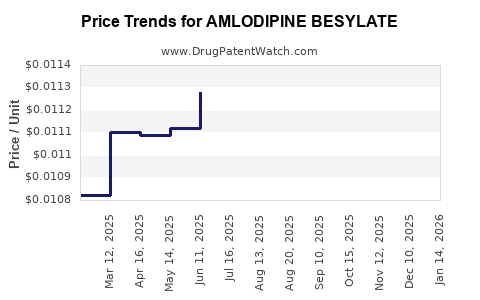
Drug Price Trends for AMLODIPINE BESYLATE


✉ Email this page to a colleague

« Back to Dashboard


Drug Price Trends for AMLODIPINE BESYLATE

Average Pharmacy Cost for AMLODIPINE BESYLATE

These are average pharmacy acquisition costs (net of discounts) from a US national survey
Drug Name NDC Price/Unit ($) Unit Date
AMLODIPINE BESYLATE 10 MG TAB 42806-0057-09 0.01671 EACH 2025-12-17
AMLODIPINE BESYLATE 10 MG TAB 29300-0398-05 0.01671 EACH 2025-12-17
AMLODIPINE BESYLATE 10 MG TAB 29300-0398-19 0.01671 EACH 2025-12-17
AMLODIPINE BESYLATE 10 MG TAB 00480-7168-10 0.01671 EACH 2025-12-17
AMLODIPINE BESYLATE 10 MG TAB 29300-0398-10 0.01671 EACH 2025-12-17
AMLODIPINE BESYLATE 10 MG TAB 00480-7168-98 0.01671 EACH 2025-12-17
AMLODIPINE BESYLATE 10 MG TAB 00904-6371-61 0.01671 EACH 2025-12-17
>Drug Name >NDC >Price/Unit ($) >Unit >Date

Best Wholesale Price for AMLODIPINE BESYLATE

These are wholesale prices available to the US Federal Government which, by law, must be the best prices available to any customer under comparable terms and conditions
Drug Name Vendor NDC Count Price ($) Price/Unit ($) Unit Dates Price Type
LOTREL 5MG/20MG CAP Sandoz, Inc. 00078-0406-05 100 769.34 7.69340 EACH 2024-01-01 - 2028-08-14 FSS
LOTREL 10MG/20MG CAP Sandoz, Inc. 00078-0364-05 100 893.39 8.93390 EACH 2024-01-01 - 2028-08-14 FSS
LOTREL 10MG/40MG CAP Sandoz, Inc. 00078-0379-05 100 970.65 9.70650 EACH 2023-09-29 - 2028-08-14 FSS
LOTREL 10MG/40MG CAP Sandoz, Inc. 00078-0379-05 100 981.48 9.81480 EACH 2024-01-01 - 2028-08-14 FSS
LOTREL 5MG/10MG CAP Sandoz, Inc. 00078-0405-05 100 718.93 7.18930 EACH 2023-09-29 - 2028-08-14 FSS
LOTREL 5MG/10MG CAP Sandoz, Inc. 00078-0405-05 100 725.33 7.25330 EACH 2024-01-01 - 2028-08-14 FSS
LOTREL 5MG/20MG CAP Sandoz, Inc. 00078-0406-05 100 757.58 7.57580 EACH 2023-09-29 - 2028-08-14 FSS
>Drug Name >Vendor >NDC >Count >Price ($) >Price/Unit ($) >Unit >Dates >Price Type
Price type key: Federal Supply Schedule (FSS): generally available to all Federal Govt agencies / 'BIG4' prices: VA, DoD, Public Health & Coast Guard only / National Contracts (NC): Available to specific agencies

Market Analysis and Price Projections for Amlodipine Besylate

Last updated: July 27, 2025

Introduction

Amlodipine besylate, a calcium channel blocker, is widely prescribed for managing hypertension and angina pectoris. With an established role in cardiovascular therapy, its market dynamics are influenced by factors including patent status, manufacturing trends, healthcare policies, and competitive landscape. This report provides a comprehensive analysis of the current market environment for amlodipine besylate, examines recent trends, and projects future pricing trajectories to assist stakeholders in strategic decision-making.

Market Overview

Global Demand and Usage

Amlodipine besylate consistently ranks among the top prescribed antihypertensive agents globally. Its favorable safety profile, once-daily dosing convenience, and extensive clinical validation underpin its widespread adoption. In 2022, the global antihypertensive drug market exceeded USD 35 billion, with calcium channel blockers constituting approximately 25% of prescriptions, translating to a significant share for amlodipine-based formulations.

Major Markets

  • United States: Dominates with high prescription volumes driven by hypertension prevalence and reimbursement frameworks.
  • European Union: Sustained demand, with generics rapidly replacing branded variants post patent expiry.
  • Emerging Markets: Rapid growth due to increasing hypertension prevalence, expanding healthcare access, and cost-sensitive consumers favoring generic options.

Competitive Landscape

The market is characterized by both branded and generic manufacturers. Key players include Pfizer, Mylan, Novartis, and Teva, with a significant shift towards generics following patent expirations around 2014-2015. The entry of numerous generic firms has intensified price competition, consistently exerting downward pressure on wholesale and retail prices.

Patent and Regulatory Environment

The original patent for amlodipine was held by Pfizer, which expired globally by 2015. Post-expiry, manufacturing rights entered the generic space, leading to an influx of lower-cost alternatives. Regulatory approvals for generics are streamlined in numerous jurisdictions, further accelerating market penetration.

In recent years, regulatory bodies have prioritized biosimilars and generics to enhance access, which has facilitated increased competition and price erosion.

Market Trends and Drivers

Generic Market Penetration

The rapid proliferation of generics has driven prices downward significantly. According to IQVIA data, generic versions account for over 85% of prescriptions in the US, with prices typically 60-80% lower than branded equivalents.

Pricing Trends

  • Price Reduction Post-Patent Expiry: The initial years following patent expiry saw prices decrease by approximately 50-60%. Continued generic entry has sustained a downward trend.
  • Formulation and Dosage Variations: Availability of multiple strengths facilitates price competition, with higher-dose products often commanding marginal premiums.
  • Supply Chain Dynamics: Manufacturing capacity, raw material costs, and geopolitical factors influence pricing stability.

Impact of Healthcare Policies

Price negotiations, formularies, and reimbursement policies directly affect market pricing. In the US, Medicare Part D and private insurers' formulary preferences play pivotal roles; in Europe, national health systems primarily dictate drug prices.

Emerging Markets

Price sensitivity dominates, with local manufacturers often offering low-cost formulations. The growing healthcare infrastructure supports increased consumption but maintains pressure on pricing.

Price Projections (Next 5 Years)

Factors Influencing Future Prices

  • Patent status: No new patents for amlodipine are anticipated.
  • Market saturation: Widespread generic availability suggests limited scope for price hikes.
  • Regulatory controls: Policies aimed at cost containment will likely sustain price declines.
  • Raw material costs: Volatility in active pharmaceutical ingredient (API) prices could influence manufacturing costs.
  • Innovative formulations: Attempts to develop combination therapies or sustained-release versions may temporarily stabilize or increase prices.

Forecast Summary

Year Expected Average Wholesale Price (AWP) per 30-count 5mg tablets Projected Trend
2023 USD 10-12 Stabilization at current levels
2024 USD 9-11 Slight decline due to competition
2025 USD 8-10 Continued downward trend
2026 USD 7-9 Market saturation persists
2027 USD 7-8 Marginal decline or stabilization

Note: Prices vary significantly by geography, formulation, and distribution channels.

Pricing Outlook

The trajectory indicates sustained price erosion driven by generics, with annual reductions of approximately 10-15%. Price stabilization may occur as the market approaches price floors set by manufacturing costs and regulatory constraints. In emerging markets, prices are expected to remain low, supporting increased access but limiting profit margins for manufacturers.

Opportunities and Risks

  • Opportunities: Expanding production capacity, exploring combination products, and entering emerging markets can capitalize on increasing demand.
  • Risks: Policy changes, supply chain disruptions, patent litigation, and commoditization pressure threaten profitability and pricing stability.

Conclusion

Amlodipine besylate's market remains heavily influenced by generics, with relentless downward pricing pressures expected over the next five years. Stakeholders should focus on cost management, strategic market expansion, and innovation opportunities to optimize margins. Accurate forecasting relies on ongoing monitoring of regulatory developments, raw material costs, and competitive entries.

Key Takeaways

  • The patent expiry of amlodipine besylate catalyzed a significant shift from branded to generic markets, intensifying price competition.
  • Market saturation and creditable manufacturing capacity are likely to sustain a downward price trend at an annual rate of 10-15%.
  • Price stabilization likely when prices reach manufacturing cost thresholds, especially in highly regulated or price-sensitive markets.
  • Emerging markets present growth opportunities driven by increasing hypertension prevalence and affordability of generics.
  • Continuous market intelligence is essential to mitigate risks and capitalize on evolving pricing and demand dynamics.

FAQs

  1. What factors have contributed most to the decline in amlodipine besylate prices?
    The primary driver is patent expiration, enabling proliferative generic entry, compounded by competitive pricing strategies and regulatory policies promoting affordability.

  2. How do regional policies influence amlodipine besylate pricing?
    Price controls, formulary considerations, and reimbursement schemes differ globally, impacting wholesale and retail prices and shaping market dynamics.

  3. Are innovative formulations likely to alter future price trends?
    While novel formulations like sustained-release or combination pills may command premium prices temporarily, their impact on overall market pricing is limited given the dominance of generics.

  4. What are the major risks to the current market outlook?
    Potential risks include regulatory reforms targeting drug pricing, raw material supply disruptions, and new entrants offering lower-cost alternatives.

  5. How should manufacturers prepare for upcoming market changes?
    Focus on cost efficiencies, diversify product portfolios with value-added formulations, and explore growth opportunities in emerging markets to mitigate downward price pressures.


References
[1] IQVIA Pharmaceutical Market Data, 2022
[2] U.S. Food & Drug Administration (FDA) Patent and Exclusivity Data, 2015
[3] Global Data Reports on Antihypertensive Market, 2022
[4] European Medicines Agency (EMA) Regulatory Frameworks, 2022

More… ↓

⤷  Get Started Free

Make Better Decisions: Try a trial or see plans & pricing

Drugs may be covered by multiple patents or regulatory protections. All trademarks and applicant names are the property of their respective owners or licensors. Although great care is taken in the proper and correct provision of this service, thinkBiotech LLC does not accept any responsibility for possible consequences of errors or omissions in the provided data. The data presented herein is for information purposes only. There is no warranty that the data contained herein is error free. We do not provide individual investment advice. This service is not registered with any financial regulatory agency. The information we publish is educational only and based on our opinions plus our models. By using DrugPatentWatch you acknowledge that we do not provide personalized recommendations or advice. thinkBiotech performs no independent verification of facts as provided by public sources nor are attempts made to provide legal or investing advice. Any reliance on data provided herein is done solely at the discretion of the user. Users of this service are advised to seek professional advice and independent confirmation before considering acting on any of the provided information. thinkBiotech LLC reserves the right to amend, extend or withdraw any part or all of the offered service without notice.