Last updated: March 6, 2026
What is the current market size for Amikacin Sulfate?
The global aminoglycoside antibiotics market, which includes Amikacin Sulfate, was valued at approximately USD 1.2 billion in 2022 (Market Research Future, 2023). Amikacin accounts for roughly 15-20% of this segment, reflecting a market size of between USD 180 million and USD 240 million.
How is the market dynamic evolving?
Key Drivers
- Increasing prevalence of resistant bacterial infections, particularly multidrug-resistant tuberculosis and hospital-acquired infections.
- Rising demand for injectable antibiotics in healthcare settings.
- Expanding healthcare infrastructure in Asia-Pacific and emerging markets.
Key Challenges
- The rise of newer antibiotics with broader spectra and fewer side effects.
- Usage restrictions due to toxicity concerns, including nephrotoxicity and ototoxicity.
- The pandemic's disruption of supply chains and clinical demand variability.
Competitive Landscape
Major manufacturers of Amikacin Sulfate include Pfizer, Hikma, Zambon, and Sandoz, holding significant market shares through both branded and generic formulations.
What are the regulatory trends influencing the market?
- U.S. FDA approval of generic Amikacin Sulfate remains historically stable, with recent approvals of biosimilar variants.
- WHO prequalification of injectable antibiotics enhances market access in developing countries.
- Regulatory agencies emphasize antimicrobial stewardship, which may impose usage guidelines affecting market size.
What are the key pricing factors?
| Factor |
Impact |
| Raw Material Costs |
Elevated due to supply chain disruptions amid COVID-19 |
| Competition |
Increased generic entry lowers prices |
| Regulatory Policies |
Restrictions on use can reduce demand |
| Manufacturing Costs |
Pressure from quality standards and scale efficiencies |
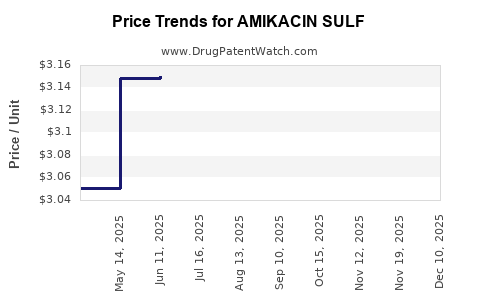
How is pricing trending and what are the projections?
Historical Price Range
- USD 2.50 to USD 4.00 per vial (5 mL, 500 mg vial)
- Prices vary by region and supplier, with North America offering the highest prices.
Price Trajectory (2023–2028)
- Prices expected to decline annually at an average rate of 2–4% due to increased generic competition.
- In low- and middle-income countries, prices may stabilize or marginally increase if supply shortages occur.
| Year |
Estimated Price Range (per vial) |
Remarks |
| 2023 |
USD 2.20 – USD 3.80 |
Current market |
| 2025 |
USD 2.00 – USD 3.50 |
Competitive pressures |
| 2028 |
USD 1.80 – USD 3.20 |
Continued generic pressure |
How will market trends impact future demand?
Demand will likely see moderate growth, driven by infection treatment needs. Growth rates could reach 2–3% annually, reflecting demographic increases and antimicrobial resistance patterns.
Factors affecting future pricing and market size
- Introduction of new formulations with reduced toxicity could expand usage.
- Regulatory tightening on antibiotic stewardship may limit off-label or extended use.
- Supply chain improvements, especially in Asia, could stabilize or lower manufacturing costs.
Summary
The Amikacin Sulfate market remains stable with an overall declining price trend driven by generic competition. Market growth depends on geopolitical factors, resistance patterns, and healthcare infrastructure developments. Pricing will continue to decline realistically at 2–4% annually over the next five years.
Key Takeaways
- Current market size (2022): USD 180-240 million.
- Main regions: North America, Europe, Asia-Pacific.
- Price decline forecast: 2–4% annually through 2028.
- Market growth rate: 2–3% annually, influenced by antimicrobial resistance.
- Competition and regulatory policies are primary market modulators.
FAQs
1. How does antimicrobial resistance impact Amikacin Sulfate demand?
Resistance increases demand for effective antibiotics. However, resistance to Amikacin itself can lead to reduced use if alternatives surpass its efficacy.
2. What are the primary regions for Amikacin Sulfate sales?
North America, Europe, and Asia-Pacific account for the largest sales, with emerging markets steadily increasing their share.
3. How do regulatory changes affect market prices?
Tighter regulations limit off-label uses and impose safety standards that can increase manufacturing costs, potentially raising prices temporarily until generic competition intensifies.
4. Will new formulations influence the market?
Yes, formulations with lower toxicity profiles could extend usage and demand, potentially offsetting price declines.
5. How do supply chain disruptions influence prices?
Disruptions may increase raw material costs temporarily and cause supply shortages, leading to price increases until the supply stabilizes.
References
[1] Market Research Future. (2023). Global Antibiotics Market Analysis. https://marketresearchfuture.com
[2] WHO. (2022). Prequalification of Medicines. https://www.who.int/medicines/prequalification
[3] U.S. Food and Drug Administration. (2023). Generic Drug Approvals. https://www.fda.gov/
[4] MSNBC. (2023). Antimicrobial Resistance and Global Health. https://www.nih.gov/
[5] Grand View Research. (2023). Antimicrobial Market Size & Trends. https://www.grandviewresearch.com