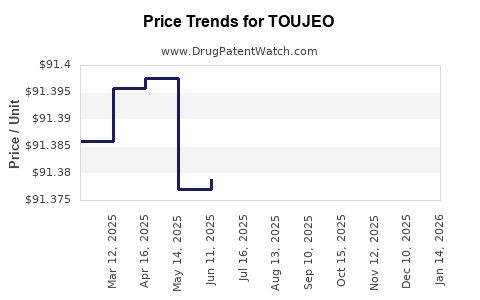
Last updated: October 28, 2026
Toujeo, Sanofi’s once-daily U-300 insulin glargine, is a mature but strategically important basal-insulin product. Its commercial position is supported by higher-concentration dosing, lower injection volume, established physician familiarity, and continued demand from insulin-treated diabetes patients. Growth is constrained by biosimilar and follow-on insulin competition, payer pressure, diabetes portfolio consolidation, and the expanding use of GLP-1 medicines.
Sanofi’s public reporting indicates that Toujeo generates approximately €1 billion or more in annual sales, making it one of the company’s largest diabetes products. The product has a longer commercial runway than Lantus because its U-300 formulation and delivery systems create barriers that are separate from the original insulin glargine molecule.
What is Toujeo and how does it differ from Lantus?
Toujeo is insulin glargine injection at a concentration of 300 units/mL. Lantus, the earlier Sanofi product, contains insulin glargine at 100 units/mL. Both products provide long-acting basal insulin, but they are not interchangeable on a unit-for-unit basis without clinical supervision.
| Attribute |
Toujeo |
Lantus |
| Active ingredient |
Insulin glargine |
Insulin glargine |
| Concentration |
U-300, 300 units/mL |
U-100, 100 units/mL |
| FDA approval |
March 2015 |
May 2000 |
| Primary use |
Basal insulin for diabetes |
Basal insulin for diabetes |
| Manufacturer |
Sanofi |
Sanofi |
| Main commercial advantage |
Lower injection volume and extended pharmacokinetic profile |
Established market presence and broad historical use |
| Primary competitive risks |
Follow-on insulin, biosimilar substitution, payer controls |
Genericized insulin glargine and biosimilar competition |
Toujeo is supplied primarily through the SoloStar prefilled pen and Max SoloStar pen. The Max SoloStar allows delivery of larger doses with fewer injections, an important feature for patients requiring high daily basal-insulin doses. The product is also supplied in a vial in some markets and indications.
How large is the Toujeo market?
Toujeo is a major branded basal-insulin product, although its sales are substantially smaller than the combined global insulin markets of Novo Nordisk and Eli Lilly.
Sanofi does not consistently present Toujeo as a fully isolated business segment in every financial disclosure. Reported figures and company portfolio commentary indicate annual sales around the €1 billion level in the early 2020s, with growth driven by conversion from Lantus and higher use of concentrated basal insulin.
| Fiscal period |
Toujeo financial trajectory |
Principal driver |
| 2015-2017 |
Rapid launch and conversion phase |
Initial uptake after FDA approval |
| 2018-2020 |
Expansion with increasing basal-insulin adoption |
Lantus conversion and pen penetration |
| 2021-2022 |
Approximately €1 billion-plus annual sales range |
Higher-dose patients and international growth |
| 2023 |
Approximately €1.2 billion reported-sales range |
Continued demand despite pricing pressure |
| 2024 onward |
Mature-product growth profile |
Mix improvement offset by payer and competitive pressure |
Toujeo represents a relatively small share of Sanofi’s total revenue, which exceeded €43 billion in 2023, but it has greater strategic importance within the company’s diabetes portfolio. The product is a recurring-revenue asset with established reimbursement, global manufacturing infrastructure, and a patient base that is difficult to move rapidly between basal-insulin products.
What drives Toujeo revenue?
Toujeo revenue depends on five commercial variables:
- Patient conversion from Lantus and other basal insulins. Toujeo benefits when physicians move patients requiring higher basal doses to a concentrated formulation.
- Insulin treatment intensity. Patients with type 2 diabetes who require larger doses are more valuable targets for U-300 insulin.
- Payer formulary placement. Contracting and rebates can determine whether Toujeo is preferred over Lantus, Semglee, Basaglar, Tresiba, or biosimilar insulin products.
- Pen utilization. Prefilled pens generally support higher net pricing than vial-based insulin and improve convenience.
- International access. Toujeo’s performance depends on reimbursement, tender awards, local pricing rules, and the availability of Sanofi’s pen platforms.
How does Toujeo compare with competing basal insulins?
Toujeo competes across three product groups: concentrated insulin glargine, other long-acting analog insulins, and lower-cost follow-on or biosimilar insulins.
| Product |
Company |
Concentration or formulation |
Competitive position |
| Toujeo |
Sanofi |
Insulin glargine U-300 |
Concentrated basal insulin with extended profile |
| Lantus |
Sanofi |
Insulin glargine U-100 |
Mature reference product |
| Semglee |
Viatris and Biocon |
Insulin glargine U-100 |
FDA-approved biosimilar; interchangeable version available |
| Rezvoglar |
Eli Lilly |
Insulin glargine U-100 |
Biosimilar and interchangeable insulin glargine |
| Basaglar |
Eli Lilly and Boehringer Ingelheim |
Insulin glargine U-100 |
Follow-on insulin glargine |
| Tresiba |
Novo Nordisk |
Insulin degludec |
Long-acting alternative with differentiated dosing profile |
| Levemir |
Novo Nordisk |
Insulin detemir |
Mature long-acting insulin, with declining commercial relevance in many markets |
Toujeo’s main direct advantage is concentration. Patients requiring large basal doses can use a smaller injection volume, which can improve administration convenience and reduce the number of injections. Its key disadvantage is price. U-100 biosimilar and follow-on products can be positioned more aggressively in formularies.
Tresiba is the principal branded non-glargine competitor in the long-acting basal-insulin segment. The competitive decision often depends on titration history, hypoglycemia profile, dose timing, device preferences, formulary status, and patient adherence.
What is the FDA regulatory status of Toujeo?
Toujeo was approved by the FDA in March 2015 under NDA 125513. It is an insulin glargine product regulated as a biologic medicine, but its original approval preceded the modern insulin transition framework under the Public Health Service Act.
The FDA-approved labeling includes use in adults with diabetes and pediatric use in specified age groups. Toujeo is administered once daily and requires dose titration based on glycemic response, prior basal-insulin exposure, hypoglycemia risk, and other clinical factors.
Toujeo is not a biosimilar to Lantus. Although both contain insulin glargine, Toujeo has a different concentration and formulation. Biosimilar or interchangeable status for U-100 insulin glargine does not create automatic pharmacy substitution rights for Toujeo.
What is the Orange Book status of Toujeo?
Toujeo is listed in FDA product databases under its NDA. The relevant intellectual-property analysis must distinguish between:
- The insulin glargine molecule.
- The U-300 concentration and formulation.
- Injection devices and delivery systems.
- Manufacturing and formulation processes.
- Method-of-use claims.
- Patent term adjustments, pediatric extensions, and jurisdiction-specific rights.
The original insulin glargine patent estate was associated primarily with Lantus and is not sufficient by itself to block all competition with Toujeo. The commercial protection for Toujeo is more dependent on its specific formulation, device presentation, regulatory requirements, and manufacturing know-how.
Publicly available FDA and patent records do not reduce Toujeo’s protection to one universally applicable expiration date. Patent terms differ by country, claim scope, patent-term adjustment, and product presentation. The practical U.S. risk window is therefore driven by the combined estate rather than by the expiration of a single molecule patent.
What patents protect Toujeo?
Toujeo protection is likely to be analyzed through several patent categories rather than through one foundational composition patent.
Formulation patents
Formulation claims can cover the concentration of insulin glargine, excipient composition, pH control, stabilization, and solution characteristics. These claims are commercially important because a competitor may need to reproduce the same concentration and performance characteristics to offer a close substitute.
Device and presentation patents
Toujeo’s SoloStar and Max SoloStar presentations create potential protection around pen architecture, dose-setting mechanisms, cartridge configuration, and high-dose delivery. Device patents may not prevent a competing insulin from launching in a vial or a different pen, but they can complicate a direct product match.
Method-of-use patents
Potential method-of-use claims can address once-daily administration, treatment of diabetes, dose conversion from U-100 insulin, or use in patients requiring high basal doses. Method-of-use patents are generally less effective against all market entry because a competitor may seek a label that omits the patented indication or dosing instruction.
Manufacturing and process know-how
Insulin manufacturing involves recombinant production, purification, formulation, aseptic filling, analytical characterization, and device assembly. Much of this protection may be maintained as know-how rather than disclosed as a patent. Manufacturing complexity can delay commercial entry even when patent barriers are limited.
When does Toujeo lose exclusivity?
Toujeo does not face a single cliff equivalent to the expiration of a small-molecule compound patent. Its exclusivity erosion is likely to be gradual.
The principal milestones are:
| Milestone |
Commercial impact |
| Expiration of early insulin glargine patents |
Enables broader U-100 competition but does not automatically authorize a Toujeo-equivalent U-300 product |
| Expiration of U-300 formulation claims |
Increases risk from direct concentrated insulin glargine competitors |
| Expiration of device claims |
Enables closer pen-based competition |
| Biosimilar or interchangeable approvals |
Increases payer leverage and substitution pressure |
| Loss of preferred formulary status |
Can reduce net sales before patent expiry |
| Manufacturing scale-up by competitors |
Converts legal freedom to operate into actual market share loss |
The most important commercial question is not whether a competitor can sell insulin glargine. It is whether the competitor can offer a legally and economically viable U-300 product with an equivalent delivery device, payer access, and reliable supply.
Which companies are challenging Toujeo?
The competitive threat comes from several groups rather than from one named challenger.
Viatris and Biocon
Semglee, including its interchangeable version, is the most visible U.S. biosimilar insulin glargine competitor. It targets the Lantus U-100 market rather than providing a direct U-300 replacement. Its effect on Toujeo is indirect: payers can use lower-cost insulin glargine to pressure Sanofi’s basal-insulin pricing and demand greater rebates.
Eli Lilly and Boehringer Ingelheim
Basaglar competes with Lantus and has contributed to the erosion of Sanofi’s U-100 insulin glargine franchise. Lilly’s Rezvoglar adds an interchangeable insulin glargine product to the U.S. market. These products increase formulary competition across the basal-insulin category.
Novo Nordisk
Novo Nordisk competes through Tresiba and through its broader diabetes portfolio. Its scale, payer relationships, and insulin manufacturing capacity create sustained pressure on Toujeo, especially where formularies favor portfolio contracting.
Potential U-300 entrants
A direct U-300 insulin glargine competitor would face formulation, device, regulatory, and manufacturing hurdles. No generic substitution mechanism automatically converts an approved U-100 insulin glargine biosimilar into a Toujeo substitute.
What generic entry risks exist for Toujeo?
Toujeo faces three levels of entry risk.
Low immediate risk from U-100 biosimilars
U-100 biosimilar products can reduce the price of insulin glargine without being pharmaceutically substitutable for Toujeo. Their strongest impact is on Sanofi’s overall basal-insulin contracting position.
Moderate risk from branded basal-insulin competitors
Tresiba and other long-acting products can capture patients during therapy initiation or treatment intensification. This risk is amplified when payers prefer a competitor or when physicians avoid higher-cost products.
Higher long-term risk from U-300 follow-on products
A direct U-300 competitor could pressure Toujeo more severely. The challenger would need to establish biosimilarity or another viable FDA pathway, secure a pen or vial presentation, overcome patent claims, and obtain reimbursement. The entry barrier is higher than for U-100 insulin glargine, but the commercial opportunity would also be substantial.
What is the Paragraph IV litigation risk for Toujeo?
Paragraph IV litigation risk depends on the filing of an abbreviated application that challenges listed patents. A Toujeo challenger could argue that relevant patents are invalid, unenforceable, or not infringed.
The legal risk is likely to concentrate on:
- U-300 formulation claims.
- Pen and high-dose delivery claims.
- Method-of-use claims.
- Patent listings associated with NDA 125513.
- Whether a proposed product is sufficiently similar to Toujeo to create a direct infringement dispute.
A Paragraph IV challenge would not guarantee immediate launch. Sanofi could seek a 30-month stay under the Hatch-Waxman framework if the relevant conditions were met. The litigation outcome would depend on the asserted patents, the challenger’s product design, and the court’s treatment of formulation and device claims.
How do licensing deals affect Toujeo?
Toujeo’s commercial model is primarily controlled by Sanofi, but external relationships matter in two areas.
First, Sanofi relies on manufacturing, device, logistics, and regional commercialization arrangements to supply a global insulin market. Second, competing insulin products may enter through partnerships such as Viatris-Biocon and Boehringer Ingelheim-Lilly arrangements.
No widely disclosed licensing transaction changes the fundamental ownership of Toujeo’s core commercial rights. The relevant business issue is Sanofi’s ability to preserve manufacturing scale and payer access while competitors use partnerships to lower production and commercialization costs.
What is Toujeo’s revenue exposure and future trajectory?
Toujeo’s revenue outlook is best characterized as stable to moderately pressured rather than high-growth.
| Factor |
Direction for Toujeo |
Financial effect |
| Conversion from Lantus |
Positive |
Supports volume and product mix |
| High-dose diabetes population |
Positive |
Favors U-300 delivery |
| Pen use |
Positive |
Supports convenience and net sales |
| U-100 biosimilar competition |
Negative |
Increases rebate and price pressure |
| GLP-1 and dual-incretin therapies |
Negative over time |
May reduce insulin initiation or delay intensification |
| Global insulin demand |
Positive |
Supports baseline volume |
| Payer contracting |
Negative or mixed |
Can shift share rapidly |
| Manufacturing scale |
Positive |
Protects supply and margins |
| Direct U-300 competition |
Potentially negative |
Could accelerate price and share erosion |
GLP-1 receptor agonists and glucose-dependent insulinotropic polypeptide/GLP-1 therapies are a medium-term competitive factor. They do not replace basal insulin for every patient, particularly those with advanced insulin deficiency or type 1 diabetes. They can reduce insulin initiation, delay escalation, and alter treatment sequencing in some type 2 diabetes populations.
Toujeo should therefore be valued as a durable cash-generating asset with declining marginal growth potential, not as a high-growth biologic platform.
How strong is the Toujeo patent estate?
The estate is commercially meaningful but less dominant than a single-patent blockbuster estate.
| Protection category |
Relative strength |
Reason |
| Insulin glargine molecule |
Low to moderate |
Earlier core claims have expired or face substantial prior-art exposure |
| U-300 formulation |
Moderate to strong |
More directly relevant to Toujeo’s product profile |
| Pen and delivery device |
Moderate |
Can delay a close product match but may not block alternative presentations |
| Method of use |
Moderate |
Enforcement depends on the competitor’s label and prescribing behavior |
| Manufacturing know-how |
Strong operationally |
Difficult to replicate at scale, though not always patent-based |
| Regulatory exclusivity |
Limited relative to newer biologics |
Toujeo launched in a mature insulin category |
Sanofi’s strongest defenses are the combined effect of formulation, device, regulatory execution, manufacturing scale, physician familiarity, and contracting. The estate is less likely to support a prolonged monopoly if a well-funded competitor develops a direct U-300 product.
What generic launch scenarios are most likely?
Three scenarios are commercially plausible.
Scenario one: Continued indirect erosion
U-100 biosimilar and interchangeable products gain share, but no U-300 competitor launches. Toujeo retains its premium position among high-dose patients while Sanofi uses rebates to preserve access. Revenue remains stable but margins decline.
Scenario two: Direct U-300 competition
A competitor launches a concentrated insulin glargine product after resolving formulation, device, and regulatory barriers. Toujeo experiences faster price erosion, increased switching, and higher contracting costs.
Scenario three: Portfolio-driven defense
Sanofi protects Toujeo through device improvements, patient-support programs, supply reliability, and formulary agreements. The product maintains share in selected patient segments even as U-100 products become more heavily commoditized.
What patent litigation affects Toujeo?
The most relevant litigation risk is likely to arise from future abbreviated applications and patent challenges involving insulin glargine formulations or delivery devices. Existing biosimilar litigation surrounding Lantus-related products demonstrates that the broader insulin-glargine estate can support patent disputes, but those cases do not automatically determine Toujeo’s outcome.
For investors and licensing teams, the decisive facts are:
- Whether a challenger targets U-300 or only U-100 insulin glargine.
- Which patents are listed for NDA 125513 at the time of filing.
- Whether the challenger uses a Toujeo-like pen.
- Whether the proposed label includes overlapping dosing instructions.
- Whether Sanofi reaches a launch settlement.
- Whether the challenger has manufacturing capacity and payer access.
Key Takeaways
- Toujeo is Sanofi’s U-300 insulin glargine product, approved by the FDA in 2015 under NDA 125513.
- Its annual sales are approximately €1 billion or more, making it a material Sanofi diabetes asset.
- Toujeo’s commercial protection comes from its formulation, concentration, pen systems, manufacturing capabilities, and market access, not only from the insulin glargine molecule.
- U-100 biosimilars such as Semglee and Rezvoglar create indirect pricing pressure but are not automatic substitutes for Toujeo.
- A direct U-300 competitor would pose a greater threat but would face higher formulation, device, regulatory, and manufacturing barriers.
- The likely financial trajectory is mature-product stability followed by gradual erosion rather than an abrupt loss of exclusivity.
- GLP-1-based therapies may reduce future insulin initiation and intensification in parts of the type 2 diabetes market.
- Toujeo remains a defensible cash-generating product, but its patent estate is less absolute than that of a new molecular entity with long-lived composition claims.
FAQs
Is Toujeo a biosimilar to Lantus?
No. Toujeo contains the same active ingredient, insulin glargine, but uses a U-300 concentration and distinct formulation. It is not a biosimilar version of Lantus.
Can Semglee be substituted automatically for Toujeo?
No. Semglee is an insulin glargine U-100 product. Its interchangeability designation does not create automatic substitution rights for Toujeo U-300.
Does Toujeo have a generic version?
There is no broadly substitutable generic Toujeo equivalent comparable to a small-molecule generic. U-100 insulin glargine biosimilars compete indirectly, while a direct U-300 entrant would require a separate regulatory and commercial strategy.
Why do high-dose patients matter to Toujeo’s revenue?
Toujeo delivers 300 units per milliliter, reducing injection volume for patients who need large basal-insulin doses. This supports product selection among patients for whom U-100 injection volume or multiple injections is burdensome.
What is the biggest long-term risk to Toujeo?
The largest long-term risk is the combination of payer-driven price erosion and a direct U-300 competitor. GLP-1 therapies and U-100 biosimilars increase pressure, but they do not by themselves create a direct Toujeo substitute.
References
-
Food and Drug Administration. (2015). Toujeo prescribing information: Insulin glargine injection, 300 units/mL. U.S. Department of Health and Human Services.
-
Food and Drug Administration. (2024). Drugs@FDA: Toujeo, NDA 125513. U.S. Department of Health and Human Services.
-
Food and Drug Administration. (2024). Purple Book: Database of licensed biological products. U.S. Department of Health and Human Services.
-
Food and Drug Administration. (2024). Approved drug products with therapeutic equivalence evaluations. U.S. Department of Health and Human Services.
-
Sanofi. (2024). 2023 annual report. Sanofi.
-
Sanofi. (2024). 2023 full-year results and financial information. Sanofi.
-
Biocon Biologics. (2024). Semglee insulin glargine product information. Biocon Biologics.
-
Eli Lilly and Company. (2024). Rezvoglar and Basaglar prescribing information. Eli Lilly and Company.