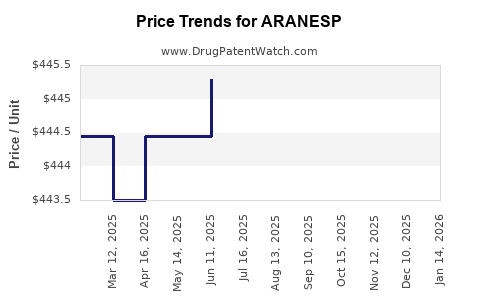
Last updated: September 8, 2026
Aranesp, Amgen's darbepoetin alfa, remains a mature erythropoiesis-stimulating agent with declining revenue, limited U.S. exclusivity protection, and persistent exposure to reimbursement controls. The product's financial profile has shifted from branded growth to cash-flow harvesting. Amgen's long-term risk is concentrated in lower pricing, reduced treatment volumes, conversion to biosimilar epoetin products, and the gradual loss of clinical differentiation in chronic kidney disease and chemotherapy-induced anemia.
What is Aranesp and how does it generate revenue?
Aranesp is a long-acting recombinant erythropoietin analogue approved by the U.S. Food and Drug Administration in 2001. Its active ingredient, darbepoetin alfa, stimulates erythropoiesis through the erythropoietin receptor. The molecule has a longer serum half-life than epoetin alfa, allowing less frequent administration in several treatment settings.
The principal approved uses are:
- Anemia associated with chronic kidney disease in adult and pediatric patients.
- Anemia caused by myelosuppressive chemotherapy in patients with non-myeloid malignancies.
Aranesp is administered intravenously or subcutaneously, depending on the indication and treatment setting. The product is sold primarily through institutional, specialty-pharmacy, dialysis, and hospital channels rather than through conventional retail prescribing.
The commercial value proposition has historically depended on reduced dosing frequency compared with epoetin alfa. That advantage is less powerful when payers use formulary controls, dialysis-provider purchasing contracts, and biosimilar substitution to reduce treatment cost.
What is Aranesp's financial trajectory?
Aranesp revenue has declined substantially from its earlier peak. Amgen's annual reports show a multiyear reduction caused by lower unit demand, pricing pressure, biosimilar competition, and treatment changes in the anemia market.
| Period |
Financial direction |
Principal drivers |
| 2010s |
Downward from historical peak |
Safety restrictions, reimbursement pressure, lower use in oncology |
| 2020-2021 |
Declining mature-product revenue |
COVID-19 treatment disruption and reduced oncology activity |
| 2022-2023 |
Continued decline |
Price erosion, competitive contracting, lower utilization |
| 2024 onward |
Harvest phase |
Mature portfolio economics and continued substitution risk |
Amgen's reported Aranesp sales were approximately $1 billion annually in the early 2020s, compared with several billion dollars at the product's earlier commercial peak. The precise annual figure varies by reporting year and presentation of foreign-exchange effects, but the direction is consistent: Aranesp is no longer a growth asset within Amgen's portfolio (Amgen Inc., 2022, 2023, 2024).
Amgen's larger products, including Enbrel, Prolia, Xgeva, Repatha, Otezla, and newer medicines, have become more important to consolidated revenue. Aranesp still contributes recurring cash flow because it has an established prescriber base and manufacturing infrastructure, but its strategic importance is lower than it was before the company's biologics portfolio matured.
What explains Aranesp's revenue decline?
The principal financial pressures are:
- Reduced use of erythropoiesis-stimulating agents in oncology after FDA safety warnings linking higher hemoglobin targets with tumor progression, thrombosis, and mortality risks.
- Dialysis-provider purchasing leverage in chronic kidney disease.
- Competition from epoetin alfa products, including biosimilar and interchangeable products in the U.S. market.
- Lower treatment intensity and more conservative hemoglobin management.
- Contracting pressure from hospitals, dialysis organizations, and group purchasing organizations.
- International price controls and government procurement systems.
- The absence of a major new indication capable of restoring volume growth.
When does Aranesp lose exclusivity?
Aranesp's principal U.S. biologic exclusivity period ended in 2013. The product received FDA approval in September 2001, and the Biologics Price Competition and Innovation Act provides 12 years of reference-product exclusivity for qualifying biologics. Aranesp therefore has no remaining U.S. reference-product exclusivity under the statutory period (FDA, 2024).
Patent protection is separate from FDA biologic exclusivity. The original darbepoetin alfa patent estate was filed in the 1990s and the principal composition and recombinant-production protections have expired or reached the end of their practical commercial life. Later patents may have covered specific formulations, dosing approaches, manufacturing processes, or methods of treatment, but those protections have not created a durable barrier comparable to the original molecule patent.
| Protection category |
Aranesp position |
| FDA approval |
2001 |
| U.S. biologic reference-product exclusivity |
Expired in 2013 |
| Core molecule protection |
Expired or commercially exhausted |
| Orange Book listing |
Not applicable to the biologic itself |
| Purple Book reference product |
Yes, as a licensed biologic reference product |
| Current exclusivity thesis |
Clinical familiarity, supply reliability, contracting, and manufacturing scale |
What patents protect Aranesp?
Aranesp protection originated from Amgen patents covering modified erythropoietin analogues containing additional carbohydrate structures and related production technology. The product's patent strategy was based on the altered glycosylation profile of darbepoetin alfa, which supports its longer circulation time relative to epoetin alfa.
Relevant patent categories included:
- Erythropoietin analogues with additional glycosylation sites.
- DNA sequences encoding modified erythropoietin proteins.
- Host cells and recombinant methods for producing the protein.
- Pharmaceutical compositions containing darbepoetin alfa.
- Dosing methods for anemia associated with kidney disease or chemotherapy.
The central commercial point is that the most important product-defining patents are old. Any remaining patent dispute would likely concern a narrow manufacturing, formulation, or method-of-use claim rather than ownership of the core darbepoetin alfa molecule.
Patent numbers and expiration dates must be evaluated against the specific jurisdiction, patent-family member, terminal disclaimers, patent-term adjustment, and any terminal disclaimer affecting enforceability. Public regulatory and company disclosures do not support treating an unexpired secondary patent as a broad barrier to U.S. competition.
What is the FDA and Orange Book status of Aranesp?
Aranesp is regulated as a biologic under a Biologics License Application rather than as a conventional small-molecule New Drug Application. It is not treated like a standard Orange Book product for purposes of Hatch-Waxman patent certification.
The relevant U.S. regulatory framework is the Purple Book and the abbreviated pathway under section 351(k) of the Public Health Service Act. A biosimilar applicant may rely on the reference product's biological license and submit comparative analytical, pharmacokinetic, pharmacodynamic, immunogenicity, and clinical data.
The FDA label contains important restrictions on erythropoiesis-stimulating-agent use. Aranesp carries boxed warnings concerning increased risks of death, myocardial infarction, stroke, venous thromboembolism, and tumor progression or recurrence in certain settings. The label directs use of the lowest dose needed to avoid red-blood-cell transfusions rather than normalization of hemoglobin (FDA, 2024).
Which companies are challenging Aranesp?
The more immediate competitive threat has come from products that compete with the erythropoiesis-stimulating-agent class rather than from a broad U.S. launch of an identical darbepoetin alfa biosimilar.
Key competitors include:
- Retacrit, epoetin alfa-epbx, marketed by Pfizer.
- Epogen, epoetin alfa, associated with Amgen.
- Procrit, epoetin alfa, associated with Janssen and Johnson & Johnson.
- Mircera, methoxy polyethylene glycol-epoetin beta, marketed by Roche in selected markets.
- Biosimilar epoetin products marketed in Europe and other jurisdictions.
- Aranesp biosimilars or follow-on darbepoetin products approved outside the United States.
In the U.S., Retacrit is particularly important because it gives providers a lower-cost ESA alternative and can be used in settings where darbepoetin's longer dosing interval does not offset its price. Dialysis providers can also use purchasing scale to influence product selection.
Are there Aranesp Paragraph IV challenges?
Paragraph IV litigation applies to patents listed in the Orange Book for small-molecule products. Aranesp is a biologic and therefore does not use the standard Orange Book Paragraph IV certification process.
A biosimilar applicant may instead follow the section 351(k) patent-disclosure and litigation framework. The process includes an exchange of patent information commonly called the patent dance, although participation and litigation sequencing can vary. The absence of a conventional Paragraph IV case does not eliminate patent risk. It changes the procedural route.
What generic and biosimilar entry risks exist for Aranesp?
The U.S. market has a greater near-term risk from therapeutic substitution and ESA-class contracting than from a large immediate wave of darbepoetin alfa biosimilar launches.
| Risk |
Financial effect on Aranesp |
| Epoetin biosimilars |
Lower net pricing and weaker formulary position |
| Darbepoetin biosimilars |
Potential direct volume substitution |
| Dialysis consolidation |
Greater buyer leverage |
| Oncology safety restrictions |
Lower use per patient |
| Hospital tenders |
Periodic price compression |
| Manufacturing complexity |
Slows entry but does not eliminate it |
| Clinical familiarity |
Supports retention in selected accounts |
Darbepoetin alfa is a complex glycoprotein, and manufacturing comparability is more difficult than for a simple small molecule. Critical quality attributes include glycosylation, charge variants, aggregation, potency, purity, and immunogenicity. These requirements raise development costs and can delay approval.
The manufacturing barrier is therefore meaningful, but it is not a durable monopoly. Contract manufacturers and large biologics companies have the technical capacity to produce follow-on erythropoietin products. The principal commercial question is whether the expected discount and market access justify the development and litigation cost.
How strong is the Aranesp patent estate?
The Aranesp patent estate is weak as a broad exclusivity platform and moderate as a source of residual commercial friction.
| Patent-estate factor |
Assessment |
| Core composition protection |
Weak because principal protections are expired |
| Biologic regulatory exclusivity |
Expired |
| Formulation protection |
Potentially narrow and jurisdiction-specific |
| Manufacturing protection |
Can create process disputes |
| Method-of-use protection |
Limited by label restrictions and prior art |
| Litigation leverage |
Lower than during the original launch period |
| Commercial defense |
Contracting, supply reliability, and clinical familiarity |
Amgen's practical defense is therefore commercial rather than primarily patent-based. Hospitals and dialysis providers may continue using Aranesp when switching costs, dosing protocols, inventory systems, and physician familiarity outweigh the price difference.
What patent litigation and settlements affect Aranesp?
Aranesp's important U.S. market period predates the current wave of biosimilar litigation. The product is not defined by an active, high-value Orange Book patent dispute. Any current patent litigation would be more likely to concern process claims, manufacturing know-how, or a specific follow-on product than the basic right to sell darbepoetin alfa.
Publicly disclosed information does not support identifying a current settlement that materially extends U.S. Aranesp exclusivity. Nor does it support treating an unexpired secondary patent as a block on all biosimilar or follow-on competition.
What is the competitive outlook for Aranesp?
Aranesp is likely to remain a declining but durable product rather than face an abrupt revenue collapse. Three scenarios define the commercial outlook.
Base case: gradual erosion
Revenue declines at a mid-single-digit to low-double-digit rate as pricing weakens and providers use lower-cost epoetin products. Amgen retains accounts with established dosing protocols and reliable supply.
Downside case: accelerated substitution
A competitive darbepoetin biosimilar gains broad payer access, or dialysis and hospital systems adopt aggressive class-wide substitution. Aranesp revenue falls faster because both price and volume decline.
Resilient case: slower erosion
Supply disruptions among competitors, physician preference for extended dosing intervals, and stable oncology or nephrology demand slow the decline. The product remains a cash-generating mature brand, but it does not return to growth.
How does Aranesp compare with competing ESAs?
| Product |
Molecule |
Dosing proposition |
Competitive position |
| Aranesp |
Darbepoetin alfa |
Longer-acting than epoetin alfa |
Mature branded product |
| Epogen |
Epoetin alfa |
Shorter-acting ESA |
Established dialysis use |
| Retacrit |
Epoetin alfa-epbx |
Biosimilar epoetin |
Lower-cost U.S. competitor |
| Procrit |
Epoetin alfa |
Shorter-acting ESA |
Legacy branded competitor |
| Mircera |
Methoxy PEG-epoetin beta |
Extended-interval dosing |
Regional and institutional competitor |
Aranesp's main advantage is dosing convenience. Its main disadvantage is that convenience is difficult to monetize when purchasers prioritize acquisition cost and class-level reimbursement.
What is the geographic coverage of Aranesp protection?
Aranesp is marketed in multiple international jurisdictions, but patent and regulatory positions differ by country. European and other non-U.S. markets have experienced biosimilar and follow-on competition earlier than the United States in several biologic categories.
Geographic revenue exposure depends on:
- National reimbursement policy.
- Hospital tender structures.
- Dialysis-provider concentration.
- Local biosimilar substitution rules.
- Patent term and supplementary protection certificates.
- Regulatory acceptance of extrapolated indications.
- Local manufacturing and supply arrangements.
The U.S. remains strategically important because of market size and high biologic pricing, but its revenue erosion is constrained by the lack of a conventional generic substitution mechanism for biologics. Payer and provider contracting can still produce the same economic effect over time.
Key Takeaways
- Aranesp is a mature darbepoetin alfa biologic with declining revenue and no remaining U.S. reference-product exclusivity.
- FDA approval occurred in 2001; the 12-year U.S. biologic exclusivity period ended in 2013.
- Core composition patents are expired or commercially exhausted. Any remaining protection is likely narrow and jurisdiction-specific.
- Aranesp is regulated under the biologics framework and is not subject to conventional Orange Book Paragraph IV litigation.
- The principal commercial threats are epoetin biosimilars, class-level contracting, dialysis-provider purchasing power, and potential darbepoetin biosimilars.
- The product's remaining value comes from clinical familiarity, dosing convenience, supply reliability, and account-level contracting.
- Revenue is likely to continue declining gradually unless competitive substitution accelerates.
- Aranesp remains a cash-generating mature asset, not a portfolio growth driver.
FAQs
Is Aranesp still patent protected in the United States?
The core darbepoetin alfa patent protection has expired or reached the end of its practical commercial life. Narrow secondary patents may differ by jurisdiction, but they do not create broad molecule-level exclusivity.
Is Aranesp interchangeable with Retacrit?
No. Aranesp contains darbepoetin alfa, while Retacrit contains epoetin alfa-epbx. They are related erythropoiesis-stimulating agents, but they are not the same biological product.
Does Aranesp have an Orange Book patent listing?
Aranesp is a biologic licensed under a BLA, so its principal regulatory and patent framework is the Purple Book and section 351(k), not the conventional Orange Book system used for small-molecule drugs.
Can a biosimilar receive all Aranesp indications through extrapolation?
Yes, the FDA may approve extrapolated indications when the totality of evidence supports biosimilarity and the mechanism, pharmacology, safety, and immunogenicity are sufficiently comparable for the requested uses.
What is the main driver of future Aranesp pricing?
The main driver is purchasing leverage from dialysis organizations, hospitals, payers, and specialty distributors. Direct biosimilar entry would increase pressure, but class-level contracting already limits pricing power.
References
-
Amgen Inc. (2022). Annual report pursuant to Section 13 or 15(d) of the Securities Exchange Act of 1934 for the fiscal year ended December 31, 2021. U.S. Securities and Exchange Commission.
-
Amgen Inc. (2023). Annual report pursuant to Section 13 or 15(d) of the Securities Exchange Act of 1934 for the fiscal year ended December 31, 2022. U.S. Securities and Exchange Commission.
-
Amgen Inc. (2024). Annual report pursuant to Section 13 or 15(d) of the Securities Exchange Act of 1934 for the fiscal year ended December 31, 2023. U.S. Securities and Exchange Commission.
-
U.S. Food and Drug Administration. (2024). Aranesp prescribing information. Amgen Inc.
-
U.S. Food and Drug Administration. (2024). Purple Book: Database of licensed biological products. U.S. Department of Health and Human Services.
-
U.S. Food and Drug Administration. (2024). Biosimilar and interchangeable products. U.S. Department of Health and Human Services.