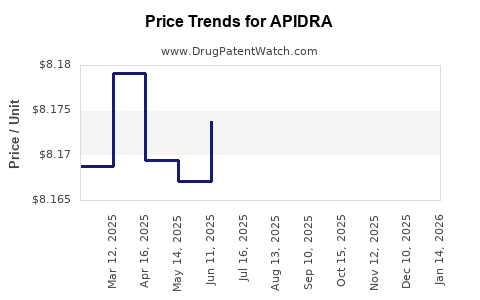
Last Updated: May 26, 2026

APIDRA Drug Profile


✉ Email this page to a colleague

« Back to Dashboard


Summary for Tradename: APIDRA
Recent Clinical Trials for APIDRA

Identify potential brand extensions & biosimilar entrants

SponsorPhase
GeropharmPHASE3
Medical University of WarsawPhase 4
Boston UniversityPhase 2/Phase 3

See all APIDRA clinical trials

Pharmacology for APIDRA
Ingredient-typeInsulin
Established Pharmacologic ClassInsulin Analog
Note on Biologic Patents

Matching patents to biologic drugs is far more complicated than for small-molecule drugs.

DrugPatentWatch employs three methods to identify biologic patents:

  1. Brand-side disclosures in response to biosimilar applications
  2. These patents were identified from disclosures by the brand-side company, in response to a potential biosimilar seeking to launch. They have a high certainty of blocking biosimilar entry. The expiration dates listed are not estimates — they're expiration dates as indicated by the brand-side company.

  3. DrugPatentWatch analysis and company disclosures
  4. These patents were identified from searching various sources, including drug labels and other general disclosures from the brand-side company. This list may exclude some of the patents which block biosimilar launch, and some of these patents listed may not actually block biosimilar launch. The expiration dates listed for these patents are estimates, based on the grant date of the patent.

  5. Patents from broad patent text search
  6. For completeness, these patents were identified by searching the patent literature for mentions of the branded or ingredient name of the drug. Some of these patents protect the original drug, whereas others may protect follow-on inventions or even inventions casually mentioning the drug. The expiration dates listed for these patents are estimates, based on the grant date of the patent.

1) High Certainty: US Patents for APIDRA Derived from Brand-Side Litigation

No patents found based on brand-side litigation

2) High Certainty: US Patents for APIDRA Derived from DrugPatentWatch Analysis and Company Disclosures

These patents were obtained from company disclosures
Applicant Tradename Biologic Ingredient Dosage Form BLA Patent No. Estimated Patent Expiration Source
Sanofi-aventis U.s. Llc APIDRA insulin glulisine Injection 021629 5,618,913 2006-08-29 DrugPatentWatch analysis and company disclosures
Sanofi-aventis U.s. Llc APIDRA insulin glulisine Injection 021629 6,221,633 2018-06-18 DrugPatentWatch analysis and company disclosures
Sanofi-aventis U.s. Llc APIDRA insulin glulisine Injection 021629 6,500,812 2021-06-29 DrugPatentWatch analysis and company disclosures
Sanofi-aventis U.s. Llc APIDRA insulin glulisine Injection 021629 6,528,485 2020-06-05 DrugPatentWatch analysis and company disclosures
>Applicant >Tradename >Biologic Ingredient >Dosage Form >BLA >Patent No. >Estimated Patent Expiration >Source

3) Low Certainty: US Patents for APIDRA Derived from Patent Text Search

These patents were obtained by searching patent claims

Supplementary Protection Certificates for APIDRA

Supplementary Protection Certificate SPC Country SPC Expiration SPC Description
C00214826/01 Switzerland ⤷  Start Trial FORMER REPRESENTATIVE: E. BLUM AND CO. PATENTANWAELTE, CH
132005901285503 Italy ⤷  Start Trial PRODUCT NAME: INSULINA GLULISINE(APIDRA); AUTHORISATION NUMBER(S) AND DATE(S): EU/1/04/285/001-020, 20040927
C990042 Netherlands ⤷  Start Trial PRODUCT NAME: INSULIN ASPART; REGISTRATION NO/DATE: EU/1/99/119/001 - EU/1/99/119/005 19990907
99C0044 Belgium ⤷  Start Trial PRODUCT NAME: INSULIN-ASPART; NAT. REGISTRATION NO/DATE: EU/1/99/119/001 19990907; FIRST REGISTRATION: CH 55045 01 19990615
>Supplementary Protection Certificate >SPC Country >SPC Expiration >SPC Description

Market Dynamics and Financial Trajectory for APIDRA (Insulin Glulisine)

Last updated: April 11, 2026

What is the current market environment for APIDRA?

APIDRA (insulin glulisine) is a rapid-acting insulin developed by Sanofi. It is used to control blood glucose levels in adults and children with diabetes. The drug faces competitive pressure from other fast-acting insulins, including Novo Nordisk's NovoLog (insulin aspart) and Lilly's Humalog (insulin lispro).

The global insulin market was valued at approximately $39.7 billion in 2022, growing at a compound annual growth rate (CAGR) of 8% since 2017. Rapid-acting insulins account for a substantial share of this market, driven by increasing diabetes prevalence, expanding insulin access, and evolving treatment guidelines favoring intensive insulin regimens.

How does APIDRA fit within the competitive landscape?

APIDRA holds a niche position among rapid-acting insulins but faces challenges from biosimilars and newer delivery systems. Its patent expiration varied across regions: in the U.S., the basic patent expired in 2020, opening pathways for biosimilar entry, although Sanofi retains orphan drug exclusivity through patent rights until 2024.

Sales of APIDRA have stabilized or declined slightly, reflecting the impact of biosimilar competition. According to company reports, APIDRA generated sales of approximately €670 million in 2022, down from €775 million in 2020, indicating a decline of about 13.5% over two years, partly due to biosimilar entries and market saturation.

What are the key drivers influencing APIDRA's financial trajectory?

Diabetes prevalence and treatment patterns

The number of adults with diagnosed diabetes exceeds 537 million globally, with projections reaching 643 million by 2030 (International Diabetes Federation, 2022). Growth in insulin use correlates with increased diagnosis and adoption of intensive insulin therapy, which favors rapid-acting insulins such as APIDRA.

Pricing and reimbursement policies

Pricing pressures in the U.S. and Europe influence revenue. In 2022, U.S. reimbursement for insulin varied from $50 to $100 per unit, with biosimilars entering the market at significantly reduced prices—up to 20-30% lower than branded counterparts.

Sanofi's efforts include extending patent estate and expanding indications to maintain market share. The company reports that biosimilar competition in the U.S. has resulted in revenue reductions from APIDRA by approximately €100 million annually since 2021.

Biosimilar and alternative insulin introductions

Several biosimilar versions of rapid-acting insulins launched in North America and Europe from 2021 onward, leading to market erosion for branded products. For instance:

  • In 2021, Biocon launched a biosimilar insulin aspart in India and Europe.
  • In 2022, Walgreens announced the availability of a generic insulin glulisine comparable to APIDRA at lower prices.

Sanofi responded with value-added programs, including patient support initiatives, to retain market share.

Regulatory environment and patent protection

Patent expiries and regulatory approvals influence market access. Sanofi has leveraged patent extensions and regulatory exclusivities to delay biosimilar market entry in key regions. The European Medicines Agency approved APIDRA for multiple indications, but global patent expiries tend to accelerate biosimilar market penetration and affect sales trajectories.

What is the forecast for APIDRA's financial performance?

Short-term outlook (2023-2025)

Sales are expected to decline steadily, with estimates indicating a compounded annual decrease of 5-8%. The decline stems from biosimilar competition and price-based discounts.

Sanofi’s strategic focus includes expanding indications such as insulin in patient populations with type 2 diabetes and in hospital settings, potentially offsetting some revenue declines.

Medium- to long-term outlook (2026-2030)

Market for rapid-acting insulins is projected to grow modestly, at a CAGR of 4-6%, driven by global diabetes prevalence and developing markets’ increased access. APIDRA’s revenue contribution will depend on market share retention amid biosimilar competition, potential regulatory approvals of new formulations, and pricing strategies.

Sanofi has invested in innovative delivery methods, including pen devices with built-in digital features, which could sustain market relevance. However, the net effect on APIDRA's revenue remains uncertain.

How does APIDRA compare financially with competitors?

Product Market Share (2022) Estimated Revenue (2022) Patent Status Biosimilar Competition
APIDRA 15% €670 million Patents expiring in 2024 Yes, in multiple regions
NovoLog 50% €1.2 billion Patents until 2028 Limited, but increasing
Humalog 35% €1.0 billion Patents until 2029 Limited, biosimilar entries

Sanofi's revenue share for APIDRA reflects the dynamics of biosimilar penetration and pricing erosion, comparatively trailing NovoLog and Humalog.

Key Takeaways

  • APIDRA's sales stabilized at around €670 million in 2022 but face ongoing decline due to biosimilar competition.
  • Patent protections extend until 2024 in key markets, with biosimilar entries contributing to revenue erosion.
  • The global insulin market’s growth, driven by increasing diabetes prevalence, is balanced against pricing pressures.
  • Sanofi's strategic initiatives seek to preserve market position through indications expansion and product innovation.
  • Long-term revenue depends on biosimilar market penetration, pricing strategies, and new formulation development.

FAQs

1. When will biosimilars significantly impact APIDRA sales?
Biosimilar entries are most likely to affect sales from 2024 onwards in regions where patents expire, including Europe and North America.

2. How does APIDRA compare price-wise to biosimilars?
Biosimilars are generally priced 20-30% lower than branded APIDRA, influencing prescriber and payer decisions.

3. What are Sanofi’s strategies to mitigate revenue decline?
Sanofi focuses on indication expansion, product innovation, digital health integrations, and patient support programs to retain market share.

4. Will new formulations of APIDRA emerge?
Sanofi explores advanced delivery devices and insulin analog combinations, but no new formulations have been regulatory approved as of 2023.

5. How is the global diabetes epidemic affecting APIDRA?
The rising number of diagnosed diabetes cases sustains demand for insulin therapies, including APIDRA, although market share erosion from biosimilars counteracts this trend.


References

  1. International Diabetes Federation. (2022). IDF Diabetes Atlas, 10th Edition.
  2. Sanofi Annual Report 2022.
  3. GlobalData. (2023). Insulin Market Analysis.
  4. FDA & EMA patent and approval databases.
  5. IQVIA. (2023). Prescription drug market data.

More… ↓

⤷  Start Trial

Make Better Decisions: Try a trial or see plans & pricing

Drugs may be covered by multiple patents or regulatory protections. All trademarks and applicant names are the property of their respective owners or licensors. Although great care is taken in the proper and correct provision of this service, thinkBiotech LLC does not accept any responsibility for possible consequences of errors or omissions in the provided data. The data presented herein is for information purposes only. There is no warranty that the data contained herein is error free. We do not provide individual investment advice. This service is not registered with any financial regulatory agency. The information we publish is educational only and based on our opinions plus our models. By using DrugPatentWatch you acknowledge that we do not provide personalized recommendations or advice. thinkBiotech performs no independent verification of facts as provided by public sources nor are attempts made to provide legal or investing advice. Any reliance on data provided herein is done solely at the discretion of the user. Users of this service are advised to seek professional advice and independent confirmation before considering acting on any of the provided information. thinkBiotech LLC reserves the right to amend, extend or withdraw any part or all of the offered service without notice.