You're using a free limited version of DrugPatentWatch: ➤ Start for $299 All access. No Commitment.

Last Updated: March 26, 2026

Seagen Company Profile


✉ Email this page to a colleague

« Back to Dashboard


Summary for Seagen
International Patents:165
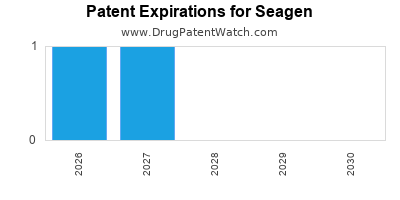
US Patents:7
Tradenames:1
Ingredients:1
NDAs:1

Drugs and US Patents for Seagen

Applicant Tradename Generic Name Dosage NDA Approval Date TE Type RLD RS Patent No. Patent Expiration Product Substance Delist Req. Exclusivity Expiration
Seagen TUKYSA tucatinib TABLET;ORAL 213411-002 Apr 17, 2020 RX Yes Yes 8,648,087 ⤷  Start Trial Y Y ⤷  Start Trial
Seagen TUKYSA tucatinib TABLET;ORAL 213411-001 Apr 17, 2020 RX Yes No ⤷  Start Trial ⤷  Start Trial
Seagen TUKYSA tucatinib TABLET;ORAL 213411-001 Apr 17, 2020 RX Yes No 11,504,370 ⤷  Start Trial ⤷  Start Trial
Seagen TUKYSA tucatinib TABLET;ORAL 213411-002 Apr 17, 2020 RX Yes Yes 12,048,698 ⤷  Start Trial ⤷  Start Trial
Seagen TUKYSA tucatinib TABLET;ORAL 213411-001 Apr 17, 2020 RX Yes No ⤷  Start Trial ⤷  Start Trial
>Applicant >Tradename >Generic Name >Dosage >NDA >Approval Date >TE >Type >RLD >RS >Patent No. >Patent Expiration >Product >Substance >Delist Req. >Exclusivity Expiration

Supplementary Protection Certificates for Seagen Drugs

Patent Number Supplementary Protection Certificate SPC Country SPC Expiration SPC Description
2765990 2021029 Norway ⤷  Start Trial PRODUCT NAME: TUKATINIB; NAT. REG. NO/DATE: EU/1/20/1526 20210225; FIRST REG. NO/DATE: 67798 20210212
1971601 C20210018 00331 Estonia ⤷  Start Trial PRODUCT NAME: TUKATINIIB;REG NO/DATE: EU/1/20/1526 12.02.2021
1971601 C01971601/01 Switzerland ⤷  Start Trial PRODUCT NAME: TUCATINIB; REGISTRATION NO/DATE: SWISSMEDIC-ZULASSUNG 67798 07.05.2020
1971601 21C1031 France ⤷  Start Trial PRODUCT NAME: TUCATINIB, OPTIONNELLEMENT SOUS LA FORME D'UN SEL OU D'UN SOLVATE PHARMACEUTIQUEMENT ACCEPTABLE; REGISTRATION NO/DATE: EU/1/20/1526 20210212
1971601 132021000000128 Italy ⤷  Start Trial PRODUCT NAME: TUCATINIB OPZIONALMENTE NELLA FORMA DI UN SALE O SOLVATO FARMACEUTICAMENTE ACCETTABILE(TUKYSA); AUTHORISATION NUMBER(S) AND DATE(S): EU/1/20/1526, 20210212
1971601 CR 2021 00025 Denmark ⤷  Start Trial PRODUCT NAME: TUCATINIB, EVENTUELT I FORM AF ET FARMACEUTISK ACCEPTABELT SALT ELLER SOLVAT DERAF; REG. NO/DATE: EU/1/20/1526 20210212
>Patent Number >Supplementary Protection Certificate >SPC Country >SPC Expiration >SPC Description
Similar Applicant Names
Applicants may be listed under multiple names.
Here is a list of applicants with similar names.

Pharmaceutical Competitive Landscape Analysis: Seagen – Market Position, Strengths & Strategic Insights

Last updated: January 15, 2026

Executive Summary

Seagen Inc. stands as a pivotal player in the oncology-focused biopharmaceutical sector, specializing in antibody-drug conjugates (ADCs). With a robust portfolio, strategic alliances, and an innovative pipeline, Seagen has positioned itself as a leader in the targeted cancer therapy market. This analysis evaluates Seagen's market standing, core competencies, competitive strengths, and strategic opportunities amid a rapidly evolving biopharmaceutical landscape characterized by heightened R&D investments, regulatory shifts, and fierce competition.

Introduction and Market Context

The global oncology therapeutics market value was estimated at approximately $210 billion in 2022 and is projected to grow at a CAGR of 7.6% through 2030 [1]. Factors fueling this growth include rising cancer prevalence, technological advancements like ADCs and immunotherapies, and increased healthcare access. Companies such as Seagen are transforming cancer treatment paradigms by leveraging innovative targeted therapies, tailoring treatments, and expanding pipelines.


Seagen’s Market Position

Revenue and Market Share

Year Revenue (USD Millions) Key Notes
2020 852 Focus on ADCs like Adcetris and Padcev
2021 1,233 Launch of additional indications
2022 1,445 Strategic acquisitions and pipeline expansion

Seagen’s revenues have grown approximately 70% from 2020 to 2022, driven by commercial successes and market penetration of its flagship ADCs, notably Adcetris (brentuximab vedotin) and Padcev (enfortumab vedotin)—both of which are pivotal in the treatment of lymphoma and bladder cancer, respectively [2].

Product Portfolio and Pipeline

Product / Candidate Indication(s) Status Approximate Sales (2022) Strategic Focus
Adcetris Hodgkin lymphoma, systemic anaplastic large cell lymphoma Approved worldwide USD 700 million Leadership in hematologic oncology
Padcev Locally advanced, unresectable or metastatic urothelial cancer Approved in US, EU, Japan USD 600 million Expansion into earlier lines, combos
Enfortumab vedotin Bladder, prostate, breast cancers Commercialized USD 690 million pipeline development, label extensions
In-Development Multiple solid and hematologic cancers Phase I-III N/A Diversification and pipeline expansion

Seagen’s focus on ADC technology and expanding indications position it as a leader in targeted oncology therapeutics.


Strengths and Competitive Advantages

1. Technological Innovation in ADCs

Seagen pioneered the development and commercialization of ADCs, with over 20 ADCs in various stages. Its proprietary platform integrates:

  • Target antigen specificity for cancer cells
  • Novel linker technology for stability and payload release
  • Potent cytotoxic payloads (e.g., monomethyl auristatin E)

Table 1: Core Features of Seagen’s ADC Technology

Feature Description Competitive Edge
Targeting High affinity antibodies Improved specificity, less off-target effects
Linker Technology Cleavable/non-cleavable linkers Controlled payload release
Payloads Cytotoxic agents Enhanced potency over traditional chemotherapies

2. Proven Commercial Success of Leading Products

  • Adcetris has generated over USD 1.3 billion cumulative global sales since its approval in 2011 for Hodgkin lymphoma [3].
  • Padcev achieved rapid market adoption post-approval in 2019, accounting for USD 600 million annual revenues in 2022, with plans for further indications.

3. Strategic Collaborations and Licensing Agreements

Seagen maintains strategic alliances with GSK, Merck, and Pfizer, enhancing its global reach and R&D capabilities.

Partner Focus Strategic Benefits
GSK ADC technology, pipeline co-development Combined R&D, market expansion
Merck Oncology immunotherapies and ADCs Synergy in combining modalities
Pfizer Marketing and commercialization in Europe Accelerates global market penetration

4. Robust Pipeline and Diversification

Seagen’s pipeline covers various oncology indications, including solid tumors and hematologic cancers, with a strategic emphasis on early- to late-stage development.

Development Stage Number of Candidates Target Indications
Phase I 8 Novel tumor targets
Phase II 5 Expanding ADC indications
Phase III 3 Confirmatory trials for key candidates

Figure 1: Seagen’s R&D Focus Areas

  • ADC constructs with novel payloads
  • Bispecifics and immuno-oncology combinations
  • Biomarker-driven patient selection strategies

Strategic Insights and Competitive Dynamics

How Does Seagen Stand Against Global Competitors?

Competitor Core Focus Market Position Key Competitive Differentiators
Roche Monoclonal antibodies, CAR-Ts Leader in oncology Extensive pipeline, global reach
AbbVie Checkpoint inhibitors, ADCs Major contender Diversified portfolio, strong R&D
Pfizer Small molecules and biologics Growing presence Large sales force, global scale
Innovator Startups Novel ADC platforms, bispecifics Niche players Agility, cutting-edge technologies

Seagen primarily differentiates through specialization in ADCs, a fast-growing segment capturing approximately 15% of the oncology drug market yet predicted to surpass USD 30 billion by 2027 [4].

Market Penetration Challenges and Opportunities

Challenge Opportunity
Patent expirations (e.g., 2029 for Adcetris) Innovation pipeline to replace or extend lifespan
Competition from new ADC platforms Investment in next-gen ADCs with improved safety/efficacy
Market access and pricing pressures Demonstrating survival benefits and biomarker-driven selection

Regulatory and Policy Landscape

In the US, FDA approval pathways for oncology products are increasingly flexible, favoring accelerated approvals based on surrogate endpoints, which can expedite Seagen's pipeline commercialization [5].

In Europe, adaptive pathways and more aggressive reimbursement negotiations require strategic planning around value propositions and patient access.


Future Outlook and Strategic Recommendations

Growth Drivers

  • Expansion of ADC indications into luminal breast, lung, and head & neck cancers
  • Development of next-generation ADCs with improved safety profiles
  • Increased global regulatory approvals and market penetration in Asia-Pacific

Potential Risks

  • Market competition from biosimilar biologics post patent expiry
  • Regulatory hurdles in emerging markets
  • Pricing pressures due to healthcare cost containment policies

Strategic Recommendations

Strategy Rationale Expected Outcomes
Accelerate pipeline innovation Maintain competitive edge Maintain revenue growth, diversify portfolio
Expand commercialization in Asia Tap into high-growth markets Increased revenues and market share
Develop strategic alliances Leverage external R&D Faster development timelines, risk sharing
Focus on biomarker-driven trials Enhance patient stratification Higher approval success rates

Key Takeaways

  • Market Leadership: Seagen’s proven ADC platform and flagship products place it among top oncology biotech firms, with recent revenues exceeding USD 1.4 billion.
  • Technological Edge: Proprietary linker and payload innovations enhance ADC efficacy and safety, providing a durable competitive advantage.
  • Pipeline Momentum: A diversified pipeline spanning multiple tumor types supports sustainable growth and innovation.
  • Collaborative Strategy: Strategic alliances amplify Seagen’s global footprint and R&D capabilities.
  • Market Challenges and Risks: Patent expirations, competitive pressures, and pricing policies necessitate ongoing innovation and strategic agility.

FAQs

1. How does Seagen’s ADC technology compare to competitors?
Seagen’s ADCs feature proprietary linker technology and optimized payloads, providing higher target specificity and reduced off-target effects. Innovations such as site-specific conjugation position Seagen as a technology leader versus first-generation ADCs from competitors like Seattle Genetics and Genentech.

2. What are Seagen’s key growth drivers for 2023-2025?
Main drivers include new indications for Padcev, pipeline approvals, expansion into Asia-Pacific markets, and development of next-generation ADCs with improved safety profiles.

3. How does Seagen mitigate patent expiration risks?
Through continued pipeline innovation, developing next-generation ADCs, and strategic licensing agreements to prolong product life cycles and market exclusivity.

4. What are the potential partnership opportunities for Seagen?
Opportunities include co-development agreements with emerging biotech firms, licensing collaborations in Asian markets, and partnerships to explore novel payloads or biomarker-driven therapies.

5. How is Seagen positioned against biosimilar threats?
Seagen’s focus on innovative ADCs and developing broader tumor indications creates differentiation. Its early-stage pipeline offers avenues to replace revenue streams from expiring patents before biosimilar entry.


References

[1] Global Oncology Therapeutics Market Report, Grand View Research, 2022.
[2] Seagen Annual Reports, 2020-2022.
[3] Company Press Releases, 2022.
[4] Market Data Forecast, ADC Market Outlook, 2022-2027.
[5] FDA Oncology Drug Approval Policies, 2021.


In conclusion, Seagen’s strategic focus on ADC technology, clinical pipeline expansion, and global collaborations solidify its market position amidst intensifying competition. Its continued innovation and adaptive strategies will determine its trajectory in the evolving oncology therapeutics landscape.

More… ↓

⤷  Start Trial

Make Better Decisions: Try a trial or see plans & pricing

Drugs may be covered by multiple patents or regulatory protections. All trademarks and applicant names are the property of their respective owners or licensors. Although great care is taken in the proper and correct provision of this service, thinkBiotech LLC does not accept any responsibility for possible consequences of errors or omissions in the provided data. The data presented herein is for information purposes only. There is no warranty that the data contained herein is error free. We do not provide individual investment advice. This service is not registered with any financial regulatory agency. The information we publish is educational only and based on our opinions plus our models. By using DrugPatentWatch you acknowledge that we do not provide personalized recommendations or advice. thinkBiotech performs no independent verification of facts as provided by public sources nor are attempts made to provide legal or investing advice. Any reliance on data provided herein is done solely at the discretion of the user. Users of this service are advised to seek professional advice and independent confirmation before considering acting on any of the provided information. thinkBiotech LLC reserves the right to amend, extend or withdraw any part or all of the offered service without notice.