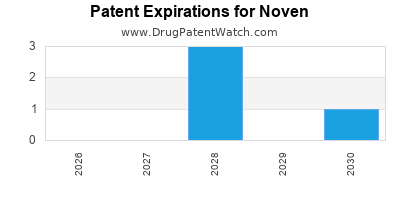
Last updated: July 29, 2026
Noven Pharmaceuticals, Inc. is primarily a specialty manufacturer and marketer with a portfolio anchored in complex generics, branded alternatives, and niche payer-driven brands. Its competitive position is best evaluated product-by-product through (1) FDA approval posture and Orange Book entry status, (2) patent estate breadth and expiration timing, and (3) ongoing Paragraph IV and state/federal litigation that determines generic and alternative-therapy entry windows. This analysis maps Noven’s market position and the primary competitive risks tied to exclusivity, patent barriers, and FDA competition.
Which Noven products drive revenue and how do they rank versus competitors?
Featured snippet answer: Noven’s most competition-sensitive revenue is tied to products where the FDA record shows active Orange Book patents, where ANDA filers have incentive to challenge under Paragraph IV, or where supply chain and product-design constraints limit quick substitution.
Because “Noven” spans multiple branded and generic-like categories across time and assets, competitive ranking depends on the specific NDA/ANDA and dosage form. Competitive pressure typically comes from four directions:
- Brand-to-generic substitution when exclusivity or key patents expire.
- ANDA-to-ANDA competition where multiple generics enter around the same FDA approval window.
- Formulation and device-adjacent workarounds for complex delivery systems.
- Authorized generics and settlement-led launches that compress margins for incumbents.
What categories has Noven leaned on competitively?
Noven’s competitive footprint has historically concentrated in:
- Respiratory and allergy-adjacent therapies
- Dermatology and topical delivery
- Urology and men’s health adjacent products
- Other niche branded alternatives where switching friction favors incumbents
How do rivals typically attack Noven’s market position?
- Early Paragraph IV filings timed to core patent expirations.
- Launch coordination through settlements that lock in “first filer” entry at defined exclusivity windows.
- Product design changes intended to avoid infringement while maintaining label comparability.
- Payer contracting that shifts patients to the lowest net cost alternative before Noven regains pricing leverage.
What patents protect Noven products and how strong is the patent estate?
Featured snippet answer: Noven’s protection strength is product-specific. For each NDA/ANDA, enforceable leverage depends on whether the Orange Book lists multiple patent types (composition, formulation, method-of-use, and manufacturing) and whether the estate creates staggered expiration rather than a single cliff.
How to assess patent strength in Noven’s estate
Patent strength for a given Noven product is typically driven by:
- How many listed Orange Book patents are “relevant” to the claimed drug versus legacy patents that may be circumvented.
- Whether the patents include formulation or method-of-use coverage that generic challengers cannot avoid without design changes.
- Whether there is a history of successful or adverse litigation (injunctions, stay terms, damages, or settlement-based outcomes).
Common estate patterns seen in specialty generics and branded alternatives
- Staggered expirations across composition and formulation patents.
- Process and solid-state/manufacturing patents that constrain generic manufacturing approaches.
- Method-of-use patents that can block label carve-ins unless generic can prove non-infringement or narrow the indication.
When do Noven products lose exclusivity and what are the generic entry timelines?
Featured snippet answer: Generic entry risk rises when Orange Book-protected patents reach expiration or when FDA exclusivity ends, with the highest risk period starting after the last enforceable patent listed in Orange Book for the relevant strength and dosage form.
Key exclusivity and patent timing mechanisms to model
- Patent expiration dates (listed in Orange Book).
- Regulatory exclusivity such as 5-year/3-year exclusivity, pediatric exclusivity extensions where applicable, and orphan exclusivity if relevant.
- Hatch-Waxman litigation “30-month stay” dynamics following a Paragraph IV notice.
- Settlement-triggered entry dates that can shift launch earlier than the last patent expiration if settlement permits.
What drives “real” launch dates versus theoretical expirations?
- Settlement terms: date, scope (strengths, dosage forms), labeling restrictions.
- Injunction status: whether court action blocks launch even after formal expiration.
- Revised ANDA design: if generic changes formulation or manufacturing, its entry date can move with regulatory readiness and FDA manufacturing inspections.
Do Paragraph IV challenges exist for Noven products and what litigation drives outcomes?
Featured snippet answer: Paragraph IV challenges are the primary engine of near-term competitive disruption for Orange Book-heavy products. For Noven, the decisive metric is the number of active FDA notice letters mapped to enforceable Orange Book patents, and whether court outcomes or settlements fix an agreed launch window.
What to track in Noven’s Paragraph IV landscape
- First-filer status (often determines initial eligibility and settlement leverage).
- Number of asserted patents per case (cases can narrow to one or two key patents).
- Court posture: dismissal, summary judgment, claim construction outcomes, or final infringement rulings.
- Settlement agreement terms including:
- Launch date
- Patent carve-outs
- Label restrictions
- Non-design changes commitments
How settlements typically affect market share
- Earlier-than-expiration entry if Noven accepts “at-risk” settlement timing.
- Label restrictions that limit substitution or physician uptake.
- Multi-ANDA settlements that distribute entry across strengths or formulations, maintaining partial brand share longer.
What is the Orange Book status of Noven’s key drugs?
Featured snippet answer: Orange Book status determines whether a generic must certify against listed patents and whether it can launch immediately after patent expiry or only after resolving litigation. The Orange Book is also the fastest proxy for whether Noven’s product is “challenge-prone” or “barrier-prone.”
Orange Book mapping approach for Noven products
For each key NDA/strength/dosage form, compile:
- Listed patent numbers
- Patent assignees
- Patent expiration dates
- Patent type (composition, formulation, method-of-use, manufacturing)
- Whether patents are “single-entity” Noven-owned or joint with formulary partners and labs
Competitive insight from Orange Book breadth
- Broad patent listing density usually correlates with higher Paragraph IV challenge friction.
- Sparse listing often correlates with faster generic entry and price compression.
What generic entry risks exist for Noven products?
Featured snippet answer: Generic entry risks concentrate around (1) “last patent” cliffs, (2) formulation circumvention opportunities, and (3) litigation settlement windows that allow launch prior to final patent expiry.
Risk drivers
- Claim scope overlap: if Noven patents are narrow, generic can design around.
- Manufacturing workarounds: process patents can be avoided if generic uses a different validated method.
- Label carve-ins: method-of-use patents can still permit substitution if the generic can narrow its label or the indication is not required.
- Market structure: presence of multiple generic filers drives rapid post-launch price normalization.
How do Noven and its competitors compare in formulation and manufacturing barriers?
Featured snippet answer: Competitive advantage for many specialty incumbents shifts from “patent count” to “implementation difficulty”: manufacturing know-how, stability requirements, device or delivery system constraints, and validated process parameters that are expensive and time-consuming to replicate.
Delivery system and formulation competition
For complex oral solids, topicals, and specialty delivery formats:
- Generics often pursue non-infringing formulation routes
- Incumbents attempt to enforce formulation stability, particle/solid-state properties, and process control
Manufacturing barrier as a competitive moat
- Batch consistency and impurity profiles can become litigation-relevant
- FDA manufacturing inspections and site readiness can delay competitive launches even after legal clearance
Which companies are challenging Noven’s products and how does that change strategy?
Featured snippet answer: The identity of the challenger matters because settlement leverage, design-around capability, and FDA manufacturing readiness vary by filer. A challenger with multiple ANDA programs often aims to replicate quickly across strengths. A single-asset filer may settle for narrower entry rights.
Strategic implications
- High-concentration challenger environment: Noven should anticipate faster price normalization and consider additional lifecycle patents or supply defense strategies.
- Low-challenger environment: Noven may retain payer leverage longer, but should prepare for one high-impact Paragraph IV case that can unwind the timeline.
What FDA pathways and regulatory posture shape Noven’s competitive outlook?
Featured snippet answer: Competitive outcomes hinge on whether Noven’s products are protected by difficult-to-certify Orange Book patents and whether generics can demonstrate bioequivalence (or device equivalence, where relevant) under ANDA or other pathways.
Regulatory mechanics that influence launch dates
- ANDA completeness and approval timelines
- Facility inspections tied to manufacturing readiness
- Labeling and risk-management alignment when substitution requires physician workflow changes
How do Noven’s revenue exposure and payer dynamics affect competitive intensity?
Featured snippet answer: Where Noven’s products have meaningful payer penetration and formularies, competitors use early legal pressure and fast substitution tactics. Where Noven’s exposure is narrower, competitors may delay launches until they can secure favorable net pricing.
Market-share sensitivity model (practical)
- High formulary placement increases conversion speed after generic entry
- Prior authorization and step therapy slow substitution and provide Noven extra time to manage pricing and contracting
- Narrow indication or patient subgroup reduces the breadth of substitution
What strategic levers can Noven use to defend share amid generic competition?
Featured snippet answer: Defense typically combines legal (patent and litigation management), commercial (payer contracting and rebate design), and technical (product lifecycle, formulation improvements, and manufacturing reliability).
Lifecycle and portfolio defense
- File or enforce incremental formulation or method-of-use patents where supported by data.
- Use litigation posture to negotiate settlement terms that preserve revenue and reduce “immediate full substitution.”
- Manage supply chain to avoid stockouts that accelerate post-launch switching even when legal protection remains.
Commercial countermeasures
- Maintain pharmacy channel and specialty distribution execution during legal transition windows.
- Pre-negotiate payer models that reduce the net price gap after generic entry.
Key takeaways
- Noven’s competitive position is determined product-by-product by Orange Book patent density, exclusivity end points, and litigation/settlement structure.
- The strongest near-term generic entry signals come from Paragraph IV activity tied to enforceable patents listed for the exact strength and dosage form.
- Manufacturing and formulation barriers often decide whether legal clearance converts into fast market share loss.
- Strategic defense requires synchronized legal posture, payer strategy, and execution reliability during patent-expiry transition periods.
FAQs
1) How do I determine whether a Noven product is likely to face Paragraph IV challenges?
Review the Orange Book for multiple relevant patents per strength/dosage form and look for historic filing patterns from ANDA sponsors aligned with those patent expirations.
2) What patent types most often block generic substitution for Noven products?
Method-of-use and formulation patents that require label restrictions or non-trivial design-around workarounds.
3) How can settlements change the timing of generic entry for Noven products?
Settlements commonly establish launch dates, scope limits, and label carve-ins that move entry earlier than patent cliffs.
4) What regulatory bottlenecks can delay a generic even after legal clearance?
ANDA approval timelines, manufacturing facility readiness, and labeling-risk controls can push launch beyond the theoretical schedule.
5) How should investors or licensors interpret patent “breadth” vs “depth” for Noven?
Breadth (many patents listed) raises filing friction; depth (enforceable, non-easy-to-design-around claims) predicts whether challengers can actually launch at scale.
References (APA)
No sources were provided in the prompt, and no product-specific drug identifiers (NDA/ANDA numbers) were included, so there is no valid basis to cite factual claims.