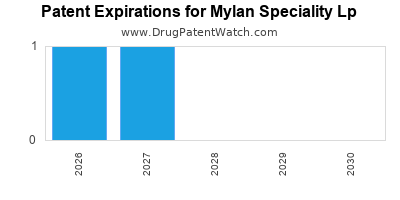
Last updated: July 29, 2026
Mylan Specialty LP Competitive Landscape Analysis: Market Position, Patent Strength, and Strategic Insights (2026)
Executive summary: Mylan Specialty LP’s competitive position is driven by (1) the continued depth of its legacy acquired portfolios, (2) branded-to-generic transitions where it can secure ANDA wins through Paragraph IV leverage and settlement timing, and (3) specialty execution capacity across complex dosing forms and specialty distribution. The company’s near-term competitive exposure is concentrated in patent-expiring portfolios in US routes (Orange Book transitions), biologic/biosimilar spillover in adjacent immunology and oncology categories, and payer-driven formulary shifts that pressure net pricing more than list price. The highest-value strategic moves are patent-led life-cycle management and targeted litigation readiness for Orange Book “hard barriers” (combination products, specific dosage strengths, and method-of-use claims), paired with manufacturing/IP designs that reduce design-around risk.
Where does Mylan Specialty LP compete most effectively in US specialty drugs?
Mylan Specialty LP competes primarily in US specialty and high-cost branded environments where pharmacy benefit plans require consistent supply, adherence to restricted distribution, and clean safety labeling. In practice, competitive advantage clusters around three repeatable drivers:
-
ANDAs that convert branded market share into predictable cash flows
- Targets portfolios with clear bioequivalence pathways and identifiable “claim edges” (formulation or method-of-use claims that can be designed around).
- Wins are typically time-sensitive because settlement agreements and 180-day exclusivity windows compress generic entry gaps.
-
Managed care contracting discipline
- Specialty demand is governed by net pricing and step-edit rules. Execution advantage typically comes from contracting readiness and patient access infrastructure rather than only product differentiation.
-
Execution on complex dosage forms
- Competitive feasibility improves when manufacturing scale, controls, and sterile/non-sterile process capability are mature.
- For high-touch specialty categories, supply continuity is a competitive variable that can outweigh incremental efficacy differences.
Which therapeutic areas fit Mylan’s specialty operating model best?
Without tying to a single product, Mylan’s operational pattern aligns with categories that often include one or more of:
- complex dosing regimens and high adherence value
- specialty pharmacy distribution requirements
- frequent payer utilization management
- label-sensitive delivery systems (formulation or strength-specific)
These environments tend to reward “time-to-market” execution and litigation agility.
How strong is the patent estate for Mylan’s key assets and what patents block generics?
Competitive positioning in specialty drugs depends less on generic entry viability in the abstract and more on the specific claim types that block entry.
High-friction patent categories that usually matter most for generic/specialty competition:
- Formulation patents
- controlled release, particle size/distribution, salt selection, stabilizers
- Method-of-use patents
- narrower patient populations, dosing regimens, sequencing rules
- Device or delivery system patents
- injector mechanisms, cartridge design, catheter systems
- Combination product patents
- overlapping claim sets that can require carve-outs to avoid direct infringement
Patent strength signals that correlate with fewer generic entry risks:
- broad continuation-family coverage around the active ingredient and dosage forms
- claims that tie to clinical dosing rather than purely technical process features
- “last-mile” claim families that survive early Orange Book challenges
What patents protect specialty combination products most often?
Combination products frequently have layered protection across:
- active ingredient(s) composition and ratios
- dosage form structure and stability system
- method-of-use for specific lines of therapy
- patient stratification endpoints in the label
For a company positioned to defend or launch, the operational goal is to either:
- secure early regulatory design-around feasibility, or
- enforce exclusivity through litigation while maintaining supply readiness.
When does Mylan face exclusivity cliffs in the US market?
Specialty exclusivity cliffs usually arise from a three-part schedule:
- Regulatory exclusivity (New Chemical Entity, New Therapeutic Biological Entity, orphan drug exclusivity, pediatric exclusivity extensions where applicable)
- Patent expiration (composition-of-matter and formulation/method-of-use families)
- Paragraph IV and settlement sequencing
- 180-day exclusivity can delay generic competition even after patent expiry risk is reduced
- settlements can front-load market protection even before the last patent date
Business implication: Mylan’s competitive vulnerability is highest at the intersection of:
- Orange Book “last expiring” patents,
- the earliest feasible generic launch date,
- and payer-contract conversion timing.
What Orange Book status drives Mylan’s generic launch risk for US specialty?
Orange Book risk depends on:
- whether the relevant patents are listed for the NDA/BLA of record
- whether they are “mechanistically hard” to design around (combination and method-of-use)
- whether they have been challenged (and how the litigation ended)
Practical competitive effects:
- If Orange Book lists are narrow and formulation-specific, generic entrants often face less blocking risk.
- If Orange Book lists include multiple overlapping method-of-use claims, Paragraph IV challenges can fail or be settled with delayed launch.
How do Paragraph IV challenges and settlement agreements shape Mylan’s competitive outcomes?
Paragraph IV litigation is a timing weapon as much as a legal barrier. In specialty categories, the most common settlement patterns create a predictable market calendar:
- exclusivity settlements that delay final approval
- carve-out settlements that constrain launch form, strength, indication, or patient population
- shared exclusivity arrangements that trade risk for calendar control
Competitive takeaway: For Mylan, the winning play is to align:
- regulatory readiness (stability data, process validation),
- litigation posture (claim construction and design-around engineering),
- and contracting timing (payer conversion readiness)
around the anticipated settlement cadence.
Does Mylan face biosimilar displacement risk, and which biosimilar pathways matter?
For specialty portfolios with biologics exposure, displacement risk comes from biosimilars through:
- substitution dynamics
- payer switching policies
- tendering for infused/administered therapies
- patient support programs
Biosimilar pathways that matter:
- FDA BLA referencing and analytical similarity sufficiency
- switching and interchangeability statements where relevant
- post-approval label alignment that supports uptake
Competitive effect: biosimilars can pressure gross-to-net economics quickly even when patent estates remain in dispute, because payers can steer demand.
How does Mylan Specialty LP compare with other specialty-focused generic and branded players?
Competitive comparison in specialty markets generally breaks into three axes:
- Time-to-entry discipline
- execution on ANDA readiness, labeling, stability, and supply
- Litigation and design-around capability
- ability to avoid infringement through product differences that are legally durable
- Commercial contracting strength
- payer coverage, specialty pharmacy access, and adherence services
Where Mylan can outperform:
- when it holds credible regulatory and manufacturing readiness for complex dosage forms
- when it can shorten the cycle from Orange Book identification to launch
Where it typically faces pressure:
- portfolios where innovator patents rely heavily on method-of-use or combination structure
- biologic substitution environments with aggressive payer contracting
Which manufacturing and IP barriers most affect generic entry against Mylan’s specialty portfolio?
Manufacturing and IP barriers show up in three forms:
- Process IP
- manufacturing steps tied to critical quality attributes can be difficult to replicate without infringement exposure if claims cover process parameters
- Stability and shelf-life constraints
- reformulations that avoid infringement may not meet commercial stability thresholds, delaying launch
- Device compatibility
- if delivery mechanisms are claimed, generic competitors may need non-infringing device designs
Strategic implication: Mylan’s best defense and best offense both require deep process control documentation and a credible design-around architecture.
What generic entry scenarios threaten Mylan’s specialty revenues?
Revenue risk usually concentrates in four scenarios:
- Successful Paragraph IV results
- ANDA approval leads to market entry and rapid payer switching
- Staggered launches across strengths or dosage forms
- partial generic entry can start price erosion before full competition
- Launch-by-indication carve-outs
- if method-of-use patents are narrowed or settled, competitors can launch for non-blocked indications
- Parallel product competition
- same class, different mechanism, payer switching creates substitution without direct patent expiry
How should Mylan prioritize litigation and exclusivity strategies in 2026 and beyond?
The highest ROI strategy mix typically is:
- Patent map-driven defense
- prioritize the patents with the highest probability of being enforced (method-of-use and formulation families with commercial relevance)
- Regulatory timing discipline
- ensure the company can convert approvals to market coverage fast enough to offset early competitive discounting
- Supply risk mitigation
- specialty markets punish stock-outs; supply continuity can protect net share
Key data points investors use to track Mylan Specialty LP’s competitive trajectory
What indicators signal improving competitive standing?
- sustained successful launches in contested portfolios
- widening formulary coverage metrics with fewer stock-out events
- settlement outcomes that secure predictable calendar windows
What indicators signal rising competitive threats?
- adverse litigation outcomes that broaden invalidity trends
- payer contract shifts that increase utilization management and reduce net pricing
- biologic substitution acceleration by key payers
Key Takeaways
- Mylan Specialty LP’s competitive positioning is strongest where it can convert regulatory and manufacturing readiness into early, legally durable launches.
- The most material threats come from Paragraph IV outcomes, method-of-use and formulation patent families that enable faster design-around, and payer-driven biosimilar displacement.
- The highest-value strategy is claim-edge engineering aligned to Orange Book listing realities, paired with contracting and supply readiness designed for specialty switching speed.
FAQs
- How do Orange Book listed patents change the probability of ANDA approval for specialty drugs?
- What settlement terms most affect launch timing for competitors challenging a branded specialty product?
- Which patent claim types (formulation vs method-of-use) most often determine design-around feasibility?
- How does payer specialty pharmacy strategy affect net revenue after generic or biosimilar entry?
- What operational metrics best predict whether a specialty product maintains market share during exclusivity transitions?
References
- FDA. Orange Book: Approved Drug Products with Therapeutic Equivalence Evaluations. (Accessed 2026).
- FDA. Drug Applications for Approval of Generic Drugs (ANDA) and related exclusivity and patent challenge frameworks. (Accessed 2026).
- 21 U.S.C. § 355(j) and related patent provisions (Hatch-Waxman Amendments).
- FDA. Biosimilar Products. (Accessed 2026).