Melinta Company Profile
✉ Email this page to a colleague
What is the competitive landscape for MELINTA
MELINTA has five approved drugs.
There are seventeen US patents protecting MELINTA drugs.
Summary for Melinta
| US Patents: | 17 |
| Tradenames: | 4 |
| Ingredients: | 3 |
| NDAs: | 5 |
| Patent Litigation for Melinta: | See patent lawsuits for Melinta |
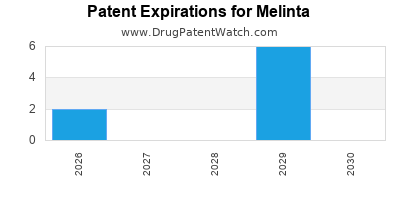
Drugs and US Patents for Melinta
| Applicant | Tradename | Generic Name | Dosage | NDA | Approval Date | TE | Type | RLD | RS | Patent No. | Patent Expiration | Product | Substance | Delist Req. | Exclusivity Expiration |
|---|---|---|---|---|---|---|---|---|---|---|---|---|---|---|---|
| Melinta | BAXDELA | delafloxacin meglumine | TABLET;ORAL | 208610-001 | Jun 19, 2017 | RX | Yes | Yes | ⤷ Start Trial | ⤷ Start Trial | |||||
| Melinta | BAXDELA | delafloxacin meglumine | TABLET;ORAL | 208610-001 | Jun 19, 2017 | RX | Yes | Yes | RE46617 | ⤷ Start Trial | Y | ⤷ Start Trial | |||
| Melinta | BAXDELA | delafloxacin meglumine | POWDER;INTRAVENOUS | 208611-001 | Jun 19, 2017 | RX | Yes | Yes | 12,558,349 | ⤷ Start Trial | ⤷ Start Trial | ||||
| Melinta Therap | ORBACTIV | oritavancin diphosphate | POWDER;INTRAVENOUS | 206334-001 | Aug 6, 2014 | RX | Yes | Yes | 9,649,352 | ⤷ Start Trial | Y | ⤷ Start Trial | |||
| Melinta Therap | KIMYRSA | oritavancin diphosphate | POWDER;INTRAVENOUS | 214155-001 | Mar 12, 2021 | RX | Yes | Yes | 8,420,592 | ⤷ Start Trial | ⤷ Start Trial | ||||
| Melinta | BAXDELA | delafloxacin meglumine | TABLET;ORAL | 208610-001 | Jun 19, 2017 | RX | Yes | Yes | 8,871,938 | ⤷ Start Trial | Y | ⤷ Start Trial | |||
| Melinta | BAXDELA | delafloxacin meglumine | POWDER;INTRAVENOUS | 208611-001 | Jun 19, 2017 | RX | Yes | Yes | 9,200,088 | ⤷ Start Trial | Y | ⤷ Start Trial | |||
| >Applicant | >Tradename | >Generic Name | >Dosage | >NDA | >Approval Date | >TE | >Type | >RLD | >RS | >Patent No. | >Patent Expiration | >Product | >Substance | >Delist Req. | >Exclusivity Expiration |
Expired US Patents for Melinta
| Applicant | Tradename | Generic Name | Dosage | NDA | Approval Date | Patent No. | Patent Expiration |
|---|---|---|---|---|---|---|---|
| Melinta Therap | TOPROL-XL | metoprolol succinate | TABLET, EXTENDED RELEASE;ORAL | 019962-001 | Jan 10, 1992 | 3,998,790 | ⤷ Start Trial |
| Melinta Therap | TOPROL-XL | metoprolol succinate | TABLET, EXTENDED RELEASE;ORAL | 019962-003 | Jan 10, 1992 | 3,876,802 | ⤷ Start Trial |
| Melinta | BAXDELA | delafloxacin meglumine | POWDER;INTRAVENOUS | 208611-001 | Jun 19, 2017 | 8,273,892 | ⤷ Start Trial |
| Melinta | BAXDELA | delafloxacin meglumine | TABLET;ORAL | 208610-001 | Jun 19, 2017 | 9,539,250 | ⤷ Start Trial |
| Melinta | BAXDELA | delafloxacin meglumine | TABLET;ORAL | 208610-001 | Jun 19, 2017 | 8,648,093 | ⤷ Start Trial |
| Melinta | BAXDELA | delafloxacin meglumine | TABLET;ORAL | 208610-001 | Jun 19, 2017 | 8,969,569 | ⤷ Start Trial |
| Melinta | BAXDELA | delafloxacin meglumine | POWDER;INTRAVENOUS | 208611-001 | Jun 19, 2017 | 9,539,250 | ⤷ Start Trial |
| >Applicant | >Tradename | >Generic Name | >Dosage | >NDA | >Approval Date | >Patent No. | >Patent Expiration |
International Patents for Melinta Drugs
| Country | Patent Number | Estimated Expiration |
|---|---|---|
| Poland | 3214083 | ⤷ Start Trial |
| Taiwan | I641372 | ⤷ Start Trial |
| Japan | 2016166368 | ⤷ Start Trial |
| Israel | 208956 | ⤷ Start Trial |
| Israel | 208956 | ⤷ Start Trial |
| Japan | 6276828 | ⤷ Start Trial |
| Spain | 2994966 | ⤷ Start Trial |
| >Country | >Patent Number | >Estimated Expiration |
Supplementary Protection Certificates for Melinta Drugs
| Patent Number | Supplementary Protection Certificate | SPC Country | SPC Expiration | SPC Description |
|---|---|---|---|---|
| 3214083 | 21C1006 | France | ⤷ Start Trial | PRODUCT NAME: DELAFLOXACINE; REGISTRATION NO/DATE: EU/1/19/1393 20191219 |
| 2337575 | SPC/GB16/054 | United Kingdom | ⤷ Start Trial | PRODUCT NAME: ORITAVANCIN AND PHARMACEUTICALLY ACCEPTABLE SALTS THEREOF, SPECIFICALLY ORITAVANCIN DIPHOSPHATE.; REGISTERED: UK EU/1/15/989/001 20150323 |
| 2337575 | CA 2016 00044 | Denmark | ⤷ Start Trial | PRODUCT NAME: ORITAVANCIN OG/ELLER FARMACEUTISKE SALTE HERAF, HERUNDER DIFOSFATSALTE; REG. NO/DATE: EU/1/15/989 20150323 |
| 3214083 | 202140002 | Slovenia | ⤷ Start Trial | PRODUCT NAME: DELAFLOXACINE OR ITS SALT OR ESTER INCLUDING DELAFLOXACINE MEGLUMIN; NATIONAL AUTHORISATION NUMBER: EU/1/19/1393; DATE OF NATIONAL AUTHORISATION: 20191216; AUTHORITY FOR NATIONAL AUTHORISATION: EU |
| 3214083 | C20210002 00366 | Estonia | ⤷ Start Trial | PRODUCT NAME: DELAFLOKSATSIIN;REG NO/DATE: EU/1/19/1393 19.12.2019 |
| 3214083 | 5/2021 | Austria | ⤷ Start Trial | PRODUCT NAME: DELAFLOXACIN ODER EIN SALZ ODER ESTER DAVON, EINSCHLIESSLICH DELAFLOXACIN-MEGLUMIN; REGISTRATION NO/DATE: EU/1/19/1393 (MITTEILUNG) 20191219 |
| 2337575 | 1690041-7 | Sweden | ⤷ Start Trial | PRODUCT NAME: ORITAVANCIN ELLER ETT FARMACEUTISKT GODTAGBART SALT DAERAV; FIRST MARKETING AUTHORIZATION NUMBER SE: EU/1/15/989, 2015-03-23 |
| >Patent Number | >Supplementary Protection Certificate | >SPC Country | >SPC Expiration | >SPC Description |
Similar Applicant Names
Applicants may be listed under multiple names.
Here is a list of applicants with similar names.
Here is a list of applicants with similar names.
