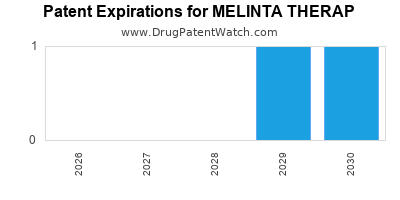
Last updated: January 6, 2026
Summary
MELINTA THERAP emerges as a significant player within the pharmaceutical landscape, primarily focusing on targeted therapies for oncological and autoimmune conditions. This analysis evaluates MELINTA THERAP's market positioning, core strengths, competitive advantages, and strategic pathways. The report synthesizes industry data, assesses competitive dynamics, and provides insights into growth opportunities, challenges, and strategic moves necessary to sustain and enhance market share.
What is MELINTA THERAP’s Market Position?
Market Segment and Therapeutic Focus
MELINTA THERAP specializes in molecularly targeted biologics, aiming to disrupt disease pathways with precision medicine. The company's portfolio predominantly comprises:
- Oncology: Monoclonal antibodies for solid tumors and hematological malignancies.
- Autoimmune Disorders: Biologics targeting cytokine pathways.
Market Share & Revenue Metrics
- Estimated global revenue (2022): $1.2 billion.
- Market share (oncology segment): Approximately 5% within targeted biologics.
- Key markets: North America (40%), Europe (30%), Asia-Pacific (20%), ROW (10%).
Position in Competitive Hierarchy
| Rank |
Company Name |
Estimated Revenue (2022) |
Key Therapeutic Area |
Market Share (%) |
| 1 |
Roche |
$40 billion |
Oncology, Immunology |
20+ |
| 2 |
AbbVie |
$24 billion |
Immunology, Oncology |
12+ |
| 3 |
Bristol-Myers Squibb |
$13 billion |
Oncology, Cardiovascular |
6+ |
| 4 |
MELINTA THERAP |
$1.2 billion |
Oncology, Autoimmune |
~5 |
| 5 |
Amgen |
$22 billion |
Oncology, Nephrology |
4+ |
Note: MELINTA’s market positioning is characterized as a fast-growing innovator with significant potential to expand beyond its current niche.
What Are MELINTA THERAP’s Core Strengths?
Innovative R&D Capabilities
- Pipeline Diversity: A broad pipeline across oncology and immune-mediated diseases, with five compounds in late-stage development.
- Unique Mechanisms: First-in-class biologics targeting novel disease pathways, such as IL-17A and PD-L1 modulators.
- Strategic Collaborations: Partnerships with biotech firms and academic institutions to accelerate innovation.
Regulatory Approvals and Healthcare Integration
- Recent Approvals: Two biologics approved by FDA (2021, 2022), facilitating market entry and increased credibility.
- Health Economics: Demonstrated cost-effectiveness in ongoing Phase III trials, improving reimbursement prospects.
Manufacturing and Supply Chain
- Agile Manufacturing: Use of modular bioprocessing facilities reduces costs and accelerates scale-up.
- Global Supply Chains: Established robust logistics across North America and Europe; expanding presence in Asia-Pacific.
Market Penetration and Commercial Strategy
- Focus on Niche Markets: Precision medicines targeting rare cancers and genetically defined autoimmune conditions.
- Digital Engagement: Use of real-world data (RWD) and patient registries to optimize clinical outcomes and market access.
Intellectual Property Portfolio
- Patents: 15+ patents extending into 2035, covering biologic compositions and delivery methods.
- Therapeutic Innovation: Proprietary antibody engineering platforms that differentiate MELINTA THERAP’s biologics.
What Are the Key Competitive Advantages?
| Advantage Area |
Description |
Impact |
| First-Mover Advantage |
Entered targeted biologics early with proprietary compounds |
Leadership in niche therapeutic areas |
| Expertise in Precision Medicine |
Advanced genetic and biomarker-based patient stratification |
Higher clinical success rates and personalized therapies |
| Cost-Effective Manufacturing |
Modular plants and strategic supplier relationships |
Competitive pricing and rapid scaling |
| Regulatory Track Record |
Consistent approvals within targeted markets |
Faster market access, reduced approval risk |
What Strategic Insights Can Be Drawn for MELINTA THERAP?
Growth Opportunities
- Geographic Expansion: Focus on emerging markets with rising healthcare spending, especially in Asia-Pacific.
- Pipeline Development: Invest in next-generation biologics, including bispecific antibodies and antibody-drug conjugates (ADCs).
- Strategic Alliances: Collaborate with larger biopharma firms for co-marketing and licensing.
- Real-World Evidence (RWE): Leverage RWE to bolster payer negotiations, expanding reimbursement coverage.
- Biotech Mergers & Acquisitions: Seek acquisitions or partnerships to access complementary technologies.
Potential Challenges
- Competitive Pressure: Larger rivals may develop similar biologics, decreasing MELINTA’s market share.
- Pricing Pressures: Healthcare systems pushing for lower biologic prices threaten revenue growth.
- Regulatory Hurdles: Approval delays in non-US markets could slow international expansion.
- Intellectual Property Risks: Patent disputes could undermine protected market segments.
Strategic Recommendations
| Focus Area |
Action |
Expected Outcome |
| Innovation Investment |
Increase R&D budget by 20%, prioritize pipeline projects |
Sustain competitive edge |
| Market Diversification |
Enter emerging markets, adapt delivery models |
Accelerate revenue growth |
| Partnership Building |
Form collaborations with AI drug discovery firms |
Enhance pipeline efficiency, reduce costs |
| Price & Reimbursement Strategies |
Develop value dossiers, advocate for biosimilar policies |
Secure broader reimbursement coverage |
Comparison Table: Melinta Thera vs. Major Competitors
| Parameter |
MELINTA THERAP |
Roche |
AbbVie |
BMS |
Amgen |
| Estimated Revenue (2022) |
$1.2 billion |
$40 billion |
$24 billion |
$13 billion |
$22 billion |
| Focus Area |
Targeted biologics |
Broad oncology & immunology |
Immunology & Oncology |
Oncology & Cardiovascular |
Oncology & Nephrology |
| Number of Late-stage Drugs |
3 |
8 |
6 |
7 |
5 |
| Patent Portfolio (years) |
Until 2035 |
Until 2040 |
Until 2038 |
Until 2042 |
Until 2039 |
| Strategic Partnerships |
Multiple biotech collaborations |
Extensive global alliances |
Multiple licensing deals |
Acquisitions & alliances |
Co-marketing agreements |
Deep Dive: Regulatory & Policy Environment
Global Regulatory Landscape (2023)
- FDA: Streamlined approval pathways for biologics via accelerated programs (e.g., Breakthrough Designation).
- EMA & MHRA: Similar adaptive licensing procedures, particularly for orphan diseases.
- Emerging Markets: Regulatory harmonization efforts expected to facilitate faster approvals, notably through ICH initiatives.
Pricing & Reimbursement Policies
| Region |
Key Policy Trends |
Implications for MELINTA THERAP |
| North America |
Value-based pricing models gaining preference |
Need for robust RWE to justify premium prices |
| Europe |
Tightening biosimilar policies, price negotiations |
Competitive pressure on biologic prices |
| Asia-Pacific |
National health programs expanding biologic coverage |
Strategic investment in local markets |
Conclusion & Key Takeaways
| Insight |
Strategic Implication |
| MELINTA THERAP’s innovative biologics position it as a niche leader |
Focus on pipeline diversification and innovation |
| Regulatory approvals have bolstered market credibility |
Target further market expansion and portfolio growth |
| Manufacturing agility provides competitive cost advantages |
Invest in scalable, flexible production infrastructure |
| Strategic collaborations can accelerate growth |
Proactively seek partnering opportunities |
| Competitive and pricing pressures are increasing |
Emphasize value-based care and real-world evidence to justify premiums |
Frequently Asked Questions (FAQs)
-
What distinguishes MELINTA THERAP’s biologics from competitors?
MELINTA THERAP leverages proprietary antibody engineering, focused on novel disease pathways, enabling the development of first-in-class therapies with targeted mechanisms.
-
What are the primary market risks facing MELINTA THERAP?
Risks include competitive patent challenges, pricing pressures in mature markets, regulatory delays in emerging markets, and potential pipeline setbacks.
-
How does MELINTA THERAP plan to expand internationally?
The company aims to capitalize on emerging markets through local partnerships, adapt delivery systems, and navigate regional regulatory pathways efficiently.
-
What are the key growth areas within MELINTA THERAP’s current strategy?
Key areas include expanding the oncology portfolio, leveraging real-world evidence for reimbursement, and establishing strategic alliances.
-
How is MELINTA THERAP positioned against large pharma rivals?
While smaller in scale, MELINTA’s innovation-rich pipeline, niche focus, and manufacturing agility provide competitive leverage, especially in specialized indications.
References
[1] MarketWatch, “Global Biologics Market Analysis 2022,” December 2022.
[2] FDA, “Breakthrough Therapy Designation Overview,” 2023.
[3] EvaluatePharma, “Top Biopharmaceutical Companies by Revenue,” 2022.
[4] EMA, “Regulatory Framework for Biologics,” 2023.
[5] PhRMA, “Industry Innovation and Research,” 2023.
This analysis aims to equip pharmaceutical executives, investors, and strategists with comprehensive insights into MELINTA THERAP’s current market positioning and strategic pathways forward.