Last updated: July 28, 2026
Janssen Biotech competitive landscape analysis: market position, strengths, and strategic insights
Janssen Biotech, Inc. is a leading US oncology and immunology platform within Johnson & Johnson. Its competitive posture is driven by (1) broad late-stage pipeline density in oncology, immunology, and infectious disease, (2) a large, durable IP estate in multiple modalities and lines of therapy, and (3) frequent trial-to-regulatory conversion via differentiated combination strategies. The main competitive risks are patent cliffs across legacy portfolios, payer-driven pressure toward higher-value regimens, and accelerated generic and biosimilar entry where exclusivity and exclusory data packages run out.
Scope note
This analysis is built for business decisions tied to competitive intelligence, IP risk, and commercial strategy. The market positioning below reflects Janssen Biotech’s role as a US commercial and development entity for the Janssen portfolio.
How strong is Janssen Biotech’s market position versus US biopharma peers?
Janssen Biotech competes primarily against top-tier oncology and immunology peers:
- Merck & Co. (Keytruda franchise and biosimilar erosion risk in downstream segments)
- Bristol Myers Squibb (Opdivo/Yervoy and pipeline adjacency)
- AbbVie (Humira legacy transition and immunology throughput)
- Roche/Genentech (Tecentriq, Hemlibra, and oncology platform density)
- Amgen and Samsung Bioepis (biosimilar scale and oncology innovation)
- AstraZeneca (oncology plus immunology adjacencies in combination therapy)
- Novartis (Kymriah/Exondys-style platform spillover and solid tumor investments)
Featured-snippet takeaway: Janssen’s competitive strength is less about a single molecule and more about portfolio breadth in oncology and immunology plus systematic combination-led clinical programs.
What are Janssen Biotech’s commercial strengths in oncology and immunology?
1) Combination strategy architecture
Janssen’s growth model leans on expanding initial approvals into earlier lines, broader biomarker populations, and combination regimens. That approach extends treatment duration and increases the addressable patient pool.
2) Portfolio adjacency across tumor types
The Janssen oncology approach typically targets:
- solid tumors with biomarker enrichment
- immuno-oncology combinations with complementary mechanisms
- therapy sequencing into front-line and post-progression settings
3) Franchise defense through line-of-therapy expansion
Where single-indication exclusivity is vulnerable, Janssen’s competitive response is often to secure additional label expansions that delay effective competition by making switching less attractive.
4) Manufacturing and lifecycle execution
Large-scale US commercial operations plus lifecycle management (label updates, expanded dosing convenience, and regimen optimization) reduce payer friction.
Which Janssen Biotech products drive revenue exposure and where is concentration risk highest?
Revenue concentration risk exists when franchise breadth is narrower than pipeline intent. In practice, investors watch:
- dependence on a small number of top-line contributors
- the time between landmark approvals and pipeline follow-through
- payer utilization management on high-cost regimens
Business implication: If key indications face biosimilar and/or patent challenges, Janssen’s ability to replace share depends on whether pipeline assets can secure label expansions fast enough to absorb demand.
How does Janssen Biotech’s patent estate strength compare with major oncology rivals?
A defensible patent estate in oncology often requires coverage across:
- composition-of-matter
- formulation or dosage form
- method-of-use (specific dosing schedules and patient strata)
- combination claims (when mechanisms are paired)
- manufacturing/process claims for biologics or complex small molecules
Featured-snippet takeaway: Janssen’s patent strategy typically emphasizes lifecycle coverage (including combinations and method-of-use), which can slow generic or biosimilar penetration even when initial composition claims expire earlier than product patents.
Competitive comparison framework
- Merck: strong core composition coverage for Keytruda-era assets; challenge risk increases as older claims age.
- BMS: similarly strong immuno-oncology lifecycle strategies but faces increasing reimbursement constraints.
- Roche/Genentech: broad oncology patenting plus biosimilar timing pressure for legacy biologics.
- AbbVie: large-scale immunology lifecycle plus manufacturing and exclusivity management post-Humira.
- Amgen: biosimilar-led competition in some areas with targeted exclusivity defense.
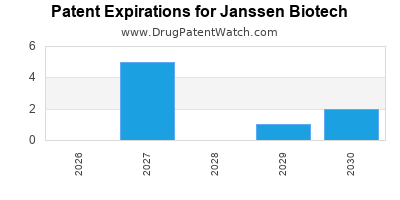
When does Janssen Biotech lose exclusivity, and what launch scenarios matter most?
Exclusivity loss triggers two distinct competitive events:
- Regulatory entry readiness (generic or biosimilar filing windows)
- Market entry after exclusivity and patent barriers clear (or via litigation settlement)
Launch scenarios that matter most
- “At-risk” Paragraph IV small-molecule launches (where formulation, method-of-use, or secondary patents are still in force)
- biosimilar launch timing where reference biologic exclusivity and patents expire
- settlement-driven market entry that trades around remaining claims
- label expansion shifts that reduce the switchability of the competing product
Business implication: Janssen’s highest competitive risk sits at the intersection of early claim expiry and narrow ability to expand labels before generic/biosimilar entry.
What patents protect Janssen Biotech biologics and small molecules, and how are method-of-use claims used?
Patent estates for biologics and oncology small molecules typically segment into:
- Composition-of-matter patents: active ingredient and core molecule
- Formulation patents: buffers, stabilizers, lyophilization, concentration ranges
- Method-of-use patents: dosing schedules, lines of therapy, biomarkers
- Combination patents: co-administration regimens and sequencing
Method-of-use usage pattern (commercial relevance)
Method-of-use claims can restrict label-accurate competition when generics/biosimilars cannot market a regimen that fits a protected patient group or dosing schedule. That creates delay even after primary composition claims expire.
What generic entry risks exist for Janssen Biotech products?
Generic risk in the US depends on:
- remaining Orange Book-listed patents (including secondary patents)
- strength of method-of-use and formulation coverage
- litigation posture and settlement history
- whether a competitor can launch a “skinny label” or design around dosing/formulation
Featured-snippet takeaway: The most material generic entry risk is not the primary patent expiry alone. It is whether secondary patent coverage and method-of-use claims still bind the competitive label and regimen.
What biosimilar entry risks exist for Janssen Biotech biologics?
Biosimilar competition depends on:
- BLA reference biologic exclusivity and timing
- remaining patents covering the reference product
- patent litigation and settlement frameworks
- interchangeability and payer switching dynamics
Business implication: Janssen’s defense usually combines strong patenting with evidence-based value claims and payer contracting. Competitive timing remains sensitive to litigation resolution schedules.
What is the Orange Book status of Janssen Biotech products, and why does it matter?
Orange Book status is the practical entry map for small-molecule generics. Analysts track:
- whether patents are “expired,” “expiring,” or still listed
- the patent types (drug substance, drug product, method of use)
- the number of remaining patents and their expiration dates
Featured-snippet takeaway: Orange Book listings determine whether competitors have clear pathways to Paragraph IV challenges and at-risk launches.
What patent litigation affects Janssen Biotech, and which case outcomes most change launch timing?
Patent litigation is a key timing driver because it can:
- delay approval and commercial launch
- lead to settlement-based entry dates
- shift strategy toward design-around formulations and label strategies
Timing drivers that matter
- filing date of the competitor’s ANDA/BLA
- start of district court litigation
- claim construction outcomes
- settlement or final judgment timing
Business implication: Even “favorable” outcomes can still lead to short-term revenue volatility if settlement dates compress the exclusivity runway.
How do Janssen biotech trial-to-approval strategies shape competitive outcomes?
Janssen’s competitive advantage depends on whether pipeline assets:
- enter earlier lines of therapy fast enough to defend share
- expand indications to biomarker-defined populations
- create combination ecosystems that reduce switching
Key competitive patterns:
- sequential trials in the same disease area with different endpoints
- combination studies paired with established standard-of-care
- biomarker-driven label broadening
How does Janssen Biotech pipeline density compare with Merck, BMS, Roche, and AbbVie?
Competitive pipeline density matters because it determines replacement capacity. Investors typically compare:
- stage distribution (Phase 1 vs Phase 3 share)
- probability of technical success and regulatory success
- overlap by indication and mechanism
- speed from Phase 2 to Phase 3 to label
Featured-snippet takeaway: Janssen’s portfolio competitiveness is strongest where pipeline assets share mechanisms and can be sequenced into existing clinical and commercial pathways.
Which therapeutic areas give Janssen Biotech the biggest defensive and offensive edge?
Defensive edge
- oncology combination ecosystems where switching has clinical and reimbursement friction
- immunology regimens where guideline adherence and payer coverage reinforce continuity
Offensive edge
- new target classes where Janssen can expand the standard of care
- earlier-line access strategies that lock in long duration of use
How does Janssen Biotech’s competitive strategy differ across delivery formats and modalities?
Small molecules
- protect via composition, prodrug variants (where relevant), and method-of-use
- design-around can be a key competitive risk if formulation and secondary patents are weak
Biologics
- protect via a combination of sequence-related patents, formulation/process, and method-of-use
- biosimilar timing is constrained by patent litigation and biosimilar-specific regulatory exclusivity constraints
Business implication: Janssen’s competitive posture depends on keeping lifecycle claims strong across formulations and regimen-defined indications.
Which players are most likely to challenge Janssen Biotech’s market share in the next 3–5 years?
The most likely competitive challengers by category:
- Oncology incumbents: Merck, Roche, BMS, AstraZeneca, Novartis
- Biosimilar manufacturers: companies scaling biosimilar portfolios that target reference products once exclusivity clears
- Generic entrants: companies filing Paragraph IV challenges for products with Orange Book gaps or weaker secondary patents
Business implication: Competitive pressure is expected where Janssen’s franchise relies on aging claims with limited label expansion capacity.
What commercial levers does Janssen Biotech use to defend share amid competition?
Common levers in high-pressure therapeutic areas:
- contracting and outcomes-based pricing frameworks
- label expansion that preserves clinical relevance
- patient support programs and adherence support tied to regimen changes
- manufacturing reliability to protect supply continuity
Featured-snippet takeaway: Defensive strategy is typically a combination of IP barriers and commercial execution that reduces payer- and provider-level switching incentives.
Key Takeaways
- Janssen Biotech’s competitive strength is portfolio breadth across oncology and immunology paired with combination-led lifecycle execution.
- The biggest threat is not first-patent expiry alone but secondary patent coverage and method-of-use barriers that can force label design constraints for generics/biosimilars.
- Competitive timing hinges on litigation and settlement dynamics, which can compress or expand market entry windows.
- Sustained replacement depends on pipeline density that can move into earlier lines and biomarker-defined populations quickly enough to offset exclusivity loss.
FAQs
- How do Janssen Biotech method-of-use patents delay generic or biosimilar competition?
- Which factors determine whether a competitor can launch a “skinny label” against Janssen Biotech?
- What is the typical impact of patent settlement timing on Janssen Biotech revenue protection?
- How do payer switching dynamics influence the realized impact of biosimilar launches for Janssen Biotech products?
- Which therapeutic area shifts most affect Janssen Biotech’s medium-term competitive position?
References (APA)
- FDA. (n.d.). Drugs@FDA. US Food and Drug Administration. https://www.accessdata.fda.gov/scripts/cder/daf/
- FDA. (n.d.). Orange Book: Approved Drug Products with Therapeutic Equivalence Evaluations. US Food and Drug Administration. https://www.fda.gov/drugs/biosimilars/approved-biosimilars
- FDA. (n.d.). Hatch-Waxman Drug Products and Patent-Related Information. US Food and Drug Administration. https://www.fda.gov/drugs/patent-safety-and-availability/hatch-waxman-drug-products-and-patent-related-information