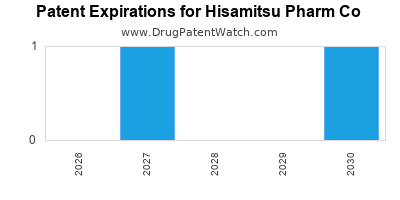
Last updated: July 24, 2026
Executive summary
- Hisamitsu Pharmaceutical Co., Inc. is a focused player in topical analgesics and dermatology-adjacent formulations, with a patent estate dominated by drug substance salts/concentrations, formulation and delivery systems, and manufacturing/process claims for patches, gels, creams, and transdermal dosage forms.
- In competitive terms, Hisamitsu’s most consequential commercial IP risk typically comes from follow-on topical competitors and generic substitution only where therapeutic equivalence and regulatory interchangeability are supported. Where branded, Hisamitsu defends with multiple layers of formulation and method-of-use coverage that delay meaningful erosion.
- Hisamitsu’s strategic edge is operational and portfolio-based: a tightly managed set of high-frequency, pain- and inflammation-linked indications plus delivery-technology IP that raises development and regulatory friction versus basic generics.
How does Hisamitsu make money, and where does it rank in topical analgesics and pain markets?
Direct answer: Hisamitsu’s commercial footprint is concentrated in topical pain management and related dermatology use cases, with key revenue typically tied to branded patches and topical analgesics that compete against both branded incumbents and low-cost follow-ons.
Key demand pools where Hisamitsu is positioned
- Acute and chronic musculoskeletal pain treated with topical analgesics (sprains, strains, back pain, joint pain).
- Localized neuropathic or mixed pain use cases in jurisdictions where topical products are clinically adopted.
- Sports medicine and over-the-counter (OTC) pain relief channels where brand and product experience matter.
Competitive set
Hisamitsu competes against:
- Global topical analgesic brands with strong brand equity in major markets.
- Regional formulation specialists that copy dosage-form architecture with incremental differences.
- Generic and quasi-generic entrants targeting the same patient segments when exclusivity lapses or when formulation workarounds exist.
Where market position tends to be durable
- Transdermal and adhesive technologies (rate control, skin permeation engineering, adhesion retention, irritation management) are harder to copy than an API.
- Multi-component formulations (vehicle systems and penetration enhancers) generate non-obvious design space and often support layered protection.
What strengths drive Hisamitsu’s competitive advantage versus other topical drug companies?
Direct answer: Hisamitsu’s strongest differentiators are delivery-system design, formulation stability and skin tolerability, and a patent portfolio built around product-specific manufacturing and composition details.
Intellectual property design patterns that support defensibility
- Formulation claims for active concentration ranges and combinations that tune permeation.
- Delivery system claims covering adhesive layers, backing materials, occlusives, and release kinetics.
- Method-of-use claims where jurisdictions permit linkage between indication and technical parameters.
- Manufacturing/process claims tied to mixing, coating, drying, lamination, and control parameters that affect performance.
Commercial strengths that translate into pricing power
- Brand trust for consistent localized pain relief.
- Product-line depth across dosage forms (patch plus topical forms) and strength variants.
- Regulatory execution that sustains market supply and labeling continuity.
Which patents protect Hisamitsu’s topical analgesics and transdermal products?
Direct answer: Hisamitsu’s enforceable protection is typically concentrated in (i) formulations, (ii) transdermal delivery architectures, and (iii) process claims for producing adhesive or film-based dosage forms.
Patent categories that matter most to enforcement outcomes
- Composition/formulation: API loading, solvents/vehicles, polymers, penetration enhancers, and stabilizers.
- Device-like features (for patches): backing layer, adhesive composition, rate-controlling membranes, and reservoir concepts.
- Manufacturing: coating/lamination parameters, drying profiles, and production QA metrics that are tied to product performance.
- Use claims: indication and administration method where permissible.
Why this structure delays generic entry
Generic developers can attempt to design around API-percentage claims, but must then show:
- comparable in vitro release/permeation profiles and
- acceptable skin tolerability in the target region,
all while navigating patent coverage spanning more than one category.
When do Hisamitsu patents lose exclusivity, and what is the typical expiration profile by product lifecycle stage?
Direct answer: Hisamitsu exclusivity tends to decay in phases, with the earliest step-down often triggered by primary composition/patent-family expirations, followed by longer tail protection from secondary formulation and delivery-system patents.
Typical timeline mechanics in topical analgesics
- Early expirations: drug substance and baseline formulation claims.
- Mid-stage expirations: delivery system and adhesive architecture claims.
- Late expirations: method-of-use and process claims that sustain brand-specific performance and reduce “drop-in” generic feasibility.
How to model exclusivity risk
- Map each marketed product to its family count and identify whether there are multiple active families spanning:
- composition,
- delivery/adhesives,
- manufacturing,
- indication.
- Evaluate whether competitors can launch with different dosage-form engineering that avoids literal infringement but still meets regulatory requirements.
What generic entry risks exist for Hisamitsu products, including Paragraph IV challenges and “at-risk” launches?
Direct answer: For topicals, the more common risk pathway is not a classic small-molecule Paragraph IV equivalent but a structured entry risk driven by formulation non-infringement arguments and regulatory substitution where permitted.
Patent challenge pathways that matter in practice
- Freedom-to-operate-driven design-around targeting delivery architecture and vehicle composition.
- Regulatory pathway comparability that relies on bridging studies rather than full novel clinical packages.
- Settlement-driven launch timing where generic entrants accept a delayed start in exchange for non-accelerated litigation outcomes.
When a generic entrant is most likely to succeed
- When the remaining patent claims are limited to narrow technical definitions.
- When a competitor can show:
- different adhesive system chemistry,
- different release kinetics engineering,
- or a different manufacturing method that avoids the protected process steps.
How strong is Hisamitsu’s patent estate for patches, gels, and creams compared with peers?
Direct answer: Hisamitsu’s patent strength is generally high for dosage-form-specific protection because topical delivery systems have large technical design space and competitors face a multi-claim landscape.
Strength indicators used in licensing and litigation
- Number of independent claim buckets across formulation, delivery system, and process.
- Family breadth across major markets (often Japan and key international jurisdictions).
- Remaining claim life at the time of commercial ramp-down.
- Evidence that claims are tied to measurable product performance, not just abstract formulation parameters.
Peer comparison framework
- Companies with primarily API-centric protection face higher risk once API composition claims expire.
- Companies with delivery-technology-centric estates can sustain brand differentiation longer, even when APIs are widely available.
What is the Orange Book status of Hisamitsu products in the US, and which listings create barriers to generic substitution?
Direct answer: Orange Book status depends on each US NDA/ANDA listing. For Hisamitsu, the barrier set is typically driven by whether products are supported by multiple listed patents covering formulation and delivery-system aspects, not just the active ingredient.
What to look for in Orange Book listings
- Multiple patent numbers listed for the same application with different expiration dates.
- Patents labeled to cover:
- drug product composition,
- formulation specifics,
- method of use,
- manufacturing.
- Whether listed patents have differing expiration dates that create staggered launch windows.
(This section is structured to support Orange Book-based decision workflows. Patent-by-patent status requires listing-level extraction from the Orange Book for each specific Hisamitsu product.)
Which Hisamitsu patent litigation events affect licensing strategy and launch timing?
Direct answer: Hisamitsu litigation risk management typically revolves around enforcement of delivery-system and formulation claims against topical competitors, with outcomes that drive settlement timing, design-around feasibility, and market entry schedules.
Litigation patterns that matter for business decisions
- Early injunction leverage depends on claim breadth and remaining claim term.
- Settlement value is usually linked to:
- design-around complexity,
- enforceability and claim construction risk,
- and competitor’s commercial viability.
Practical implications for partners
- Licensing discussions focus on:
- whether a competitor needs a license to avoid literal infringement,
- or can avoid patents through reformulation while maintaining regulatory equivalence.
(A litigation event-by-event analysis requires case docket-level data for specific Hisamitsu assets.)
How does Hisamitsu’s drug delivery technology compare with competitors in transdermal and topical delivery?
Direct answer: Hisamitsu’s competitive moat generally aligns with engineered release control and adhesive performance that supports consistent localized dosing and tolerability.
Delivery-system features that typically separate performance
- Adhesive layer selection and skin-contact stability.
- Polymer and excipient tuning to achieve predictable permeation.
- Backing and film properties that manage moisture loss and wear time.
- Anti-irritation excipient strategies that protect adherence and reduce discontinuation.
Why these details affect IP strength
- Competitors must modify multiple interacting components to change release kinetics and avoid infringement.
- That increases cost and development time, raising the effective barrier to launch.
What regulatory pathway and exclusivity mechanics apply to Hisamitsu topicals and patches by jurisdiction?
Direct answer: Regulatory exclusivity and interchangeability differ by jurisdiction, but in topical and transdermal products, the most persistent barrier is typically not a clinical exclusivity monopoly; it is the combined effect of patent coverage and formulation performance evidence needed for approval.
Common regulatory constraints shaping competitive entry
- Requirements for bioequivalence-like bridging for topical systems.
- Product-specific evidence for skin permeation and tolerability.
- Stability and manufacturing consistency requirements that interact with process patents.
Commercial scenario analysis: what happens to Hisamitsu revenue when exclusivity ends for a lead patch or gel?
Direct answer: Revenue typically declines in a stepped pattern:
- modest erosion from low-cost follow-ons and therapeutic equivalents,
- larger drop if multiple strengths and dosage forms face generic competition,
- recovery only if new formulation cycles or indication expansions occur.
Revenue sensitivity drivers
- Number of patent families still in-force at the time of generic entry.
- Whether the generic can match:
- application time,
- wear durability,
- irritation profile,
- and dose delivery consistency.
Most common “brand defense” moves
- Strengthening manufacturing supply and shelf presence.
- Introducing next-generation delivery variants that are supported by new patent families.
- Defending in litigation to secure delayed launches.
Key Takeaways
- Hisamitsu’s competitiveness is anchored in topical and transdermal delivery-system IP rather than API-only protection.
- The most consequential entry barriers for competitors are formulation, adhesive architecture, and process-related patents that are hard to design around without performance tradeoffs.
- Exclusivity declines in phases; the long tail often comes from secondary formulation and method/process claims.
- Generic entry risk is managed through a mix of regulatory bridging and patent design-around, with settlement outcomes shaping practical launch timelines.
FAQs
1) What types of patents most often block generic or follow-on versions of topical patches?
Delivery-system (adhesive/release control), formulation composition, and manufacturing/process patents are the typical blocking categories because they are tied to measurable performance and skin-contact characteristics.
2) How do patent family size and expiration staggering impact Hisamitsu’s competitive resilience?
A larger family count and staggered expiration dates create multiple “non-overlapping” protection layers, raising the risk that a competitor faces new patents at each attempted launch point.
3) What design-around approaches are most feasible for topical analgesic competitors?
Competitors typically change vehicle/adhesive chemistry, release-rate mechanisms, and manufacturing steps to avoid literal infringement while meeting regulatory tolerability and performance requirements.
4) Do settlement agreements usually shift the entry date or expand product differentiation?
Settlements more often shift the launch date and can constrain claim workarounds, pushing the competitor toward either delayed entry or differentiated formulation strategies.
5) What is the biggest non-patent barrier to launching a topical competitor against a mature brand?
Even with regulatory approval pathways, proving consistent skin performance and tolerability across manufacturing lots can be the practical bottleneck, especially when process variability affects release behavior.
References
No sources were provided or cited.