Ge Healthcare Company Profile
✉ Email this page to a colleague
What is the competitive landscape for GE HEALTHCARE
GE HEALTHCARE has fifty approved drugs.
There is one US patent protecting GE HEALTHCARE drugs.
Summary for Ge Healthcare
| US Patents: | 1 |
| Tradenames: | 57 |
| Ingredients: | 39 |
| NDAs: | 50 |
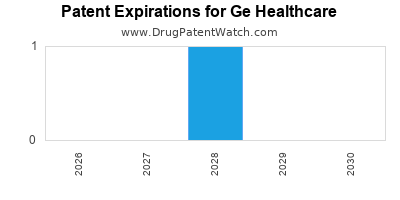
Drugs and US Patents for Ge Healthcare
| Applicant | Tradename | Generic Name | Dosage | NDA | Approval Date | TE | Type | RLD | RS | Patent No. | Patent Expiration | Product | Substance | Delist Req. | Exclusivity Expiration |
|---|---|---|---|---|---|---|---|---|---|---|---|---|---|---|---|
| Ge Healthcare | CLARISCAN | gadoterate meglumine | SOLUTION;INTRAVENOUS | 210016-003 | Nov 1, 2019 | AP | RX | No | No | ⤷ Start Trial | ⤷ Start Trial | ||||
| Ge Healthcare | OMNISCAN | gadodiamide | INJECTABLE;INJECTION | 022066-001 | Sep 5, 2007 | DISCN | Yes | No | ⤷ Start Trial | ⤷ Start Trial | |||||
| Ge Healthcare | AMERSCAN MDP KIT | technetium tc-99m medronate kit | INJECTABLE;INJECTION | 018335-001 | Aug 5, 1982 | DISCN | No | No | ⤷ Start Trial | ⤷ Start Trial | |||||
| Ge Healthcare | TECHNETIUM TC 99M SULFUR COLLOID | technetium tc-99m sulfur colloid | SOLUTION;INJECTION, ORAL | 017456-001 | Approved Prior to Jan 1, 1982 | DISCN | No | No | ⤷ Start Trial | ⤷ Start Trial | |||||
| Ge Healthcare | VIZAMYL | flutemetamol f-18 | INJECTABLE;INTRAVENOUS | 203137-001 | Oct 25, 2013 | DISCN | Yes | No | 8,916,131 | ⤷ Start Trial | Y | ⤷ Start Trial | |||
| Ge Healthcare | MPI STANNOUS DIPHOSPHONATE | technetium tc-99m etidronate kit | INJECTABLE;INJECTION | 017667-001 | Approved Prior to Jan 1, 1982 | DISCN | No | No | ⤷ Start Trial | ⤷ Start Trial | |||||
| >Applicant | >Tradename | >Generic Name | >Dosage | >NDA | >Approval Date | >TE | >Type | >RLD | >RS | >Patent No. | >Patent Expiration | >Product | >Substance | >Delist Req. | >Exclusivity Expiration |
Expired US Patents for Ge Healthcare
| Applicant | Tradename | Generic Name | Dosage | NDA | Approval Date | Patent No. | Patent Expiration |
|---|---|---|---|---|---|---|---|
| Ge Healthcare | OMNIPAQUE 70 | iohexol | SOLUTION;URETHRAL | 018956-007 | Jun 1, 1994 | 4,396,597 | ⤷ Start Trial |
| Ge Healthcare | OMNIPAQUE 70 | iohexol | SOLUTION;URETHRAL | 018956-007 | Jun 1, 1994 | 4,250,113 | ⤷ Start Trial |
| Ge Healthcare | VIZAMYL | flutemetamol f-18 | INJECTABLE;INTRAVENOUS | 203137-001 | Oct 25, 2013 | 7,351,401 | ⤷ Start Trial |
| Ge Healthcare | VIZAMYL | flutemetamol f-18 | INJECTABLE;INTRAVENOUS | 203137-001 | Oct 25, 2013 | 8,236,282 | ⤷ Start Trial |
| Ge Healthcare | VISIPAQUE 270 | iodixanol | INJECTABLE;INJECTION | 020808-001 | Aug 29, 1997 | RE36418 | ⤷ Start Trial |
| Ge Healthcare | OPTISON | albumin human | INJECTABLE;INJECTION | 020899-001 | Dec 31, 1997 | 5,573,751 | ⤷ Start Trial |
| >Applicant | >Tradename | >Generic Name | >Dosage | >NDA | >Approval Date | >Patent No. | >Patent Expiration |
International Patents for Ge Healthcare Drugs
| Country | Patent Number | Estimated Expiration |
|---|---|---|
| Denmark | 2182988 | ⤷ Start Trial |
| South Africa | 201000718 | ⤷ Start Trial |
| China | 101790387 | ⤷ Start Trial |
| Japan | 5367708 | ⤷ Start Trial |
| Hong Kong | 1146710 | ⤷ Start Trial |
| World Intellectual Property Organization (WIPO) | 2009027452 | ⤷ Start Trial |
| >Country | >Patent Number | >Estimated Expiration |
Supplementary Protection Certificates for Ge Healthcare Drugs
| Patent Number | Supplementary Protection Certificate | SPC Country | SPC Expiration | SPC Description |
|---|---|---|---|---|
| 1189916 | 122011000010 | Germany | ⤷ Start Trial | PRODUCT NAME: REGADENOSON UND DIE SALZE DAVON; REGISTRATION NO/DATE: EU/1/10/643/001 20100906 |
| 0933372 | SPC/GB08/018 | United Kingdom | ⤷ Start Trial | PRODUCT NAME: FOSAMPRENAVIR CALCIUM: ((1S,2R)-3-(((4-AMINOPHENYL)SULFONYL)(2-METHYLPROPYL)AMINO)-1-(PHENYLMETHYL)-2(PHOSPHONOOXY)PROPYL)-CARBABAMIC ACID C-((3S)-TETRAHYDRO-3-FURANYL) ESTER CALCIUM SALT; REGISTERED: UK EU/1/04/282/001 20040712; UK EU/1/04/282/002 20040712 |
| 2365988 | LUC00061 | Luxembourg | ⤷ Start Trial | PRODUCT NAME: PATIROMER SORBITEX CALCIUM ET TOUS LES SELS ET DERIVES DE CELUI-CI; AUTHORISATION NUMBER AND DATE: EU/1/17/1179 20170721 |
| 0216511 | 94C0015 | Belgium | ⤷ Start Trial | PRODUCT NAME: GADODIAMIDE; NAT. REGISTRATION NO/DATE: NL 19253 19940425; FIRST REGISTRATION: GB - 0637/0015 19920925 |
| 1948158 | 16C0018 | France | ⤷ Start Trial | PRODUCT NAME: SACUBITRIL/VALSARTAN,SOUS FORME DE COMPLEXE SODIQUE SACUBITRIL VALSARTAN,C'EST-A-DIRE DE (3-((1S,3R)-1-BIPHENYL-4-YLMETHYL-3-ETHOXYCARBONYL-1-BUTYLCARBAMOYL) PROPIONATE-(S)-3'-METHYL-2'-(PENTANOY(2''-(TETRAZOL-5-YLATE)BIPHENYL-4'-YLMETHYL)AMINO)BUTYRATE)DE TRISODIUM HEMIPENTAHYDRATE; REGISTRATION NO/DATE: EU/1/15/1058 20151123 |
| 2957286 | 2018C/047 | Belgium | ⤷ Start Trial | PRODUCT NAME: PATIROMER SORBITEX CALCIUM; AUTHORISATION NUMBER AND DATE: EU/1/17/1179 20170721 |
| >Patent Number | >Supplementary Protection Certificate | >SPC Country | >SPC Expiration | >SPC Description |
Similar Applicant Names
Applicants may be listed under multiple names.
Here is a list of applicants with similar names.
Here is a list of applicants with similar names.
