GALDERMA LABS LP Company Profile
✉ Email this page to a colleague
What is the competitive landscape for GALDERMA LABS LP, and what generic alternatives to GALDERMA LABS LP drugs are available?
GALDERMA LABS LP has twenty-six approved drugs.
There are fifty-eight US patents protecting GALDERMA LABS LP drugs.
There are four hundred and five patent family members on GALDERMA LABS LP drugs in thirty-seven countries and one hundred and seventy-eight supplementary protection certificates in eighteen countries.
Summary for GALDERMA LABS LP
| International Patents: | 405 |
| US Patents: | 58 |
| Tradenames: | 18 |
| Ingredients: | 16 |
| NDAs: | 26 |
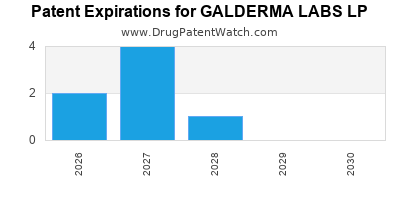
Drugs and US Patents for GALDERMA LABS LP
| Applicant | Tradename | Generic Name | Dosage | NDA | Approval Date | TE | Type | RLD | RS | Patent No. | Patent Expiration | Product | Substance | Delist Req. | Exclusivity Expiration |
|---|---|---|---|---|---|---|---|---|---|---|---|---|---|---|---|
| Galderma Labs Lp | SOOLANTRA | ivermectin | CREAM;TOPICAL | 206255-001 | Dec 19, 2014 | AB | RX | Yes | Yes | 8,815,816 | ⤷ Try a Trial | Y | ⤷ Try a Trial | ||
| Galderma Labs Lp | EPSOLAY | benzoyl peroxide | CREAM;TOPICAL | 214510-001 | Apr 22, 2022 | RX | Yes | Yes | 9,868,103 | ⤷ Try a Trial | Y | ⤷ Try a Trial | |||
| Galderma Labs Lp | AKLIEF | trifarotene | CREAM;TOPICAL | 211527-001 | Oct 4, 2019 | RX | Yes | Yes | 9,498,465 | ⤷ Try a Trial | Y | ⤷ Try a Trial | |||
| Galderma Labs Lp | SOOLANTRA | ivermectin | CREAM;TOPICAL | 206255-001 | Dec 19, 2014 | AB | RX | Yes | Yes | 9,782,425 | ⤷ Try a Trial | ⤷ Try a Trial | |||
| Galderma Labs Lp | CLOBEX | clobetasol propionate | LOTION;TOPICAL | 021535-001 | Jul 24, 2003 | AB | RX | Yes | Yes | ⤷ Try a Trial | ⤷ Try a Trial | ||||
| >Applicant | >Tradename | >Generic Name | >Dosage | >NDA | >Approval Date | >TE | >Type | >RLD | >RS | >Patent No. | >Patent Expiration | >Product | >Substance | >Delist Req. | >Exclusivity Expiration |
Expired US Patents for GALDERMA LABS LP
| Applicant | Tradename | Generic Name | Dosage | NDA | Approval Date | Patent No. | Patent Expiration |
|---|---|---|---|---|---|---|---|
| Galderma Labs Lp | METVIXIA | methyl aminolevulinate hydrochloride | CREAM;TOPICAL | 021415-001 | Jul 27, 2004 | 6,034,267 | ⤷ Try a Trial |
| Galderma Labs Lp | EPIDUO | adapalene; benzoyl peroxide | GEL;TOPICAL | 022320-001 | Dec 8, 2008 | 8,105,618 | ⤷ Try a Trial |
| Galderma Labs Lp | DIFFERIN | adapalene | SOLUTION;TOPICAL | 020338-001 | May 31, 1996 | RE34440 | ⤷ Try a Trial |
| Galderma Labs Lp | ORACEA | doxycycline | CAPSULE;ORAL | 050805-001 | May 26, 2006 | 8,603,506 | ⤷ Try a Trial |
| Galderma Labs Lp | ORACEA | doxycycline | CAPSULE;ORAL | 050805-001 | May 26, 2006 | 8,394,406 | ⤷ Try a Trial |
| >Applicant | >Tradename | >Generic Name | >Dosage | >NDA | >Approval Date | >Patent No. | >Patent Expiration |
Paragraph IV (Patent) Challenges for GALDERMA LABS LP drugs
| Drugname | Dosage | Strength | Tradename | Submissiondate |
|---|---|---|---|---|
| ➤ Subscribe | Delayed-release Capsules | 40 mg | ➤ Subscribe | 2008-12-11 |
| ➤ Subscribe | Cream | 1% | ➤ Subscribe | 2016-12-30 |
| ➤ Subscribe | Topical Gel | 1% | ➤ Subscribe | 2008-10-21 |
| ➤ Subscribe | Lotion | 0.05% | ➤ Subscribe | 2006-03-27 |
| ➤ Subscribe | Topical Shampoo | 0.05% | ➤ Subscribe | 2008-01-09 |
| ➤ Subscribe | Topical Gel | 0.30% | ➤ Subscribe | 2009-09-15 |
| ➤ Subscribe | Gel | 0.1%/2.5% | ➤ Subscribe | 2011-12-30 |
| ➤ Subscribe | Topical Gel | 0.33% | ➤ Subscribe | 2014-12-15 |
| ➤ Subscribe | Spray | 0.05% | ➤ Subscribe | 2008-09-29 |
International Patents for GALDERMA LABS LP Drugs
| Country | Patent Number | Estimated Expiration |
|---|---|---|
| Canada | 2622468 | ⤷ Try a Trial |
| Brazil | 0307550 | ⤷ Try a Trial |
| World Intellectual Property Organization (WIPO) | 2020170032 | ⤷ Try a Trial |
| Cyprus | 1111797 | ⤷ Try a Trial |
| China | 1829518 | ⤷ Try a Trial |
| >Country | >Patent Number | >Estimated Expiration |
Supplementary Protection Certificates for GALDERMA LABS LP Drugs
| Patent Number | Supplementary Protection Certificate | SPC Country | SPC Expiration | SPC Description |
|---|---|---|---|---|
| 3170818 | CA 2020 00039 | Denmark | ⤷ Try a Trial | PRODUCT NAME: KOMBINATION AF (A) 3-(6-(1-(2,2-DIFLUORBENZO(D)(1,3)DIOXOL-5-YL)CYCLOPROPANCARBOXAMIDO)-3-METHYLPYRIDIN-2-YL)BENZOESYRE OG (B) N-(5-HYDROXY-2,4-DITERT-BUTYL-PHENYL)-4-OXO-1H-QUINOLIN-3-CARBOXAMID ELLER ET FARMACEUTISK ACCEPTABELT SALT DERAF; REG. NO/DATE: EU/1/15/1059 20151124 |
| 3170818 | 2020/035 | Ireland | ⤷ Try a Trial | PRODUCT NAME: A COMBINATION OF (A) 3-(6-(1-(2,2-DIFLUOROBENZO(D)(1,3)DIOXOL-5- YL)CYCLOPROPANECARBOXAMIDO)-3-METHYLPYRIDIN-2-YL)BENZOIC ACID (LUMACAFTOR) AND (B) N-(5-HYDROXY-2,4-DITERT-BUTYL-PHENYL)-4-OXO-1H-QUINOLINE-3- CARBOXAMIDE (IVACAFTOR) OR A PHARMACEUTICALLY ACCEPTABLE SALT THEREOF; REGISTRATION NO/DATE: EU/1/15/1059 20151124 |
| 1631293 | C 2014 030 | Romania | ⤷ Try a Trial | PRODUCT NAME: BRIMONIDINA SI SARURILE FARMACEUTICE ALE ACESTEIA5-BROMO-N-(4,5-DIHIDRO-1-H-IMIDAZOL-2-IL)QUINOXALIN-6-AMINA; NATIONAL AUTHORISATION NUMBER: EU/1/13/904; DATE OF NATIONAL AUTHORISATION: 20140221; NUMBER OF FIRST AUTHORISATION IN EUROPEAN ECONOMIC AREA (EEA): EU/1/13/904; DATE OF FIRST AUTHORISATION IN EEA: 20140221 |
| 2340828 | LUC00195 | Luxembourg | ⤷ Try a Trial | PRODUCT NAME: SACUBITRIL ET VALSARTAN, SOUS FORME DE COMPLEXE DE SEL DE SODIUM SACUBITRIL VALSARTAN, C'EST-A-DIRE (((S)-N-VALERYL-N-((2'-(1H-TETRAZOLE-5-YL)-BIPHENYL-4-YL)-METHYL)-VALINE) ((2R,4S)-5-BIPHENYL-4-YL-4-(3-CARBOXY-PROPIONYLAMINO)-2-METHYL-ESTER ETHYLIQUE D'ACIDE PENTANOIQUE))NA3 X H2O, DANS LEQUEL X EST 0 A 3; AUTHORISATION NUMBER AND DATE: EU/1/15/1058 20151123 |
| 2826776 | 122021000025 | Germany | ⤷ Try a Trial | PRODUCT NAME: EINE KOMBINATION VON (A) (R)-1-(2,2-DIFLUORBENZO(D)(1,3)DIOXOL-5-YL)-N-(1-(2,3-DIHYDROXYPROPYL)-6-FLUOR-2-(1-HYDROXY-2-METHYLPROPAN-2-YL)-1H-INDOL-5-YL)CYCLOPROPANCARBOXAMID ODER EIN PHARMAZEUTISCH ANNEHMBARES SALZ DAVON UND (B) N-(5-HYDROXY-2,4-DI-TERT-BUTYL-PHENYL)-4-OXO-1H-CHINOLIN-3-CARBOXAMID ODER EIN PHARMAZEUTISCH ANNEHMBARES SALZ DAVON; REGISTRATION NO/DATE: EU/1/18/1306 20181031 |
| >Patent Number | >Supplementary Protection Certificate | >SPC Country | >SPC Expiration | >SPC Description |
Similar Applicant Names
Applicants may be listed under multiple names.
Here is a list of applicants with similar names.
Here is a list of applicants with similar names.


