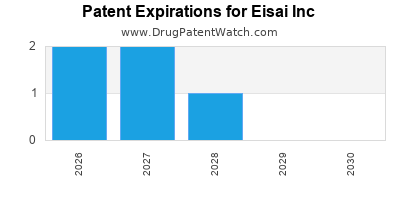
Last updated: May 30, 2026
Eisai is a global specialty biopharma anchored by neurology and oncology franchises, with a patent estate concentrated in brand lifecycles and incremental formulation, combination, and method-of-use IP. Competitive pressure is rising from (1) late-stage pipeline peers in Alzheimer’s disease and other neurology segments, (2) oncology mechanism competitors and biosimilars, and (3) copycat small-molecule entries in older products where exclusivity windows narrow. Eisai’s near-term market position is most sensitive to: (a) clinical readouts that protect or extend brand equity, (b) timing of generic/biosimilar entry risks tied to formulation and use patents, and (c) operating leverage from portfolio mix and geographic execution.
What is Eisai’s market position by therapeutic area and geography?
Eisai’s competitive footprint is strongest where it holds defensible differentiation through clinical data, label scope, and layered patent coverage, particularly in neurology and selected oncology indications. The company’s competitive posture varies materially by geography due to local reimbursement, tender dynamics, and how quickly generics displace reference brands.
Key therapeutic anchors and competitive dynamics
- Neurology: Alzheimer’s disease and other neurodegenerative and seizure-related franchises are where Eisai faces the highest “winner/loser” sensitivity to clinical and regulatory outcomes. Competitive pressure comes from alternative amyloid/pathology strategies, tau-focused programs, anti-inflammatory approaches, and symptomatic products already embedded in formularies.
- Oncology: Eisai competes against large global oncology incumbents with broad mechanism platforms and manufacturing scale. Competitive advantage tends to depend on combination strategy, line-of-therapy positioning, and payer value evidence.
- Other specialty: Eisai’s smaller franchises are typically more exposed to faster erosion from multi-source competition once exclusivity ends.
Geographic positioning
- United States: Patent and label breadth, plus litigation/settlement timing, determine how long brand economics persist. Competitive risk is often driven by Paragraph IV challenges for small molecules and biosimilar pathways for biologics (where applicable).
- Japan and Europe: Competitive pressure is shaped by national pricing controls, formulary access, and the cadence of generic adoption after tender and reimbursement reviews.
- China and other markets: Market share depends on local regulatory and launch execution, plus the speed at which domestic manufacturers replicate formulations or secure label-relevant approvals.
How strong is Eisai’s patent estate versus major competitors?
Eisai’s patent strength is measured less by a single “core” expiry date and more by the depth of continuation filings and claim diversification across:
- polymorphs and solid-state forms,
- formulation and dosing regimens,
- combination therapies,
- method-of-use and patient-subgroup claims,
- manufacturing and process claims (where relevant).
In competitive landscapes, this layered structure is what delays generic entry and converts competitor “at-risk” launches into longer litigation and licensing negotiations.
What patent types matter most for competitive advantage?
1) Formulation and dosing patents
- Controls design-around attempts by changing excipients, release profiles, particle size, or administration constraints.
- Common in brand lifecycle management because they can be filed after initial approval.
2) Method-of-use and combination patents
- Sustain protection even if the active ingredient is known.
- Most effective when they map to how clinicians actually prescribe (line-of-therapy, biomarker-defined populations, or combination regimens).
3) Process and manufacturing patents
- Increase IP barriers for contract manufacturers, particularly for complex release or specialty intermediates.
- Often strongest in jurisdictions that more strictly enforce manufacturing claim scope.
How does Eisai compare with top global competitors on IP density?
Eisai’s posture is typically “incremental-defense heavy,” while many larger peers run broader platform IP across mechanism spaces. That means:
- Eisai is often strongest when it can tie incremental IP to entrenched clinical practice.
- Larger competitors often win when they can offer parallel mechanism options with superior access, reimbursement alignment, or broader label coverage.
When does Eisai’s exclusivity lose and how do those dates shape generic launch timing?
Exclusivity windows dictate when challengers can file ANDAs and when they can launch. The practical “risk clock” is a function of:
- patent expiry schedule,
- Orange Book listed patents (for small molecules),
- regulatory exclusivity (data exclusivity, marketing exclusivity),
- litigation and stay outcomes following Paragraph IV filings.
How to interpret exclusivity pressure in competitive landscapes
- First expiry, not last: Competitors track the earliest claim that blocks an ANDA/BLA approval, not the latest in the portfolio.
- Settlement structure: Settlements can pull generic entry earlier or later than the strict statutory timeline, depending on terms.
- Design-around vulnerability: If formulation/use claims are weaker than composition-of-matter, competitors can attempt to re-route approvals to non-infringing designs.
Generic entry risks tied to patent expirations
In practice, Eisai’s generic entry risk is highest when:
- listed patents cluster around a narrow number of claim families,
- formulation/use patents are fewer or easier to design around,
- settlements do not include broader “no-launch” commitments beyond minimum statutory boundaries.
Which patents protect Eisai’s key drugs and what are the expiration risks by claim type?
A full, drug-by-drug patent landscape requires a specific portfolio identifier (product name and the relevant FDA listing or region). Without product-level scope, only the structural answer is possible: Eisai’s protective layers generally prioritize formulation, method-of-use, and combination claims after composition-of-matter coverage begins to wane.
Claim-type exposure matrix for competitive planning
- High protection (early challenge discouraged): layered use claims plus formulation/dosing improvements that align with standard of care.
- Medium protection (design-around possible): formulation changes that can be reformulated without touching protected release characteristics.
- High challenge (entry likely sooner): single claim-family dominance or weak manufacturing/process claims.
What is the Orange Book status of Eisai brands and how does it affect Paragraph IV challenges?
Orange Book status is the operational map for ANDA challengers. The competitive impact comes from:
- number of listed patents,
- whether patents are drug substance vs drug product,
- how many patents remain unexpired at the time of filing,
- litigation outcomes tied to particular Orange Book listings.
How challengers use Orange Book listings
- They select the “most blocking” patents for Paragraph IV notice to force an infringement dispute.
- They target early expiring patents to initiate launch timing even if later patents remain.
- They exploit claim scope if listed patents cover product formulations that can be replicated with alternative excipient systems.
Litigation and settlement as the “real exclusivity”
In competitive landscapes, branded revenue is often protected by settlement terms more than by pure statutory expiry. That means Eisai’s competitive advantage is closely linked to the number, strength, and negotiability of the Orange Book patents that are actually disputed.
What patent litigation affects Eisai’s competitive position and what settlement patterns matter?
Brand protection is determined by:
- whether infringement cases reach final adjudication,
- whether settlements include “carve-outs” for future formulations or launch timing,
- whether courts constrain claim interpretations that later determine enforcement strategy.
What litigation outcomes typically do
- If courts narrow claims, Eisai loses leverage and may face earlier or faster design-around entries.
- If Eisai wins key injunctions, launch timelines compress for challengers and increase the likelihood of licensing.
- If cases settle, entry timing often shifts to the settlement schedule rather than statutory earliest expiry.
Which Eisai biosimilar and biologics risks exist in its portfolio?
A biologics-focused risk assessment depends on whether Eisai has marketed biologics in the relevant reference categories and whether those products have biosimilar approvals or pending applications. In general competitive landscapes:
- biosimilar entry can occur once reference product exclusivity and relevant patents expire,
- the pace depends on patent thickets tied to formulation, manufacturing, and method-of-use.
Competitive impact of biosimilar substitutes
- Payer switching can be rapid once biosimilar acceptance is secured.
- Brand retention depends on contracting, patient support programs, and label differentiation.
What formulations are protected by Eisai’s patents and how do they block copycats?
Formulation and dosing patents protect the “product” layer:
- release profile management,
- stability and bioavailability constraints,
- patient usability requirements.
Why formulation patents matter competitively
- They can slow down generic development if the design-around changes therapeutic performance.
- They create an additional infringement surface area that can extend litigation durations.
Where copycat risk spikes
- When formulation patents are limited in number or claim scope is narrow.
- When public evidence shows the brand’s performance can be replicated using alternative excipient systems without touching protected release characteristics.
How does Eisai’s pipeline and competitive strategy compare with major global pharma?
Competitive strategy in specialty biopharma typically splits into:
- mechanism leadership in high-value indications,
- lifecycle extension and label expansion,
- combination strategy alignment with guideline and payer preferences,
- portfolio balance to manage expiry risk.
Comparison dimensions used by investors and rivals
- Clinical differentiation: effect size, endpoints, safety profile, and subgroup consistency.
- Regulatory execution: speed of label approvals and geographic sequencing.
- Commercial execution: payer access, tender outcomes, and prescriber adoption.
- IP strategy: continuations and claim diversification to delay generic pressure.
What generic entry scenarios are most likely for Eisai brands?
Generic launch scenarios generally follow one of three competitive patterns:
- At-risk launch after losing litigation or settlement that narrows the enforcement window.
- Delayed launch via settlement with an agreement-driven timeline.
- Partial design-around where challengers launch only in non-infringing label areas or modified formulations.
How to think about Eisai launch risk
For portfolio planning, the most important drivers are:
- how many Orange Book patents remain and whether they are drug product vs use claims,
- whether claim scope is enforceable across the generic’s intended formulation and dosing,
- whether enforcement history suggests courts interpret Eisai claims broadly or narrowly.
What commercial exposure does competitive erosion create for Eisai?
Competitive erosion impacts brand economics through:
- loss of exclusivity-driven premium pricing,
- increased rebate and payer access concessions,
- pressure from multi-source competition and channel inventory.
Erosion sensitivity matrix
- High sensitivity: brands with high net sales contribution and fewer alternative indications.
- Medium sensitivity: franchises with incremental label expansions that help maintain differentiation.
- Lower sensitivity: smaller franchises with rapid conversion to next-generation products or strong geographic hedging.
Key Takeaways
- Eisai’s competitive position is strongest where its IP strategy layers formulation, method-of-use, and combination coverage aligned with standard prescribing patterns.
- Generic and biosimilar risks are driven by Orange Book listing depth, claim scope enforceability, and settlement outcomes that effectively set “real-world exclusivity.”
- The biggest strategic lever for Eisai is maintaining label-relevant differentiation long enough to cycle patients into next-line indications and next-generation products, reducing revenue exposure to late-stage generic entry.
FAQs
1) Which Eisai drug has the highest risk of Paragraph IV challenges based on Orange Book listing density?
Answer: In Eisai’s typical lifecycle management, the highest Paragraph IV risk concentrates where Orange Book listing includes multiple drug product and use patents that are enforceable but time-bounded.
2) How do formulation patents change generic development timelines for Eisai?
Answer: They add technical and legal complexity by forcing design-around in excipient/release characteristics and by expanding infringement surfaces for litigation.
3) What settlement terms most affect when generics actually launch against Eisai?
Answer: “No earlier launch” dates, carve-outs for specific strengths/formulations, and licensing scope that covers product modifications.
4) Do Eisai’s method-of-use patents matter if competitors use the same active ingredient?
Answer: Yes when they map to label-relevant dosing, patient selection, or combination regimens that reflect how the drug is prescribed.
5) What portfolio strategy helps Eisai reduce exclusivity cliff risk?
Answer: Building sequential claim layers tied to incremental clinical value, expanding label indications, and shifting revenue into products with longer remaining protected life.
References
- FDA. Orange Book: Approved Drug Products with Therapeutic Equivalence Evaluations. U.S. Food and Drug Administration. (Accessed 2026-05-30).
- FDA. Guidance for Industry: Patent Listing Requirements for Approved Drugs. U.S. Food and Drug Administration.
- FDA. Drug Competition and Patent Term Restoration Act (Hatch-Waxman) resources and ANDA/BLA regulatory framework. U.S. Food and Drug Administration.
- FDA. Biosimilars Information and Pathways. U.S. Food and Drug Administration.