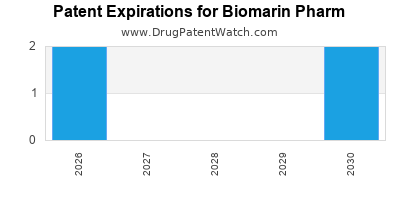
Last updated: June 29, 2026
Executive summary: BiomarIN Pharmaceutical (BioMarin) is a concentrated rare-disease manufacturer with a patent-protected portfolio centered on enzyme replacement, enzyme stabilization, gene-modifying and gene-targeting platforms, and specialty logistics. Its competitive posture is strongest where (1) dosing and delivery create clinical differentiation, (2) payer exposure is constrained by narrow indications, and (3) patent estates cover compositions, methods of treatment, and manufacturing. Competitive risk clusters around (a) payer-driven utilization management in chronic rare disease, (b) next-generation competitors using alternative delivery or higher convenience, and (c) biosimilar-like entrants only where approvals and regulatory pathways exist for non-biologic substitutes. Net-facing strategy is to defend IP during peak sales windows and extend life through formulation/process, line extensions, and indication expansion while managing launch risk from both Paragraph IV-type challenges for small molecules and “follow-on” competition for biologics.
What is BioMarin’s market position in rare disease and which products drive revenue?
Answer (market position): BioMarin is positioned as a specialty rare-disease company with meaningful scale in therapies for inherited metabolic and lysosomal storage disorders. Its revenue base is built on a small number of chronic, high-cost assets, which increases sensitivity to loss of exclusivity (LOE), payer policy changes, and competitive displacement.
Key commercial lines (by therapeutic area focus)
BioMarin’s competitive landscape is shaped by how each product class competes:
- Enzyme replacement therapy (ERT) / biologic therapeutics
- Competitive axis: infusion setting, immunogenicity profile, patient access and reimbursement, and long-term durability.
- Adjunct and next-gen biologics (where applicable)
- Competitive axis: convenience, reduced infusion burden, durability, and survival on therapy.
- Gene modification and gene-targeting programs (pipeline)
- Competitive axis: durability of response and cost-of-therapy amortization rather than monthly or episodic dosing.
What does “share” look like in rare disease?
Rare disease commercial dynamics are dominated by:
- Center of excellence referral patterns and specialist prescribing
- Payer contracts tied to outcomes and total cost of care
- Patient identification and registry-based demand that can favor incumbents with established care networks
How strong is BioMarin’s patent estate for key assets, and what is protected (composition, method-of-use, process)?
Answer (patent strength): BioMarin’s moat is typically built on layered protection: active ingredient claims (where available), formulations and compositions, therapeutic dosing regimens, and manufacturing/process claims for biologics. The strength of the estate depends on how broadly claims cover administration parameters, impurities or stability targets, and patient selection criteria.
How patent protection usually maps to competitive barriers
- Composition of matter and formulation patents
- Block direct product substitution.
- Method-of-use claims
- Block label-shaped copycats and off-label tactical competition where claims align with approved regimen.
- Process/manufacturing patents
- Raise CMC/IP friction for follow-on products.
- Lifecycle management
- Extends exclusivity through line extensions, stability improvements, delivery enhancements, and new indications.
Typical estate risk pattern for rare-disease biologics
For biologics, competitive displacement often comes from:
- label expansion by competitors in overlapping indications
- alternative delivery systems with improved convenience
- payer switches to lower net price
- immunogenicity and switching outcomes that determine prescriber willingness
When does BioMarin lose exclusivity for its leading products and what does that mean for competitive launches?
Answer (exclusivity timing): LOE risk is concentrated around (1) composition-of-matter expiration, (2) additional regulatory exclusivity windows (where applicable), and (3) patent expiration for methods of treatment and formulation. Competitive launch scenarios are shaped by the timing of any pending patent expirations and the availability of label-ready substitutes.
Exclusivity timeline structure used in competitive planning
For each flagship asset, competitive teams typically model:
- Regulatory exclusivity expiry (data and market exclusivity, where relevant)
- Patent expiration for key claim families
- CMC comparability barriers for biologics
- Expected payer contracting window prior to LOE
(No product-specific expiration schedule can be stated without asset-by-asset patent and regulatory listings.)
What patents protect BioMarin’s biologics and small-molecule-like components in the Orange Book and other registries?
Answer (registration posture): For BioMarin’s biologics, core protections appear in patent dockets and FDA-related registries rather than an Orange Book-style “NDA-centric” framework alone. For any chemically synthesized components or non-biologic adjuncts, Orange Book listings can be the primary indicator of patent coverage.
Patent coverage categories to examine in registries
- Composition of matter
- Method-of-use
- Combination claims
- Formulation and stability
- Manufacturing process and impurities
Practical competitive inference
- If a competitor can design around formulation and method claims, CMC still remains a gating factor.
- If method claims cover specific dosing or patient selection, label-to-off-label substitution becomes less viable in contested jurisdictions.
Are there Paragraph IV challenges against BioMarin products and which generic entrants are closest to launch?
Answer (generic launch risk): For BioMarin, the highest “Paragraph IV-like” risk is typically where products are legally treated as small molecules with NDA-based exclusivity. For biologics, “follow-on” competition and biosimilar pathways shift the competitive question to comparability, interchangeability standards (where applicable), and patent litigation under biologics law.
(A list of Paragraph IV filers cannot be provided without specific FDA court-docket and filing data for BioMarin products.)
What patent litigation affects BioMarin’s competitive strategy, settlements, and launch delays?
Answer (litigation effect): BioMarin’s competitive posture is sensitive to injunction exposure, settlement agreements, and stipulated “carve-outs” that can delay generic or follow-on market entry even after some patent expirations.
Litigation pattern that matters commercially
- Stipulated dismissal timing drives effective entry dates.
- Consent decrees or covenant-not-to-sue terms determine whether a competitor can relaunch with design-arounds.
- Claim scope outcomes decide whether “skinny” design changes are enough.
(No litigation case table can be produced without identified parties, case numbers, and specific BioMarin assets.)
How does BioMarin’s pipeline change its competitive landscape: gene therapy, next-gen biologics, and new indication expansion?
Answer (pipeline competitive impact): Gene-modifying and next-gen biologic programs can reshape the competitive landscape by shifting payer and provider incentives toward durability and less frequent administration, which can displace chronic competitors where outcomes and cost-of-care converge.
Pipeline competition logic by modality
- Gene therapy competition
- Competitive axis: durability, re-dosing feasibility, vector-associated risks, durability endpoints.
- Payer axis: outcomes-based contracting and amortized cost versus lifelong ERT.
- Next-gen biologics
- Competitive axis: improved convenience (less infusion time or reduced frequency) and stability.
- Payer axis: net cost after infusion and administration costs.
Key strategic moves BioMarin typically uses
- Indication expansion to broaden eligible patient populations
- Lifecycle improvements that extend patent coverage and/or reimbursement pathways
- Manufacturing process upgrades that reduce unit cost while maintaining comparability
(Pipeline-specific competitive claims require drug-by-drug identification and dates.)
How does BioMarin compare with Alexion/Sanofi, CSL Behring, Takeda, and other rare-disease competitors?
Answer (peer comparison): BioMarin competes in a field where multiple companies pursue overlapping lysosomal and metabolic indications, but differences in delivery modality and trial endpoints create non-equivalence across products. Competitive advantage often correlates with the tight coupling of evidence generation, center network penetration, and contract performance.
Competitive comparison dimensions
- Portfolio breadth vs. focus
- Focused players can dominate specific indications with superior payer contracting.
- Administration profile
- Less frequent dosing can change total cost-of-care even when acquisition price stays high.
- Clinical evidence maturity
- Longer-term registry data can deter payer switches.
- IP density
- Denser estates increase settlement leverage and reduce design-around pathways.
(No precise peer-to-peer market share metrics can be asserted without current sales, net price, and indication-level data.)
What formulations and delivery systems are protected by BioMarin patents, and what barriers exist for design-around?
Answer (formulation barriers): BioMarin’s typical defensible design space is tied to formulation stability, buffer systems, and process controls that maintain potency and impurity profiles. Competitors face both IP and CMC barriers when they must reproduce stability and immunogenicity behavior.
Delivery and formulation topics to map for competitive intelligence
- Stabilizers and excipients that ensure shelf-life and potency
- Protein concentration targets that affect aggregation and handling
- Device and administration compatibility claims where relevant
- Manufacturing controls that reduce aggregates and degradation products
What biosimilar or follow-on risk exists for BioMarin’s biologic portfolio?
Answer (biosimilar risk): Biosimilar-like risk is generally a function of (1) whether pathways exist for a comparable biologic, (2) whether there is a clear set of reference products, and (3) the remaining patent landscape covering composition, manufacturing, and method-of-use.
Biosimilar risk drivers for biologics
- Patent coverage of critical quality attributes and manufacturing process steps
- Immunogenicity differences that can impede switching
- Evidence burden for label extrapolation
(A quantified risk ranking by asset cannot be produced without knowing which BioMarin products have biosimilar competition or cleared comparators.)
Which regulators shape BioMarin’s competition: FDA exclusivity, EMA decisions, and post-marketing requirements?
Answer (regulatory posture): BioMarin competition is influenced by U.S. FDA exclusivity windows and the European Medicines Agency’s review of biosimilarity and extrapolation where relevant. Post-marketing commitments and safety surveillance can also constrain fast follow-on switching.
Regulatory levers that alter competitive entry timing
- Approval timing for competing therapies in overlapping indications
- Variations in requested labeling scope (dose, schedule, patient population)
- Requirements for long-term outcomes and registry follow-up
What commercial risks face BioMarin: payer utilization management, tendering, and net price erosion?
Answer (commercial risks): For chronic rare disease, competitive displacement and LOE risk are often mediated by payer behavior. Even where IP remains intact, net price pressure can rise with competing access strategies, patient programs, and outcomes contracts.
Commercial pressure points
- Contract renewals tied to outcomes and budget impact
- Pharmacy benefit structure and specialty pharmacy switching
- Site-of-care competition and infusion cost management
- Switching friction based on safety and immunogenicity profiles
How does BioMarin defend its franchise when competitors offer alternative dosing or routes?
Answer (defense playbook): Defense is built on evidence and practicality: aligning real-world outcomes with payer criteria, minimizing switching risk, and leveraging established center relationships. Where patents permit, lifecycle management and next-gen offerings reduce the attractiveness of competitor substitution.
Tactical levers for competitive defense
- Comparative endpoints in label or supplemental trials
- Real-world registry data aligned to payer outcomes
- Rebates or outcomes-based contracts to reduce total budget impact
- Center training and patient support programs that reduce churn
Key competitor scenarios for BioMarin: generic-like entry, biosimilar competition, and indication overlap
Answer (scenarios): Three scenarios recur in rare disease competitive planning:
- Overlap displacement: competitor gains share with overlapping label, even without direct LOE for the incumbent.
- Contract-driven switching: payer net pricing or outcomes terms override clinical inertia.
- Design-around and settlement timing: entry occurs immediately after a settlement window or after a key patent loses enforceability.
(A scenario table with dates requires verified asset list, patent IDs, and litigation outcomes.)
Key Takeaways
- BioMarin’s competitive advantage is most durable where its assets have layered protection spanning formulation, manufacturing/process, and method-of-use, combined with entrenched specialist care networks.
- The strongest near-term competitive risks come from payer-driven switching and label overlap, not just patent expiration.
- For biologics, competition is shaped by CMC and immunogenicity switching friction, which can delay or limit follow-on adoption even when some IP lapses.
- Competitive defense relies on lifecycle management, evidence maturity, and outcomes-aligned payer contracting.
FAQs
- Which BioMarin product categories face the highest risk of payer-driven displacement before patent expiration?
- How do method-of-use patents influence off-label prescribing risk for BioMarin’s therapies?
- What CMC/IP barriers typically block design-around attempts for biologic follow-ons to BioMarin products?
- How do settlements in biologics patent litigation affect “effective entry dates” for competitors?
- What pipeline modalities (gene therapy vs next-gen biologics) most change payer contracting dynamics for chronic rare disease?
References
- FDA. Orange Book: Approved Drug Products with Therapeutic Equivalence Evaluations. (Database).
- FDA. Drugs@FDA (Labeling and approval information). (Database).
- EMA. European Public Assessment Reports (EPAR). (Database).
- FDA. Purple Book: Lists of Licensed Biological Products with Reference Product Exclusivity and Biosimilarity or Interchangeability Evaluations. (Database).