Last updated: July 25, 2026
What is Biogen’s US market position across neurology and where is it most exposed to competitive entry?
Biogen operates in one of the highest-competition segments of the US specialty pharmaceutical market: immunology and neuroscience, with MS and AD representing the critical demand pools.
Where competition hits hardest (US)
- MS DMTs: other DMTs, payer steering, and future biosimilar or generic conversion depending on modality and formulation.
- AD therapeutics: high-efficacy but narrow patient-selection constraints and ongoing payer scrutiny tied to real-world outcomes.
- Biosimilar pressure and interchangeability: for biologics and infusion products, competitive entry paths depend on exclusivity, patent scope, and practical manufacturing and delivery constraints.
Commercial reality shaping the competitive landscape
- Neurology US purchasing is governed by formulary placement, prior authorization, and step therapy. That means the “effective monopoly” often depends on contracting and patient flow as much as on patent protection.
- Competition is not only molecule-based; it includes administration convenience (infusion vs injection), monitoring requirements, infusion center leverage, and patient support programs.
How strong is Biogen’s patent estate in the US and what patents protect its key US neurology products?
Biogen’s patent strength in the US typically derives from three overlapping layers: composition of matter (drug substance), method-of-use (clinical administration and endpoints), and formulation or delivery patents (stability, dosing regimen, device-assisted administration).
MS portfolio IP patterns that drive sustained US exclusivity
- Long-lived claims around antibody constructs, binding epitopes, and manufacturing processes for biologics (where applicable).
- Method-of-use claims tied to specific MS subtypes and treatment regimens.
- Formulation and dosing interval patents that preserve brand differentiation even after some functional competition begins.
AD IP patterns that drive differentiation
- Claims covering therapeutic use in patient-defined populations.
- Manufacturing and formulation protections for stability and administration route.
- Regulatory and litigation posture that delays generic or biosimilar substitution.
Competitive implication: when an IP estate includes at least one “late-expiring” secondary patent family (formulation, dosing regimen, or method-of-use), US market share can remain protected against full replacement even if the earliest composition-of-matter patent expires.
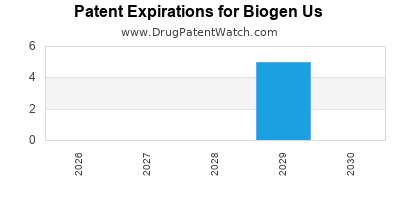
When does Biogen’s US exclusivity end for major products and what are the patent expiration timelines?
Biogen’s exclusivity profile in the US is best viewed as a ladder across multiple product-specific and patent-family-specific expiration dates rather than a single cliff.
Featured snippet answer: US exclusivity ends product-by-product based on a staggered set of composition, method-of-use, formulation, and regulatory exclusivity dates, with the competitive entry timing determined by when the last enforceable Orange Book-listed patent and any associated litigated claims fall away.
How to model the entry window for competitive planning
- Regulatory exclusivity end date (data exclusivity and any granted exclusivity).
- Orange Book patent expiration dates (if listed for the product).
- Patent litigation effects (stay orders, settlements, and final decision dates).
- Launch readiness constraints (manufacturing scale, device compatibility, labeling updates).
Competitive planning takeaway: the “effective launch window” for competitors is the earliest date they can both clear regulatory requirements and avoid meaningful infringement exposure.
What is the Orange Book status of Biogen’s US products and which patents are listed?
Orange Book coverage varies by product and by whether the drug is an approved small-molecule vs biologic. For biologics, the US patent landscape is often captured through the BPCIA framework rather than the Orange Book alone.
Featured snippet answer: Determine US generic substitution risk using two registries in parallel: Orange Book for small molecules and biologic-specific patent listings and BPCIA-related disclosures for biologics.
How patent listing density translates into generic risk
- Dense listing across drug substance, use patents, and formulation patents typically reduces the probability of a clean, early Paragraph IV route.
- If multiple patents expire at different times, competitors can “pick off” claims through partial settlement or launch-after-patent-drop strategies, depending on the settlement terms and remaining enforceable claims.
What patent litigation affects Biogen in the US and how do it shape generic and biosimilar entry risks?
Biogen’s competitive threats tend to be driven by two litigation archetypes:
- Paragraph IV litigation for chemically derived or non-biologic products where Orange Book patents are asserted.
- BPCIA-driven patent disputes for biologics where biosimilar entry hinges on complex claim construction and timing.
Featured snippet answer: litigation determines whether competitors can launch at the earliest regulatory permissibility date, and it can shift timelines by years through stays, claim-specific injunction leverage, or settlement-based launch design.
Litigation mechanics that matter for competition
- Claim-by-claim validity and infringement outcomes: a competitor can sometimes proceed for some claims while others remain.
- Settlement agreements: negotiated “design-around” or delayed launch windows.
- Injunction risk: if a court blocks the competitor’s proposed product before approval, launch timing moves later.
What biosimilar or generic entry risks exist for Biogen’s US products?
For Biogen, biosimilar risk is tied to biologic modality and the maturity of the molecule. Generic risk is tied to whether a product is a small molecule and whether Orange Book patents are narrow or broad.
Featured snippet answer: biosimilar entry risk increases when enforceable secondary patents expire or when settlements reduce remaining legal leverage.
Biologics vs small molecules: different competitive pathways
- Biologics: biosimilar developers must navigate BPCIA patent listings, a notice-and-exchange structure, and a multi-step approval and litigation timeline.
- Small molecules: Paragraph IV challenges can accelerate generic timelines if the asserted patents fall or if settlements are reached.
Competitive implication for Biogen: the most durable defense usually appears where Biogen maintains a layered patent set and where administration and patient support practices raise switching costs.
Which companies are challenging Biogen in the US and how do their strategies compare?
Competitors in Biogen’s segments typically include large pharma, specialty neurology-focused firms, and generics/biosimilars entrants. Strategy generally splits into:
- “Direct molecule competition” with label expansions and payer contracts.
- “Biosimilar substitution” with pricing pressure and interchangeability narratives.
- “Line-extension” strategies that target patient segments not fully covered by Biogen’s labeling.
Featured snippet answer: the competitive field is usually a mix of (i) other branded neurology incumbents competing on efficacy and access and (ii) biosimilar/generic developers competing on timeline and legal clearing.
How competitor behavior affects Biogen’s launch defensibility
- Competitors often target the easiest-to-displace subpopulation first, backed by payer leverage.
- When Biogen’s brand is entrenched, competitors rely on negotiation-driven access rather than pure clinical displacement.
How does Biogen’s product differentiation compare with rival MS and AD therapies in the US?
Differentiation in neurology is multi-dimensional:
- Mechanism-of-action fit to disease phenotype
- Safety and monitoring burden
- Treatment administration convenience and adherence
- Real-world effectiveness in claims datasets
- Payer outcomes tied to hospitalization avoidance, MRI stabilization, and relapse reduction
Featured snippet answer: Biogen’s competitive positioning depends on clinical differentiation plus access contracting. Competitors can match mechanism but struggle to match end-to-end real-world execution.
MS differentiation levers
- Dosing interval
- Safety profile for comorbidities and infection risk
- Evidence in specific MS subtypes
- Patient support and infusion infrastructure
AD differentiation levers
- Eligibility criteria and infusion burden
- Evidence in biomarker-selected populations
- Payer coverage policies tied to clinical endpoints
What formulations and delivery systems are protected by Biogen in the US?
Delivery systems and formulation can sustain protection after core drug substance patents weaken.
Common formulation protection categories in competitive IP estates
- Stability and shelf-life improvements
- Buffering and pH control
- Lyophilized vs liquid presentation (if applicable)
- Pre-filled device or infusion preparation methods
- Handling requirements to reduce aggregation and maintain potency
Featured snippet answer: even if core claims weaken, formulation or device-linked patents can reduce generic or biosimilar interchangeability by limiting “practical equivalence” without a workaround.
What method-of-use patents protect Biogen’s clinical positioning and patient-selection strategy?
Method-of-use claims frequently protect:
- Indications by disease subtype and stage
- Treatment sequencing (first-line vs switch-from-other-DMT)
- Dosing regimen specifics
- Treatment monitoring endpoints tied to label usage
Featured snippet answer: method-of-use patents can block biosimilar or generic labeling changes, even if the underlying drug substance becomes less protected.
Why method-of-use claims raise switching barriers
- Payers reimburse based on indication and evidence; switching to a competitor may require a labeling match.
- Clinicians are less likely to shift outside label without strong evidence.
What licensing deals or collaborations shape Biogen’s competitive options in the US?
Biogen’s competitive landscape is also influenced by:
- Co-development or commercialization agreements
- Technology licensing that expands pipeline reach
- IP cross-licenses that settle disputes or enable manufacturing pathways
Featured snippet answer: licensing and settlements can reallocate market access, define launch dates, and allow alternative manufacturing routes, which changes the competitive entry calendar.
What FDA regulatory status and approval history affect Biogen’s US exclusivity and generic/biosimilar timing?
Biogen’s US exclusivity profile is tied to FDA approval milestones and any granted exclusivity programs.
Featured snippet answer: FDA approval date governs earliest possible generic or biosimilar filing timing; exclusivity and patent status determine whether approval converts into commercial entry.
Regulatory levers that shift competition
- Indication breadth at launch can expand the protected market.
- Post-approval label expansions can re-anchor market size even when the initial core claims begin to weaken.
- Real-world evidence expectations can affect payer coverage even after legal exclusivity ends.
How does Biogen manage market share after patent challenges and what generic entry scenarios are realistic?
Market share after patent challenges depends on:
- Settlement terms (delayed entry vs at-risk launch)
- Competitive pricing and payer contracts
- Clinical conversion rates between therapies
- Evidence generation after approval
Featured snippet answer: Biogen’s realistic defense after exclusivity erosion is a mix of continued enforcement, contracted access, and patient retention programs, which can delay competitive substitution even when legal barriers weaken.
Generic or biosimilar entry scenarios
- Clean launch after final patent expiration with no settlement: highest competitive pressure and pricing compression.
- At-risk launch: higher litigation probability; market impact depends on injunction risk and final outcomes.
- Settlement with delayed launch: competitive pressure begins later but can still displace share if payer switching programs are ready.
What are the commercial revenue exposure areas for Biogen in the US where competitive pressure is most likely?
For competitive planning, revenue exposure is best mapped to:
- High-share neurology indications with strong prescriber adherence
- Products with near-term exclusivity or patent expiration windows
- Assets with crowded or late-stage competitor pipelines
Featured snippet answer: the highest exposure sits where Biogen has the most share combined with the most predictable switching trigger, such as dosing convenience, payer preferred status changes, or loss of last enforceable patent.
How does Biogen’s competitive strength compare with other major neurology-focused pharma companies in the US?
Biogen’s comparative strengths:
- Established neurology execution in payer contracting and access support
- Deep IP layering typical of long-running specialty brands
- Strong clinical evidence base used for coverage and formulary negotiation
Typical competitor strengths:
- Broader portfolio diversification and cross-therapy payer leverage
- Aggressive pricing strategies by biosimilar/generic entrants
- Mechanism novelty or convenience improvements that shift prescribing
Featured snippet answer: Biogen’s relative strength is best evaluated by patent layering plus access. Competitors win when they combine legal clearance with payer-ready economics and smooth patient switching pathways.
What strategic options does Biogen have to defend the US competitive position?
High-impact strategies in the US typically include:
- Continuing enforcement on the last remaining enforceable patents to delay substitution
- Running evidence-generation programs to maintain payer and prescriber confidence
- Contracting strategies that reduce switching by tying coverage to outcomes or treatment history
- Portfolio defense via line extensions and label updates where legally supportable
Featured snippet answer: Biogen’s most reliable defense is layered exclusivity plus payer access strategy; pipeline additions matter most when timed to offset demand loss from exclusivity erosion.
Key Takeaways
- Biogen’s US competitive position is anchored by layered IP estates and long-run payer execution in neurology, with MS and AD representing the highest strategic focus.
- Competitive entry timing is driven by staggered patent and exclusivity expirations, not a single cliff, and litigation or settlement terms can shift the effective entry calendar materially.
- Biosimilar and generic risks exist on a product-by-product basis, with method-of-use and formulation patents often extending practical market protection.
- The strongest threat scenario is when legal barriers weaken simultaneously with payer-ready economics and low-friction switching for patients and providers.
- Biogen’s best defense combines enforcement, evidence generation, and contracting that preserves treatment continuity through the exclusivity transition.
FAQs
- How do BPCIA patent disputes determine when a biosimilar can enter Biogen’s US market?
- What Orange Book patent categories most often block Paragraph IV challenges to neurology branded drugs?
- Which exclusivity mechanism usually extends branded biologics or neurologic small molecules in the US beyond composition patent expiry?
- How do payer prior authorization requirements change competitive switching dynamics after patent expiration?
- What settlement structures are most common in neurology patent cases and how do they affect launch design?
References (APA)
- FDA. (n.d.). Drug Approval Reports and Databases. US Food and Drug Administration.
- FDA. (n.d.). Orange Book: Approved Drug Products with Therapeutic Equivalence Evaluations. US Food and Drug Administration.
- United States Patent and Trademark Office. (n.d.). Patent Trial and Appeal Board and Patent Basics. USPTO.