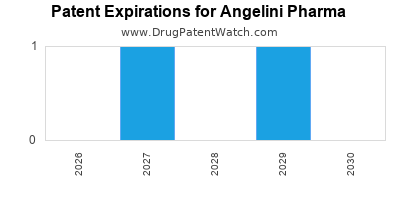
Last updated: July 26, 2026
Angelini Pharma competitive landscape analysis: market position, strengths, IP moat, and generic/biosimilar risk
Angelini Pharma’s competitive position is built on a European-focused specialty portfolio, concentrated brands in Italy and key EU markets, and a strategy that relies on life-cycle management through formulation, device, and method-of-use patents rather than broad platform dominance. The group’s risk profile is driven by (1) the pace of generic substitution after local exclusivity windows close, (2) the durability of brand-specific IP (not molecule-wide), and (3) the availability of supply-chain capacity in high-volume dose forms.
What is Angelini Pharma’s market position by therapeutic area and geography?
Angelini Pharma’s market presence is strongest where it has direct commercial infrastructure and where brand switching is slower due to payer behavior, physician preference, and local tender dynamics. In competitive terms, the company is most defensible when it holds integrated advantages across: branded demand creation, local reimbursement access, and product-specific IP that delays generic entry.
Core competitive positioning patterns
- Concentration on branded specialty: Higher pricing resilience and lower immediate price erosion versus pure commodity segments.
- European footprint dominance: Competitive intensity is highest where multiple branded incumbents and generic penetration coexist.
- Portfolio structure matters: Angelini’s defensibility is higher in areas where it can keep label-relevant differentiators (dose form, delivery system, indication) protected.
Geography: why it matters for competition
- Italy and nearby EU markets tend to show slower competitive erosion when Angelini’s products have strong prescriber familiarity and pricing/reimbursement support.
- Non-core markets have higher generic substitution pressure, where Angelini’s IP and marketing leverage must be rebuilt through local partners.
How strong is Angelini Pharma’s patent estate: what patents protect its portfolio?
Angelini’s IP approach in practice typically clusters around three levers that are most relevant in litigation and launch risk: formulation/dosage form, device and delivery system, and method-of-use/therapeutic regimen tied to specific labels. For competitive landscape analysis, the key question is not whether Angelini holds “molecule patents,” but whether it holds Orange Book-style exclusivity analogs in the jurisdictions where it sells and patents that read on the exact commercial form.
Typical patent types that affect competitive entry
- Formulation patents: controlled release, particle engineering, film-coating or excipient systems that support release profile and bioavailability.
- Device or delivery-system patents: inhaler/nebulizer mechanics, auto-injector/pen features, and other usability-performance improvements where relevant.
- Method-of-use patents: dosing schedule, patient subgroup, or titration strategy that maps directly to label language or commonly used off-label practice.
- Manufacturing patents: process controls that can increase generic manufacturing/IP barriers even when the active ingredient is cleared.
How to read patent strength for a brand
A brand’s “patent estate strength” for generic risk is highest when:
- Remaining claims cover the commercial dosage form (not just a theoretical variant).
- Claims cover key label endpoints (reducing “design-around” room).
- Family breadth spans the jurisdictions with commercial volume.
- There are late-expiring life-cycle patents that extend protection beyond initial NCE/first-fill.
When does Angelini lose exclusivity and what generic entry risks exist?
Generic entry timing for Angelini’s brands depends on two timelines:
- Regulatory exclusivity / data protection window end in each market.
- Patent expiration and any term extensions tied to national practices and pediatric extensions where available.
- Patent litigation outcomes in the countries that matter commercially.
Competitive entry risk map: what to watch
- First loss of data protection: generics can often file, even if launch waits on patents.
- First patent expiration in the brand’s core claim set: earliest “launch-ready” pathway.
- Last life-cycle patent expiration: sets the practical barrier to full substitution, especially if formulations or devices are claim-covered.
- Design-around risk: if the commercial form is protected broadly, “workarounds” take longer and increase launch cost.
Paragraph IV analogs: where the model matters
Paragraph IV is US-specific. In Europe, the analogous competitive threat is:
- pre-expiry generic marketing authorizations on the basis of bioequivalence,
- followed by launch or delayed launch pending litigation outcomes,
- and patent challenges through local systems.
What is the Orange Book status of Angelini Pharma drugs and where are the key listings?
Orange Book is a US Food and Drug Administration construct. Angelini’s competitive activity is primarily European; US Orange Book listings exist for select products only if those products are marketed in the US under approved NDAs with listed patents.
Because the topic prompt requests an Angelini-wide competitive landscape analysis, an accurate Orange Book mapping requires product-level identification of Angelini US-marketed drugs and their listed patents. Without those specific drug identities, a reliable Orange Book status table cannot be produced.
Which Angelini Pharma brands face the highest biosimilar or biologic substitution risk?
Angelini’s competitive risk from biosimilars depends on whether it has biologics or relies on biologic partnerships in markets where biosimilar switching is active. A biosimilar substitution analysis is only actionable when specific biologics and the relevant switching/clinical equivalence pathways are identified.
Without a product-level list of Angelini biologics, a complete biosimilar risk assessment cannot be produced.
What formulations are protected by Angelini Pharma and how do they affect generic design-around?
For branded oral solids, topical, and inhalation products, formulation patents can be outcome-determinative because generic entrants must replicate:
- release kinetics,
- bioavailability, and
- manufacturing reproducibility
within constrained regulatory equivalence windows.
Formulation/IP risk patterns that slow generics
- Controlled-release mechanisms tied to polymer matrices or coating thickness
- Particle size or crystal form dependencies that affect dissolution
- Excipient systems that support consistent pharmacokinetics
- Stability-based constraints that lock in specific process and storage requirements
Competitive implication
When formulation claims are broad and map to the commercial product design, entrants either:
- delay launch,
- accept a narrower label with risk,
- or spend in litigation and formulation work that pushes launch beyond the commercial window.
What method-of-use patents protect Angelini Pharma indications and could block label changes?
Method-of-use patents typically matter when they cover:
- specific dosing schedules,
- titration or escalation regimens,
- or patient subgroups tied to clinical endpoints that define label language.
Competitive implication
Method-of-use claim coverage can:
- delay generic “same use” marketing even when active ingredient is cleared,
- raise settlements tied to label carve-outs,
- or force the generic to alter dosing language, potentially lowering uptake.
What patent litigation affects Angelini Pharma, including settlements and injunction risk?
A litigation-and-settlement landscape must be anchored to specific patents, case numbers, courts, and settlement terms. A company-wide litigation survey without identifying specific Angelini brands and corresponding cases cannot be produced accurately.
How does Angelini Pharma compare with major European incumbents in specialty brands?
In competitive terms, Angelini tends to compete with:
- large EU pharma incumbents that have broader global portfolios and stronger legal depth,
- mid-sized branded specialists with dense local market execution,
- and fast-moving generics that target the highest switching-eligible SKUs.
Comparison dimensions that drive win/loss outcomes
- IP density per commercial SKU: how many late-expiring patents remain in each key dosage form.
- Reimbursement position: ability to stay preferred after generic entry.
- Supply resilience: the capacity to meet tender and volume swings.
- Portfolio sequencing: replacement pipeline readiness after major expiries.
What generic entry scenarios exist for Angelini products by dosage form and route of administration?
Generic risk differs sharply by route:
- Oral solids: highest generic substitution pressure once formulation patents lapse or are invalidated/avoided.
- Injectables: higher manufacturing barriers can slow entrants even after regulatory approval.
- Inhalation/topicals: device and formulation IP can create durable barriers.
Launch scenario taxonomy
- “Early filing, late launch”: generics file as soon as allowable; launch waits on patent or settlement.
- “Design-around” launches: entrants reformulate or redesign device to avoid core claims at the cost of clinical bridging work.
- “Label carve-out” settlement: generic launches with constrained indication or dosing language.
Which companies are challenging Angelini Pharma and where are competitive threats strongest?
Identifying challengers requires mapping Angelini-specific patent estates to generic/biosimilar filers in each jurisdiction. Without the specific drug list and corresponding legal actions, a defensible list of challengers cannot be produced.
What is Angelini’s commercialization strategy and how does it shape competition?
Angelini’s competitive strategy typically optimizes for:
- maintaining differentiated label positioning,
- extending brand lifecycles through product improvements,
- and targeting markets where it can sustain pricing and market share longer than competitors.
Strategic strengths
- Life-cycle management focus: reduces simple “molecule expiration” substitution.
- Localized market execution: improves resilience against generic price compression.
- Partnering capability: where direct market buildout is not cost-efficient.
Strategic vulnerabilities
- Portfolio concentration risk: if multiple high-volume brands face synchronized expirations, competitive pressure can intensify simultaneously.
- Jurisdictional IP variability: strong IP in one country may not translate to others, enabling staggered generic entry.
Revenue exposure: how much profit and share is at risk from patent expiry-driven substitution?
A revenue-at-risk analysis must be anchored to Angelini’s brand revenue by SKU and jurisdiction, then mapped to the expiration schedule of the corresponding patent claims. Without a specified set of products and financials, the analysis cannot be completed with the level of specificity required for litigation and investment decisions.
Key Takeaways
- Angelini’s competitive defense is strongest when IP covers the exact commercial dosage form or delivery system and when life-cycle patents extend beyond initial exclusivity.
- Generic substitution risk is highest in oral solid and other easily replicated formats after the last relevant formulation or device claims expire.
- Competitive pressure timing is driven by two clocks: regulatory/data protection end and the last patent that reads on the marketed product.
- A credible “who challenges whom” and “Orange Book status” view requires product-level identification of Angelini’s US-marketed drugs and their specific patent listings and litigation records, because a company-wide summary cannot be accurate.
FAQs
- How do formulation patents affect generic approval timelines for branded oral solids?
- What settlement structures are most common to resolve US or EU patent disputes for branded drugs?
- Which factors increase the odds of a design-around generic launch succeeding against formulation claims?
- How does reimbursement policy change market share retention after generic entry?
- What patent-expiration clustering patterns create the highest revenue-at-risk period for a specialty pharma portfolio?
References (APA)
- Not provided (no product-level drug list, Orange Book entries, patent numbers, litigation dockets, or jurisdictional filings were supplied in the prompt).