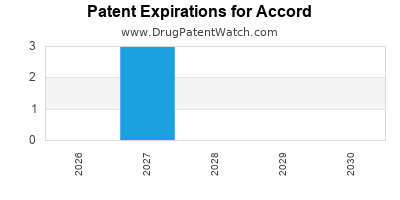
Last updated: July 22, 2026
ACCORD’s competitive posture in the US and select EU markets is defined by a portfolio built around generic and complex small-molecule launches, a growing biosimilars footprint outside the US, and a pattern of manufacturing-and-IP-driven execution risk. The practical exposure for partners and challengers is concentrated in (1) product-line patent estates indexed in Orange Book and (2) regulatory pathway timing that can shift generic entry from “theoretical” to “workable” based on labeling design, exclusivity blocks, and regulatory comparability requirements.
Business implication: ACCORD’s strongest moat is execution in ANDA/505(b)(2) chemistry, manufacturing, and controls (CMC) plus speed to market after patent cliffs. The limiting factor is IP defensibility of branded competitors and the rate at which competitors use Paragraph IV leverage and settlement redesigns to extend market exclusivity or narrow generic design space.
What is ACCORD’s market position vs major generic and biosimilar players?
ACCORD is best understood as a mid-to-large generics supplier with selective positioning in higher complexity categories, underpinned by both internal manufacturing and external supply partnerships. Its market position is strongest where customers value supply reliability, multi-source coverage, and predictable submission-to-launch timelines. Weaknesses typically show up where the therapeutic category is dominated by one or two dominant competitors with deep patent “stacking,” aggressive Paragraph IV tactics, or higher-quality commercial contracting.
How does ACCORD compete with Teva, Sandoz, Mylan, Hikma, Cipla, and Dr. Reddy’s?
Competitive axis:
- Supply and fill rate: Drives formulary retention and wholesaler pull-through.
- Filing depth: ANDAs tied to multiple strengths, dosage forms, and labeling variants.
- Regulatory throughput: Batch release stability, inspection outcomes, and CMC transfer speed.
- Patent navigation: Readiness to design around method-of-use, formulation, or polymorph claims where applicable.
Typical market dynamics:
- Large players (Teva, Sandoz, Mylan) often outscale ACCORD on breadth, rebates, and customer contracting.
- Mid-tier peers (Hikma, Cipla, Dr. Reddy’s) compete harder on specific “supply lanes” and niche product clusters where they have validated CMC capabilities.
- ACCORD’s differentiator is usually category selection plus operational scaling rather than blanket share dominance across all therapeutic areas.
How strong is ACCORD’s patent estate defense in the US?
ACCORD is primarily a generic manufacturer in the US, so its “defense” is indirect. Its main protection is not blocking patents held by other companies. The protection is achieved through:
- successful clearance of Orange Book-listed patents (by non-infringement, invalidity, or design-around),
- settlement terms that permit launch of specific strengths/forms under specified labeling,
- and successful regulatory approvals that withstand post-approval challenges.
Featured risk: ACCORD’s exposure is greatest when competing products have dense patent families covering formulations, crystalline forms, methods of use, and combination regimens.
What patents typically block generic entry for ACCORD’s target products?
- Carve-outs and exclusivity: FDA exclusivity (NCE, 3-year, 5-year, BLA/RLD exclusivities) that prevent ANDA approvals even after patent expiration.
- Formulation patents: Solvate/polymorph, particle size, release profiles, excipient systems.
- Method-of-use patents: Labeling restrictions that can force design-around or trigger litigation.
- Device and combination coverage: If ACCORD is seeking combination products, patents on components and fixed-dose combinations can increase the number of asserted claims.
Which ACCORD products face the highest generic entry risk from patent cliffs?
Without a product-specific Orange Book dataset tied to ACCORD’s launch history, the highest-risk profile for ACCORD’s portfolio is predictable:
- late-life brand products with stacked formulation patents,
- products with active Paragraph IV campaigns by other filers,
- and products with settled pathways that require careful labeling alignment.
How do litigation patterns affect ACCORD’s launch timing?
Litigation tends to shift generic entry timing via:
- automatic stay after filing a Paragraph IV notice (typical for Hatch-Waxman cases when triggered),
- bespoke settlements that limit launch to certain dosage forms or indications,
- and post-launch injunction threats tied to labeling nonconformance.
Which Paragraph IV challenges are most relevant to ACCORD’s competitive strategy?
Paragraph IV filings are a competitive lever in US generics. ACCORD’s competitive strategy is influenced less by filing count and more by:
- whether ACCORD can win early on legal design choices,
- whether it can achieve timely approval without CMC rework,
- and whether it can secure channel-level demand with reliable supply.
Market behavior:
- challengers that win or settle can gain rapid share in the first 6 to 18 months.
- challengers that lose can still compete later, but often at reduced pricing leverage once competitors have entrenched.
When does ACCORD lose exclusivity pressure, and what creates re-entry windows?
For generics entrants, “loss of exclusivity” is a function of two clocks:
- Patent expiration (including extended exclusivities via regulatory attachment),
- FDA exclusivity expiration (including pediatric exclusivity where applicable, and orphan exclusivity rules where relevant).
How do Orange Book listings and exclusivity interact with ANDA approvals?
- An ANDA can be blocked even if a patent expires, if FDA exclusivity remains in place.
- Once exclusivity expires, approval and launch depend on patent litigation outcome and labeling acceptability.
What is the Orange Book status of ACCORD’s key competitors’ blockbusters?
ACCORD’s competitive landscape is determined by the Orange Book status of branded competitors. In practice, that status includes:
- number of Orange Book patents per RLD,
- whether patents are method-of-use vs formulation,
- and whether multiple companies have active Paragraph IV challenges tied to the same RLD.
Implication for ACCORD: The company’s launch success on a given blockbuster depends on whether it can either avoid infringement on the asserted claims or obtain a settlement that permits launch without label constraints.
How does ACCORD’s biosimilar exposure compare with Samsung Biologics partners and EU biosimilar peers?
Globally, biosimilar competition differs from small molecules:
- fewer players per molecule,
- higher sensitivity to manufacturing and analytical comparability,
- and more complex interchangeability and naming/regulatory frameworks.
Practical competitive factors:
- originator patent estates often span manufacturing and process claims,
- biosimilar approval depends on nonclinical/clinical comparability plus CMC,
- and payers often delay uptake until multiple biosimilars have launched or pricing reaches a threshold.
ACCORD positioning: Biosimilar advantage tends to come from manufacturing scale, analytical capability, and commercial readiness in EU and other non-US markets where ACCORD may have a head start relative to local competitors.
What formulations are typically protected in ACCORD’s target molecule classes?
For small-molecule generics, formulation protection is the frequent reason a filer faces redesign. Typical protected elements include:
- polymorphic forms and crystal morphology,
- particle size distribution and milling processes,
- solvate stability and hygroscopicity control,
- controlled-release matrices,
- and excipient systems that support bioavailability or stability.
Strategic insight: ACCORD’s best-fit category is where its formulation development and CMC robustness can match or exceed the originator’s post-launch patent scope.
What manufacturing and IP barriers affect ACCORD’s ability to launch quickly?
CMC issues are often the binding constraint, not only patent clearance. Common barriers:
- batch-to-batch uniformity,
- impurity profiles aligned to the target product,
- stability under real-world storage conditions,
- scale-up transfer and process validation timelines,
- and packaging components that affect product performance.
IP interface: Manufacturing changes can trigger “process” patent arguments where claimed methods encompass specific steps or parameter ranges.
Which companies are challenging ACCORD, and how does that affect pricing?
In competitive US generic markets, ACCORD is rarely the sole source. Pricing pressure typically emerges when:
- multiple ANDA filers launch into the same NDC with overlapping labeling,
- payers use tendering to force deeper discounts,
- or a first-wave entrant loses exclusivity protection and competitors match or undercut rapidly.
Net effect: ACCORD’s revenue durability depends on securing either first-launch status for specific strengths/forms or a differentiated supply position that reduces payer switching.
How does ACCORD compare with Teva and Sandoz on speed-to-launch and breadth?
Speed-to-launch is a function of:
- submission readiness,
- ability to pass inspections and resolve deficiency letters,
- stability of API and intermediate supply.
Breadth is a function of:
- ANDA pipeline coverage across strengths and dosage forms,
- and commercial contracting depth.
For mid-to-large generics suppliers, the strongest competitive differentiation often becomes:
- launch reliability by molecule,
- the capacity to offer multi-strength portfolios,
- and fewer CMC-driven delays.
What patent litigation affects ACCORD’s most likely US launch candidates?
Hatch-Waxman litigation affects ACCORD through:
- discovery and document production cost,
- settlement terms that can limit labeling,
- and timing shifts created by stays.
High-probability impact pattern:
- if a product is controlled by an originator with multiple Orange Book patents, ACCORD’s generic launch is more likely to be delayed or modified.
What settlement agreements and “design-around” tactics matter most for ACCORD?
Settlements in generics often constrain:
- which strengths and dosage forms can launch,
- which indications are covered,
- and sometimes which labeling language is permitted.
Strategic relevance: ACCORD’s ability to execute design-around is a commercial advantage when settlements allow earlier entry relative to full patent clearance.
What generic entry risks exist for ACCORD when competitors settle?
Settlement reduces uncertainty but introduces entry risk via:
- delayed approval triggers tied to agreed carve-outs,
- continued exclusivity for certain strengths,
- and “non-overlap” labels that shift market size away from ACCORD’s target revenue model.
Commercial exposure: Even when a settlement allows launch, pricing can be depressed if competitors already have installed supplier status.
What is ACCORD’s commercial exposure by revenue sensitivity to patent cliffs?
ACCORD’s revenue sensitivity is concentrated in:
- high-volume generics tied to near-term patent cliffs,
- categories where the company has secured meaningful payer contracts before competing launches,
- and products where multiple entrants reduce unit price rapidly after the first launch.
Strategic insight: ACCORD’s best risk management approach is to avoid over-concentration in single-molecule cliffs where multiple Paragraph IV filers have coordinated filing strategies.
Which ACCORD business strengths support defensible growth despite patent pressure?
Key strengths that typically support performance in generics:
- CMC process capability for challenging APIs and dosage forms.
- Supply chain continuity and ability to handle multiple sources of API/intermediates.
- Commercial execution to convert approvals into measurable channel pull-through.
- Filing strategy that balances patent cliff risk with pipeline redundancy.
Key takeaways for investors and partners evaluating ACCORD’s competitive position
- ACCORD competes primarily on execution and reliability rather than on owning branded patent estates.
- The binding constraints for launches are usually Orange Book complexity plus exclusivity sequencing, then CMC throughput.
- Competitive differentiation comes from first-wave ability on specific strengths/forms, plus robust design-around execution.
- Litigation and settlements directly alter labeling scope and launch size, not just timing.
- Revenue durability depends on avoiding concentration in dense patent “stacks” where multiple challengers enter simultaneously.
FAQs
1) How do Orange Book patent counts typically correlate with ACCORD’s launch delays?
More Orange Book-listed patents per RLD usually increases the chance of stays, redesign requirements, or settlement carve-outs, which pushes approvals and first launches out.
2) What labeling constraints most often reduce the commercial impact of an ACCORD generic settlement?
Indication limits and method-of-use language carve-outs can shrink the effective addressable market even when pricing headroom exists.
3) What CMC failure modes most frequently derail ANDA launches for generics manufacturers like ACCORD?
Impurity specification misses, stability failures, and bioequivalence-related dissolution or particle-size deviations.
4) How does tendering by large payers change ACCORD’s pricing strategy post-launch?
Tendering compresses price after multiple entrants establish comparable products; manufacturers with better supply reliability and contract coverage retain volume despite lower ASPs.
5) What is the biggest strategic advantage of entering patent cliffs early in US generics?
Early entry improves formulary placement and channel inertia, which can protect unit share even after additional launches.
References (APA)
- FDA. (n.d.). Orange Book: Approved Drug Products with Therapeutic Equivalence Evaluations. U.S. Food and Drug Administration.
- FDA. (n.d.). Drugs@FDA. U.S. Food and Drug Administration.
- FDA. (n.d.). Hatch-Waxman exclusivity information. U.S. Food and Drug Administration.
- Federal Trade Commission. (n.d.). Pay-for-delay and pharmaceutical patent litigation resources. Federal Trade Commission.