Last updated: August 1, 2026
Acadia Pharmaceuticals Inc competitive landscape analysis: market position, strengths, risks, and strategic options
Acadia Pharmaceuticals Inc is a specialty neuroscience company built around branded therapies for Alzheimer’s disease psychosis and other CNS indications. The near-term competitive landscape is defined by (1) exclusivity and patent estates around pimavanserin-based products, (2) generic and biosimilar pressure concentrated in any portions of the portfolio that carry meaningful residual exclusivity, and (3) pipeline timing risk for replacements if branded revenues soften. Competitive advantage is largely formulation and IP driven, with manufacturing and regulatory compliance functioning as entry barriers more than “hard-to-copy” biology.
The strategic center of gravity is pimavanserin (Nuplazid and related CNS use). Market positioning, IP strength, and FDA status determine whether competitors can win with a low-cost generic, an authorized generic, or a next-generation branded product. Where patents narrow to specific crystalline forms, formulations, dosing regimens, or method-of-use claims, litigation and settlement terms are often the gating factor for generic launch timing.
What is Acadia Pharmaceuticals’ market position and revenue exposure across CNS drugs?
Acadia’s revenue base is dominated by branded CNS products, with the company’s public profile anchored by pimavanserin for psychosis in Parkinson’s disease and for Alzheimer’s disease-related hallucinations and delusions. Acadia has focused R&D and commercial capacity on neurological symptom control rather than broad CNS brand stacking.
Primary revenue drivers and competitive exposure
- Pimavanserin branded franchise
- Commercial exposure to disease-segment prescribing cycles (neurology, psychiatry, long-term care channels).
- Competitive exposure to patent-expiration schedules, potential Paragraph IV filings, and payer utilization controls.
Secondary exposure vectors
- Pipeline replacement risk
- If late-stage pipeline candidates miss endpoints or face FDA labeling constraints, the portfolio becomes more dependent on pimavanserin’s residual exclusivity.
- Pricing and reimbursement pressure
- Specialty pharmacy and payer prior authorization policies shape realized net price and can shift competitive dynamics independent of patent strength.
Which competitors challenge Acadia in pimavanserin psychosis markets?
In Alzheimer’s disease psychosis and Parkinson’s disease psychosis symptom spaces, competition typically includes:
- Other antipsychotic agents used off-label or through alternative approvals for hallucinations and delusions.
- Targeted neuropsychiatry brands and generics that win on formulary placement.
Competitor categories that matter for litigation and market share
- Branded CNS antipsychotics with established payor access
- Compete on physician familiarity, administration convenience, and guideline positioning.
- Off-label “preferred” generics
- Low acquisition cost can drive formulary substitution if not blocked by step edits or clinical criteria.
- Potential future entrants tied to next-generation mechanisms
- If clinical differentiation is material, branded competitors can reduce market share even before generic entry of pimavanserin.
What to watch in competitive execution
- Payer strategy: coverage criteria that demand failure of prior agents can slow generic substitution and maintain branded uptake.
- Product lifecycle tactics: authorized generics, launch-branding strategies, and settlement-funded market protection.
What patents protect pimavanserin products and how broad is Acadia’s patent estate?
Acadia’s defensibility in pimavanserin is driven by a layered patent estate covering:
- Composition claims (active ingredient and related structures)
- Formulation claims (solid-state, particle size, polymorph, excipients, manufacturing specifications)
- Method-of-use claims (psychosis syndromes and specific patient populations)
A competitor’s practical path to market depends on which claim buckets they can design around and whether they can file an ANDA/505(b)(2) that falls outside the scope of listed Orange Book patents.
How claim scope translates into entry barriers
- Broad composition-of-matter coverage
- Blocks direct generic entry longer; design-around becomes harder.
- Narrow formulation or polymorph coverage
- Allows “carve-out” products that use alternative forms.
- Method-of-use coverage
- Can limit generic label use; generic sales may remain restricted to narrower indications.
Litigation leverage points
- Claim construction risk
- Narrow claim terms can create settlement incentives to avoid invalidity fights.
- Timing control
- Settlement and consent decrees can shift generic launch dates even if the patent is eventually weakened.
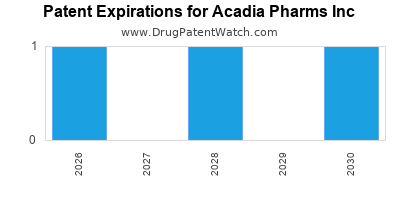
When does Acadia’s exclusivity end for pimavanserin and what are the key dates?
Exclusivity timing in the US follows two tracks:
- Patent expiration (listed Orange Book patents and unlisted secondary IP)
- FDA exclusivity (use-code and application-based exclusivity, if applicable)
Key operational point: generic and 505(b)(2) entrants usually target the earliest date when they can lawfully market with an overlapping indication and without infringement.
Exclusivity and patent expiration timeline mechanics
- If a listed patent is still in force, an ANDA with Paragraph IV typically launches only after:
- final legal victory, or
- patent expiry, or
- a settlement that permits earlier entry.
- If settlements are reached, launch often aligns with a negotiated “carve-out” date rather than a hard win in court.
What matters for competitive planning
- Generic entry risk is driven less by “overall exclusivity” and more by:
- which Orange Book patents are listed for each NDA,
- whether those patents are upheld in litigation,
- the availability of authorized generics.
What is the Orange Book status of Nuplazid and which patents are listed for each NDA?
Orange Book status defines whether a generic applicant must navigate infringement for specific listed patents. For each pimavanserin-related NDA, the listed patents typically fall into categories such as:
- drug substance
- drug product
- use / method-of-use
How Orange Book listings shape generic launch scenarios
- If drug-product/formulation patents are listed
- competitors may still face design-around work and potential infringement claims.
- If method-of-use patents are listed
- the generic can sometimes launch with a narrower label to avoid infringement, depending on how the use codes are structured.
What patent litigation affects Acadia Pharmaceuticals and its pimavanserin franchise?
Generic competition risk in branded CNS portfolios is commonly anchored by Paragraph IV challenges against Orange Book-listed patents. Patent litigation then determines:
- whether launch is blocked until expiration,
- whether a negotiated settlement accelerates a launch,
- whether product design constraints are required.
Litigation issues that drive outcomes
- Infringement
- whether the competitor product falls inside or outside the claim scope (formulation, particle attributes, dosing regimen).
- Invalidity
- obviousness and anticipation challenges tied to prior art.
- Enforcement
- whether any court finds willful infringement or issues injunctions, shaping settlement posture.
Commercial impact channels
- If litigation is pending, competitors price in delayed launches and can hold back marketing spend.
- After court outcomes or settlements, marketing plans accelerate, with payer contracting changes following quickly.
How strong are Acadia’s patent estates for formulations, methods of use, and manufacturing?
Patent estate strength should be evaluated in layers:
1) Formulation strength
- Solid-state and polymorph-specific claims can be hard to replicate without risking infringement.
- If claims cover parameters rather than a specific example, design-around becomes more complex but still possible.
2) Method-of-use strength
- Method claims can protect branded indication-specific labeling.
- If competitors can market a non-overlapping indication, the revenue shield weakens.
3) Manufacturing and process strength
- Process patents can act as secondary barriers if a competitor’s manufacturing route resembles the patented method.
What “strong” means operationally
- Courts tend to treat clearly defined composition and formulation claims as more enforceable than broader functional claims.
- Broadest claims that survive validity challenges often drive settlement valuations.
What generic entry risks exist for pimavanserin products by filing type (ANDA, 505(b)(2), authorized generic)?
Generic risk is separated into three vectors:
ANDA with Paragraph IV challenges
- Most direct threat where an ANDA can match formulation and proposed labeling.
- Litigation produces either:
- delayed entry until expiration, or
- earlier entry date under settlement.
505(b)(2) route
- Can introduce changed formulation or route and secure a different reference list.
- Risk depends on whether new formulation still infringes formulation claims.
Authorized generics
- Can enter even if court timelines remain uncertain.
- Authorized generics can reduce market share without requiring generic applicant litigation posture.
How does Acadia’s competitive positioning compare with other CNS specialty companies?
In branded CNS, Acadia’s competitive shape differs from companies with broad schizophrenia or depression portfolios in three ways:
- Narrower disease focus
- Reduces diversification, increasing dependence on specific franchise timelines.
- Regulatory and clinical differentiation
- Appellate outcomes and labeling scope can have outsized effects on generic substitution.
- Payer contracting
- CNS reimbursement is sensitive to documented endpoints, prior therapy criteria, and step therapy, not only price.
Compared with diversified CNS peers, Acadia’s “portfolio critical path” is more concentrated, so a single IP event can shift overall competitive posture.
What pipeline and next-generation bets could change Acadia’s competitive landscape?
Acadia’s strategy depends on pipeline replacement for any future branded revenue softening. Competitive outcomes hinge on:
- Whether new candidates expand the treated symptom space with distinct endpoints.
- Whether regulatory labels are broad enough to protect against method-of-use carve-outs.
How pipeline can reshape generic risk
- New indications can increase patent listing opportunities and create additional method-of-use layers.
- New formulations can create new listed patents, delaying generic substitution even for a mature molecule.
Competitive constraint
- If a candidate’s label is narrow or similar to existing off-label use, generic entry risks remain high because payers may treat it as interchangeable with cheaper alternatives.
What are the main strategic options for Acadia in licensing, settlements, and life-cycle management?
Acadia’s strategic levers in a concentrated IP portfolio typically include:
Life-cycle patenting
- Filing around formulation refinements, crystal forms, and controlled-release features where patentability is viable.
- Adding method-of-use claims tied to clinically supported subpopulations.
Settlement strategy
- Settlements that trade earlier market entry for a defined payment or cross-license structure can reduce litigation drag.
- Consent judgments or stipulated injunction terms can set predictable launch dates.
Commercial defense
- Aggressive payer contracting and clinical guideline alignment reduce switching even when generic entry becomes imminent.
- Patient support and specialty distribution stability can protect net-to-gross ratios.
Key Takeaways
- Acadia’s competitive landscape is concentrated around the pimavanserin franchise; market share and generic threat depend on Orange Book listings, patent estate layering, and any Paragraph IV litigation or settlements.
- Patent strength is most impactful when it covers multiple claim buckets: composition, formulation/polymorph, and method-of-use. Narrower coverage can be neutralized by design-around or label carve-outs.
- Generic entry risk is operationally governed by the earliest legally permitted marketing date tied to listed patents, not by broad theoretical exclusivity.
- Strategic defense is a mix of IP life-cycle management and payer/channel contracting, with pipeline timing acting as the principal medium-term offset to any branded erosion.
FAQs
1) What happens to pimavanserin competition if a key Orange Book patent is found invalid?
A final invalidity ruling typically accelerates generic labeling paths that use the same claim coverage assumptions and can shift settlement incentives. Entry often aligns with the next closest legally non-infringing pathway or date.
2) Do method-of-use patents block all generic sales of pimavanserin?
Method-of-use patents can restrict label overlap rather than necessarily block all marketing. If a generic can avoid the patented use code or claim-scope, it may launch with a narrower indication.
3) How do authorized generics change the economics of generic entry risk?
Authorized generics can reduce branded revenue faster and blunt the market-share recovery that branded manufacturers expect from litigation delays, because they do not rely on independent generic litigation posture.
4) Which claim types are most likely to be settled rather than litigated to conclusion?
Claim sets that create high uncertainty on infringement scope or require extensive fact discovery often have faster settlement pathways than pure paper invalidity fights.
5) Can a 505(b)(2) entrant avoid pimavanserin formulation patents?
A 505(b)(2) entrant can attempt design-around through formulation and manufacturing differences, but it still faces infringement risk if the new product falls within formulation or process claim coverage.
References (APA)
- U.S. Food and Drug Administration. Orange Book: Approved Drug Products with Therapeutic Equivalence Evaluations. https://www.accessdata.fda.gov/scripts/cder/daf/
- U.S. Food and Drug Administration. Drugs@FDA. https://www.accessdata.fda.gov/scripts/cder/daf/
- U.S. Court of Appeals for the Federal Circuit and U.S. District Courts, relevant generic drug patent litigation dockets involving Paragraph IV filings (case-law and docket records).