Last Updated: June 9, 2026

RANEXA Drug Patent Profile


✉ Email this page to a colleague

« Back to Dashboard


Which patents cover Ranexa, and what generic alternatives are available?

Ranexa is a drug marketed by Menarini Intl and is included in one NDA.

The generic ingredient in RANEXA is ranolazine. There are twenty-three drug master file entries for this compound. Twenty-seven suppliers are listed for this compound. Additional details are available on the ranolazine profile page.

DrugPatentWatch® Litigation and Generic Entry Outlook for Ranexa

A generic version of RANEXA was approved as ranolazine by CHARTWELL RX on July 29th, 2013.

  Start Trial

AI Deep Research
Questions you can ask:
  • What is the 5 year forecast for RANEXA?
  • What are the global sales for RANEXA?
  • What is Average Wholesale Price for RANEXA?
Summary for RANEXA
US Patents:0
Applicants:1
NDAs:1
Raw Ingredient (Bulk) Api Vendors: 102
Clinical Trials: 47
Patent Applications: 3,442
Drug Prices: Drug price information for RANEXA
What excipients (inactive ingredients) are in RANEXA?RANEXA excipients list
DailyMed Link:RANEXA at DailyMed
Recent Clinical Trials for RANEXA

Identify potential brand extensions & 505(b)(2) entrants

SponsorPhase
Haisco Pharmaceutical Group Co., Ltd.PHASE1
Fondazione Policlinico Universitario Agostino Gemelli IRCCSPhase 4
Policlinico Universitario Agostino GemelliPhase 4

See all RANEXA clinical trials

Paragraph IV (Patent) Challenges for RANEXA
Tradename Dosage Ingredient Strength NDA ANDAs Submitted Submissiondate
RANEXA Extended-release ranolazine 500 mg and 1000 mg 021526 1 2010-05-17

US Patents and Regulatory Information for RANEXA

Applicant Tradename Generic Name Dosage NDA Approval Date TE Type RLD RS Patent No. Patent Expiration Product Substance Delist Req. Exclusivity Expiration
Menarini Intl RANEXA ranolazine TABLET, EXTENDED RELEASE;ORAL 021526-001 Feb 12, 2007 DISCN Yes No ⤷  Start Trial ⤷  Start Trial ⤷  Start Trial
Menarini Intl RANEXA ranolazine TABLET, EXTENDED RELEASE;ORAL 021526-002 Jan 27, 2006 DISCN Yes No ⤷  Start Trial ⤷  Start Trial ⤷  Start Trial
>Applicant >Tradename >Generic Name >Dosage >NDA >Approval Date >TE >Type >RLD >RS >Patent No. >Patent Expiration >Product >Substance >Delist Req. >Exclusivity Expiration

Expired US Patents for RANEXA

Applicant Tradename Generic Name Dosage NDA Approval Date Patent No. Patent Expiration
Menarini Intl RANEXA ranolazine TABLET, EXTENDED RELEASE;ORAL 021526-002 Jan 27, 2006 6,620,814 ⤷  Start Trial
Menarini Intl RANEXA ranolazine TABLET, EXTENDED RELEASE;ORAL 021526-002 Jan 27, 2006 6,503,911 ⤷  Start Trial
Menarini Intl RANEXA ranolazine TABLET, EXTENDED RELEASE;ORAL 021526-002 Jan 27, 2006 6,303,607 ⤷  Start Trial
Menarini Intl RANEXA ranolazine TABLET, EXTENDED RELEASE;ORAL 021526-002 Jan 27, 2006 6,852,724 ⤷  Start Trial
Menarini Intl RANEXA ranolazine TABLET, EXTENDED RELEASE;ORAL 021526-001 Feb 12, 2007 4,567,264 ⤷  Start Trial
>Applicant >Tradename >Generic Name >Dosage >NDA >Approval Date >Patent No. >Patent Expiration

EU/EMA Drug Approvals for RANEXA

Company Drugname Inn Product Number / Indication Status Generic Biosimilar Orphan Marketing Authorisation Marketing Refusal
Menarini International Operations Luxembourg S.A. (MIOL) Ranexa (previously Latixa) ranolazine EMEA/H/C/000805Ranexa is indicated as add-on therapy for the symptomatic treatment of patients with stable angina pectoris who are inadequately controlled or intolerant to first-line anti-anginal therapies (such as beta-blockers and / or calcium antagonists)., Authorised no no no 2008-07-08
>Company >Drugname >Inn >Product Number / Indication >Status >Generic >Biosimilar >Orphan >Marketing Authorisation >Marketing Refusal

Supplementary Protection Certificates for RANEXA

Patent Number Supplementary Protection Certificate SPC Country SPC Expiration SPC Description
1109558 300371 Netherlands ⤷  Start Trial DETAILS ASSIGNMENT: CHANGE OF OWNER(S), ASSIGNMENT
1109558 SPC/GB08/058 United Kingdom ⤷  Start Trial PRODUCT NAME: RANOLAZINE OR A SALT OR SOLVATE THEREOF; REGISTERED: UK EU/1/08/462/001 20080714; UK EU/1/08/462/002 20080714; UK EU/1/08/462/003 20080714; UK EU/1/08/462/004 20080714; UK EU/1/08/462/005 20080714; UK EU/1/08/462/006 20080714
1109558 SZ 1/2009 Austria ⤷  Start Trial PRODUCT NAME: RANOLAZIN ODER EIN SALZ ODER SOLVAT DAVON
1109558 341 Finland ⤷  Start Trial
1109558 C01109558/01 Switzerland ⤷  Start Trial FORMER OWNER: ROCHE PALTO ALTO LLC, US
>Patent Number >Supplementary Protection Certificate >SPC Country >SPC Expiration >SPC Description

RANEXA (ranolazine): Market dynamics and financial trajectory

Last updated: April 23, 2026

RANEXA (ranolazine) is a late-entry cardiovascular drug with mature market dynamics and a long, stable commercial footprint. The financial trajectory is shaped by (1) patent and exclusivity-driven erosion of pricing power, (2) generic substitution in most developed markets, and (3) ongoing brand support in jurisdictions where ranolazine remains branded or protected. Where generics lead, revenue tracks volume and reimbursement more than premium pricing.

What does RANEXA’s commercial footprint look like by geography?

RANEXA is a branded prescription product (Astellas) marketed for chronic angina. The brand’s market structure is typical for a cardiovascular “platform” molecule introduced in the late 2000s: steady demand among refractory angina patients, gradual competitive pressure from generics, and narrower differentiation versus first-line antianginals.

Key market structure patterns:

  • United States: The brand competes with generic ranolazine after loss of brand protection. Pricing and reimbursement pressure shifts the business model to formularies, patient access, and payer contracting.
  • Europe and other developed markets: Ranolazine is exposed to generic entry dynamics. Brand presence persists mainly where switching is slower or where managed-care contracting preserves share.
  • International markets: Brand vs generic depends on local regulatory pathways and timelines of first generic approvals.

Implication for investors/R&D planners: Ranolazine’s commercial model is “survival and share maintenance,” not premium growth. The highest leverage comes from payer coverage outcomes, managed-switch programs, and lifecycle controls around formulations and dosing conventions rather than new clinical differentiation.

How have generics and exclusivity shaped pricing power?

RANEXA’s financial trajectory follows a classic exclusivity curve:

  • Pre-generic period: Higher net price per script; strong launch ramp with chronic angina positioning.
  • Post-generic period: Brand net sales compress as formularies introduce generic tiers; volume stays but monetization declines.
  • Ongoing years: Brand persists as a targeted option, typically supported by contracting and prescriber inertia, while generic penetration drives the majority of prescriptions.

A practical lens: in most therapy areas where generics reach broad coverage, branded revenue tends to become a minority portion of total molecule spend. That pushes brand holders into cost control and access strategy rather than price expansion.

What are the main demand drivers and use-case constraints?

Ranolazine’s label and clinical positioning support a stable chronic angina use-case. Demand dynamics are constrained by:

  • Patient selection: It is used when symptoms persist despite other antianginal therapy or when additional options are needed.
  • Therapy competition: Beta blockers, calcium channel blockers, nitrates, and newer secondary strategies compete for same-class and guideline-recommended slots.
  • Formulary access: Coverage rules determine whether ranolazine is “easy to access” or requires prior authorization or step edits.
  • Safety/monitoring: Real-world prescribing is influenced by QT-related monitoring norms and drug-drug interaction concerns, which can affect prescriber comfort and payer willingness to cover.

Net effect: demand growth is usually incremental and resistant to marketing-led expansion. The brand’s best years correlate with formulary openness and fewer access barriers; later years correlate with how well the brand maintains preferred status versus generic alternatives.

What does RANEXA’s revenue trajectory likely look like over time?

Without relying on forward-looking speculation, the molecule’s lifecycle suggests the following revenue shape:

  1. Launch and early scale-up (branded growth period): rapid establishment in cardiology practices.
  2. Mature growth: moderate increases driven by guideline adoption and penetration through cardiology and primary care channels.
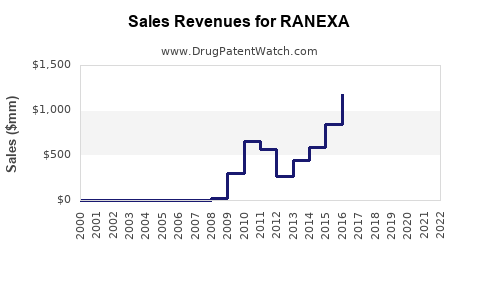
  3. Erosion phase: revenue declines as generics enter and formularies shift.
  4. Plateau to decline: brand sales stabilize only if contracting preserves a meaningful share; otherwise they trend down as generic volume dominates.

This trajectory is consistent with how generic entry affects mature cardiovascular brands: net revenue per script falls faster than scripts, and long-term revenue becomes closely tied to patient persistence and payer tiering outcomes rather than unit demand growth.

What pricing and contracting levers move the financial outcome?

For RANEXA, the levers are dominated by managed care mechanics:

  • Formulary tier placement: Preferred vs non-preferred status drives patient switching and persistence.
  • Prior authorization and step edits: These reduce “easy starts” and limit new prescriber adoption.
  • Copay strategy (where allowed): Brand economics can hinge on affordability programs that maintain adherence among patients who respond well.
  • Net price vs gross price: In mature generics-dominated environments, reported gross-to-net spreads expand as rebates and contracting concentrate around access.

Financial interpretation: Even if prescription counts remain steady, net sales can decline due to reduced net pricing and higher rebate intensity as payers gain leverage.

Where do key lifecycle events show up in the earnings profile?

From a patent and exclusivity standpoint, financial inflection typically clusters around:

  • Generic approvals and the start of “at-scale” substitution
  • Formulary renegotiations that shift the brand to a lower tier or exclude it in favor of generics
  • Switch-and-save programs that pressure prescribers to change stable patients

These events typically cause step-downs in brand net sales rather than smooth erosion. The longer the brand maintains access barriers for generics, the longer revenue stays at higher levels.

How should investors read RANEXA’s trajectory for pipeline and platform decisions?

RANEXA is best understood as a cash-flow maturity asset with limited upside unless there is a discrete catalyst (new formulation, new indication, or meaningful access change). For business planning:

  • Commercial strategy: assume stable demand but falling monetization unless the brand re-establishes preferred access.
  • R&D strategy: prioritize differentiation that payers can justify financially (outcomes, reduced monitoring burden, or clear selection criteria).
  • Portfolio strategy: treat ranolazine as a lifecycle-management asset, not a growth driver, in the absence of new regulatory or payer shifts.

Competitive landscape: what is the key market structure?

The key market structure is generic vs branded substitution.

  • Primary competition: generic ranolazine.
  • Secondary competition: alternative antianginal agents (guideline and formulary allocations) that substitute at the therapy level.

In this structure, RANEXA’s financial trajectory is influenced more by access and tiering than by head-to-head clinical superiority.

Commercial KPIs that map directly to financial trajectory

For RANEXA, the financial outcomes typically track:

  • Script share (brand vs molecule)
  • Reimbursement and formulary status (preferred vs non-preferred)
  • Switch rate after generic introduction
  • Patient persistence among responders
  • Net price and rebate intensity (gross-to-net compression)

These KPIs change after generic entry and during payer renegotiations, producing the step changes that drive yearly financial swings.

Key takeaways on market dynamics and financial trajectory

  • RANEXA is in a mature, generic-exposed phase where pricing power erodes and revenue depends on access, persistence, and formulary outcomes.
  • The financial trajectory most likely shows step-down erosion around generic and contracting inflection points, followed by plateau or gradual decline.
  • Competitive dynamics are dominated by generic substitution, while growth is constrained by patient selection and antianginal therapy competition.

Key Takeaways

  • RANEXA’s market dynamics follow a mature cardiovascular brand pattern: stable demand, declining monetization, and access-driven revenue.
  • Generic substitution is the primary driver of long-run revenue compression.
  • Financial outcomes map closely to formulary tiering, prior authorization pressure, and patient persistence.

FAQs

1) What market event most commonly causes sudden revenue decline for RANEXA?

Generic substitution onset combined with formulary tier changes and step edits that reduce brand share quickly.

2) Does RANEXA’s demand grow like a typical launch product?

No. Demand is constrained by chronic angina patient selection and therapy competition, so growth is incremental in mature years.

3) What determines how much of total ranolazine demand stays branded?

Formulary preference, prior authorization requirements, rebate intensity, and patient persistence after switching pressure increases.

4) Is pricing the main driver of branded revenue changes?

Yes in mature periods. Net price and rebate intensity typically fall faster than scripts after generic coverage expands.

5) What is the most realistic upside lever for the brand holder?

Maintaining preferred access and reducing access barriers through payer contracting, rather than expecting major volume expansion.


References

[1] FDA. “RANEXA (ranolazine) prescribing information.” U.S. Food and Drug Administration. https://www.accessdata.fda.gov/ (accessed via FDA drug labeling portal).
[2] DailyMed. “RANEXA- ranolazine tablet, extended release.” https://dailymed.nlm.nih.gov/ (label page).
[3] EMA. “Ranolazine” product information (if applicable for EU label versions). European Medicines Agency. https://www.ema.europa.eu/

More… ↓

⤷  Start Trial

Make Better Decisions: Try a trial or see plans & pricing

Drugs may be covered by multiple patents or regulatory protections. All trademarks and applicant names are the property of their respective owners or licensors. Although great care is taken in the proper and correct provision of this service, thinkBiotech LLC does not accept any responsibility for possible consequences of errors or omissions in the provided data. The data presented herein is for information purposes only. There is no warranty that the data contained herein is error free. We do not provide individual investment advice. This service is not registered with any financial regulatory agency. The information we publish is educational only and based on our opinions plus our models. By using DrugPatentWatch you acknowledge that we do not provide personalized recommendations or advice. thinkBiotech performs no independent verification of facts as provided by public sources nor are attempts made to provide legal or investing advice. Any reliance on data provided herein is done solely at the discretion of the user. Users of this service are advised to seek professional advice and independent confirmation before considering acting on any of the provided information. thinkBiotech LLC reserves the right to amend, extend or withdraw any part or all of the offered service without notice.