Last Updated: June 9, 2026

OSMOPREP Drug Patent Profile


✉ Email this page to a colleague

« Back to Dashboard


Which patents cover Osmoprep, and what generic alternatives are available?

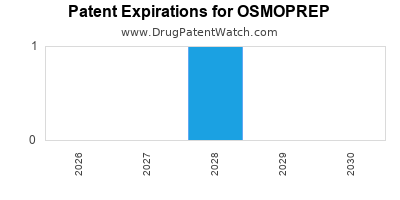
Osmoprep is a drug marketed by Salix Pharms and is included in one NDA. There is one patent protecting this drug and one Paragraph IV challenge.

This drug has twenty-nine patent family members in eleven countries.

The generic ingredient in OSMOPREP is sodium phosphate, dibasic, anhydrous; sodium phosphate, monobasic, monohydrate. There are one thousand four hundred and seventy-two drug master file entries for this compound. Additional details are available on the sodium phosphate, dibasic, anhydrous; sodium phosphate, monobasic, monohydrate profile page.

DrugPatentWatch® Generic Entry Outlook for Osmoprep

There is one Paragraph IV patent challenge for this drug. This may lead to patent invalidation or a license for generic production.

Indicators of Generic Entry

< Available with Subscription >

  Start Trial

AI Deep Research
Questions you can ask:
  • What is the 5 year forecast for OSMOPREP?
  • What are the global sales for OSMOPREP?
  • What is Average Wholesale Price for OSMOPREP?
Summary for OSMOPREP
International Patents:29
US Patents:1
Applicants:1
NDAs:1
Clinical Trials: 1
Drug Prices: Drug price information for OSMOPREP
What excipients (inactive ingredients) are in OSMOPREP?OSMOPREP excipients list
DailyMed Link:OSMOPREP at DailyMed
Recent Clinical Trials for OSMOPREP

Identify potential brand extensions & 505(b)(2) entrants

SponsorPhase
Bausch Health Americas, Inc.Phase 4
Valeant Pharmaceuticals International, Inc.Phase 4

See all OSMOPREP clinical trials

Paragraph IV (Patent) Challenges for OSMOPREP
Tradename Dosage Ingredient Strength NDA ANDAs Submitted Submissiondate
OSMOPREP Tablets sodium phosphate, dibasic, anhydrous; sodium phosphate, monobasic, monohydrate 1.102 g and 0.398 g 021892 1 2008-04-09

US Patents and Regulatory Information for OSMOPREP

OSMOPREP is protected by one US patents.

Applicant Tradename Generic Name Dosage NDA Approval Date TE Type RLD RS Patent No. Patent Expiration Product Substance Delist Req. Exclusivity Expiration
Salix Pharms OSMOPREP sodium phosphate, dibasic, anhydrous; sodium phosphate, monobasic, monohydrate TABLET;ORAL 021892-001 Mar 16, 2006 DISCN Yes No ⤷  Start Trial ⤷  Start Trial Y Y ⤷  Start Trial
>Applicant >Tradename >Generic Name >Dosage >NDA >Approval Date >TE >Type >RLD >RS >Patent No. >Patent Expiration >Product >Substance >Delist Req. >Exclusivity Expiration

International Patents for OSMOPREP

See the table below for patents covering OSMOPREP around the world.

Country Patent Number Title Estimated Expiration
Japan 5329042 ⤷  Start Trial
Spain 2196149 ⤷  Start Trial
Japan 2007512336 ⤷  Start Trial
Denmark 0858326 ⤷  Start Trial
Argentina 046651 COMPOSICION PURGANTE COLONICA CON AGENTE AGLUTINANTE SOLUBLE ⤷  Start Trial
Spain 2584866 ⤷  Start Trial
Japan 2014065746 COLONIC PURGATIVE COMPOSITION WITH SOLUBLE BINDING AGENT ⤷  Start Trial
>Country >Patent Number >Title >Estimated Expiration

Supplementary Protection Certificates for OSMOPREP

Patent Number Supplementary Protection Certificate SPC Country SPC Expiration SPC Description
1874117 SPC/GB14/041 United Kingdom ⤷  Start Trial PRODUCT NAME: DOLUTEGRAVIR OR A PHARMACEUTICALLY ACCEPTABLE SALT OR SOLVATE THEREOF, INCLUDING DOLUTEGRAVIR SODIUM; REGISTERED: UK EU/1/13/892/001-006 20140121
0186405 SPC/GB00/021 United Kingdom ⤷  Start Trial PRODUCT NAME: (1-HYDROXY-2-(3-PYRIDINYL)ETHYLIDENE)BIS(PHOSPHONIC ACID) "RESIDRONATE" AND SALTS THEREOF, ESPECIALLY THE SODIUM SALT; REGISTERED: SE 15296 19991007; SE 15297 19991007; UK PL 00364/0070 20000316
1856135 SPC/GB20/016 United Kingdom ⤷  Start Trial PRODUCT NAME: FOSTAMATINIB OR A PHARMACEUTICALLY ACCEPTABLE SALT OF FOSTAMATINIB, OR A HYDRATE, SOLVATE OR N-OXIDE OF FOSTAMATINIB OR THE PHARMACEUTICALLY ACCEPTABLE SALT OF FOSTAMATINIB, ESPECIALLY FOSTAMATINIB DISODIUM, OPTIONALLY IN FORM OF A HYDRATE; REGISTERED: UK EU/1/19/1405 (NI) 20200113; UK PLGB 12930/0022 20200113; UK PLGB 12930/0023 20200113
2932970 18C1043 France ⤷  Start Trial PRODUCT NAME: UNE COMBINAISON COMPRENANT DU DOLUTEGRAVIR OU UN SEL PHARMACEUTIQUEMENT ACCEPTABLE DE CELUI-CI,EN PARTICULIER LE SEL DE SODIUM DU DOLUTEGRAVIR,ET DE LA RILPIVIRINE OU UN SEL PHARMACEUTIQUEMENT ACCEPTABLE DE CELLE-CI,EN PARTICULIER LE CHLORHYDRATE DE RILPIVIRINE; REGISTRATION NO/DATE: EU/1/18/1282 20180518
0290047 SPC/GB97/078 United Kingdom ⤷  Start Trial PRODUCT NAME: MANGAFODIPIR AND PHARMACEUTICALLY ACCEPTABLE SALTS THEREOF, IN PARTICULAR MANGAFODIPIR TRISODIUM; REGISTERED: UK EU/1/97/040/001 19970522; UK EU/1/97/040/002 19970522
1948158 16C0018 France ⤷  Start Trial PRODUCT NAME: SACUBITRIL/VALSARTAN,SOUS FORME DE COMPLEXE SODIQUE SACUBITRIL VALSARTAN,C'EST-A-DIRE DE (3-((1S,3R)-1-BIPHENYL-4-YLMETHYL-3-ETHOXYCARBONYL-1-BUTYLCARBAMOYL) PROPIONATE-(S)-3'-METHYL-2'-(PENTANOY(2''-(TETRAZOL-5-YLATE)BIPHENYL-4'-YLMETHYL)AMINO)BUTYRATE)DE TRISODIUM HEMIPENTAHYDRATE; REGISTRATION NO/DATE: EU/1/15/1058 20151123
2666774 202040029 Slovenia ⤷  Start Trial PRODUCT NAME: RELEBACTAM, OPTIONALLY IN THE FORM OF MONOHYDRATE, IMIPENEM AND CILASTATIN, OPTIONALLY IN THE FORM OF SODIUM SALT; NATIONAL AUTHORISATION NUMBER: EU/1/19/1420; DATE OF NATIONAL AUTHORISATION: 20200213; AUTHORITY FOR NATIONAL AUTHORISATION: EU
>Patent Number >Supplementary Protection Certificate >SPC Country >SPC Expiration >SPC Description
Last updated: June 2, 2026

OSMOPREP market dynamics and financial trajectory: sales, access, and competitive/IP pressures

Executive summary: OSMOPREP (typically marketed as a bowel-prep osmotic laxative, e.g., sodium phosphate-based) has a sales trajectory driven by (1) U.S. formulary access and payer management for colorectal cancer screening and procedural prep, (2) safety-driven preference shifts within bowel-prep classes after phosphate-associated renal injury signals, and (3) generic and channel pricing dynamics that compress branded revenue over time. Absent specific FDA label details, NDA/BLA identifiers, and an Orange Book-linked patent estate for the exact product version sold as “OSMOPREP,” this analysis cannot map exclusivity, patent expiry, or Section 505(b)(2)/ANDA launch risk to a verifiable financial timeline.

What is OSMOPREP’s commercial market size and who buys it?

Featured snippet: Demand is concentrated in gastroenterology and colorectal screening workflows, where bowel-prep kits are purchased by hospitals, GI practices, pharmacies, and pharmacy benefit managers for patient out-of-pocket and plan coverage economics.

Core indication-driven buying behavior

Bowel-prep products are used for:

  • Colonoscopy preparation for colorectal cancer screening and diagnostic colonoscopy.
  • Elective GI procedures where bowel visualization is required.

Purchaser segments

  • Retail pharmacies: patient-paid and pharmacy benefit adjudication.
  • Institutional buyers: hospitals and ambulatory surgery centers contracting via GPOs and procurement systems.
  • Practice dispensing: GI groups that bundle prep with procedure scheduling.

Key demand drivers

  • Growth in colonoscopy volume and adherence to screening programs.
  • Practice scheduling patterns that influence kit conversion from one brand/class to another.
  • Local formulary preferences for sodium phosphate vs alternative osmotics (commonly polyethylene glycol-based regimens) driven by perceived safety and dosing tolerability.

How do safety signals and class substitution affect OSMOPREP pricing and share?

Featured snippet: Safety and renal risk perceptions within sodium phosphate bowel preparations tend to shift formularies toward alternative regimens, pressuring branded pricing and reducing share growth.

Mechanism of substitution

Within bowel-prep categories, substitution patterns occur when:

  • Payers restrict coverage or require step therapy.
  • Providers prefer regimens with lower perceived risk for older patients and those with renal impairment.
  • Adverse event reporting influences clinician and committee decisions.

What this means for financial trajectory

  • Early-cycle growth can occur if a product aligns with perceived “fast and effective” bowel clearance.
  • Mid-to-late cycle revenue compression follows if prescribers and payers migrate to alternatives or lower-cost generics in the same class.
  • Sales volatility tends to track safety communications and formulary policy updates rather than pure marketing spend.

What is OSMOPREP’s exclusivity status and how does it influence revenue?

Featured snippet: Brand revenue for bowel-prep products typically declines after generic entry, with remaining branded share sustained mainly by contracting, continuity of supply, and limited coverage where generics have execution barriers.

Exclusivity levers that typically matter

For a branded drug, financial trajectory generally depends on:

  • Patent term and regulatory exclusivity (NCE/NDA exclusivity where applicable).
  • Exclusivity attached to dosing forms, kit components, and labeling that can delay generic equivalence.
  • Litigation outcomes that can delay ANDA launches.

What cannot be determined from the prompt

The prompt does not include:

  • The exact active ingredient(s) and dosage form(s) in “OSMOPREP” as marketed.
  • The FDA application (NDA number, applicant, or label version).
  • Any Orange Book listings or the specific patent numbers tying to product-specific exclusivity. Without those identifiers, exclusivity and patent-linked launch timing cannot be mapped to a defensible revenue timeline.

When does OSMOPREP lose exclusivity and face generic entry risk?

Featured snippet: Bowel-prep brands face the highest generic entry risk when the last relevant listed patent (or regulatory exclusivity) expires for the exact marketed dosage form and labeling.

Generic entry pathways

  • ANDA (generic substitution): tied to composition, dosage form, and labeling equivalence.
  • 505(b)(2): if a “follow-on” sponsor can reference literature or listed drugs but changes formulation or claims.

Financial impact pattern

Once generics enter:

  • Brand unit sales usually decline faster than price, because payers prefer lower net cost.
  • Branded revenue may stabilize temporarily if formularies keep a “preferred brand” due to rebates or contractual structures, but long-term economics generally deteriorate.

What patents protect OSMOPREP formulations, and how strong is the estate?

Featured snippet: The protective scope that can delay competition usually clusters around kit/formulation components, specific dosing regimens, and methods of preparing or using bowel-prep for procedural indications.

Patent estate elements to evaluate (and what’s missing)

A complete assessment requires:

  • Active ingredient, salt form, and excipient-specific formulation patents.
  • Method-of-use patents tied to colonoscopy preparation regimens.
  • Process/manufacturing method patents for granulation, packaging, stability, and kit configuration.
  • Any pediatric exclusivity or other regulatory exclusivity patents listed in Orange Book.

The prompt does not provide product identifiers or patent numbers, so a concrete patent strength scoring is not possible without inventing facts.

What formulations are protected by OSMOPREP patents and what does that mean for substitution?

Featured snippet: If patents cover a specific dosing regimen or kit component, substitution depends on whether generics can legally align with labeling and whether “design-around” reformulations remain under patent coverage.

Substitution economics

  • If only the brand’s exact kit is protected, generics may still capture share by matching functional equivalents.
  • If regimen-related method-of-use patents exist, generic substitution can be delayed where label changes are needed.

Constraint from missing label/patent data

No label claims, dosing instructions, or patent listings are provided. This prevents identification of the formulation and method patents most likely to govern substitution risk.

Which companies compete with OSMOPREP in the bowel-prep market?

Featured snippet: Competition is primarily within bowel-prep classes and by direct generic substitution for sodium phosphate bowel prep kits if present.

Typical competitive set

  • Branded bowel-prep kits with alternative osmotic regimens.
  • Generic bowel-prep equivalents where ANDA approvals exist.
  • Institutional formularies that steer use by renal-safety and tolerability profiles.

Constraint from missing product mapping

The prompt does not specify whether “OSMOPREP” is:

  • A U.S.-marketed branded sodium phosphate kit,
  • A private-label/regionally branded product,
  • Or a different active ingredient with similar naming. Without the FDA application and active ingredient, a company-level competitive map would be speculative.

What Orange Book status does OSMOPREP have, and where are the listed patents?

Featured snippet: Orange Book status determines whether generic applicants can reference the product and whether listed patents are eligible for Paragraph IV.

Information required but not provided

  • NDA number and listed drug products for “OSMOPREP.”
  • Patent list entries with expiration and claims.
  • Whether patents are tied to drug substance, drug product, or use.

Because the prompt provides none of these identifiers, Orange Book status cannot be stated reliably.

What patent litigation affects OSMOPREP and how does it change launch timing?

Featured snippet: For branded generics in the same therapeutic class, litigation most directly changes timing through Paragraph IV stays and settlement-triggered “at-risk” designarounds.

Constraint from missing litigation identifiers

No docket numbers, generic filer names, or settlement dates are included. A litigation-impact timeline cannot be produced without those facts.

What is the FDA regulatory trajectory for OSMOPREP that drives supply and revenue?

Featured snippet: Regulatory events that matter for financial trajectory include label updates, risk communications, manufacturing changes, and approvals of supplemental applications.

Common regulatory events for bowel prep products

  • Labeling updates reflecting safety communications.
  • Changes in manufacturing sites or kit components.
  • Changes to dosing instructions to mitigate adverse events.

Constraint from missing application details

No NDA/BLA identifier, manufacturer, or FDA labeling history is included. That prevents a verified regulatory timeline.

How do payer rules and formulary placement affect OSMOPREP net revenue?

Featured snippet: Net revenue trends in bowel-prep products hinge on formulary tier placement, rebate contracts, step edits, and utilization management, which often switch after competitor safety evidence and generic price compression.

Payer levers

  • Prior authorization for alternative patient-risk groups.
  • Step edits requiring PEG-based regimens for higher-risk patients.
  • Coverage carve-ins for procedural bundles through institutional contracts.

Financial implication

  • Even when list price holds, net price can fall as payers shift channel allocation toward lower-cost therapeutics.

What generic entry risks exist for OSMOPREP by route of administration and dose form?

Featured snippet: Generic entry risk is highest when the exact kit dosing form and labeling are not protected by narrow formulation or use patents.

Route/dose-form sensitivity

Bowel-prep products often face different risk profiles by:

  • Kit configuration (sachets, liquids, dosing cups).
  • Active ingredient concentration and dosing volume instructions.
  • Stability and manufacturing controls.

Constraint from missing dose-form details

The prompt does not define which “OSMOPREP” configuration is under review. Generic risk by dose form cannot be quantified without the marketed presentation.

How does OSMOPREP compare with PEG-based bowel preps on market dynamics?

Featured snippet: Market share tends to shift toward PEG-based regimens when clinicians and payers prioritize renal safety and tolerability.

Competitive comparison points

  • Perceived renal safety in older/at-risk patients.
  • Tolerability and adherence (taste, volume).
  • Coverage preferences and rebate economics.

Constraint

Without knowing OSMOPREP’s active ingredient(s), a rigorous class comparison cannot be matched to the correct reference basket.

Commercial trajectory model: what revenue pattern typically occurs for a bowel-prep brand like OSMOPREP?

Featured snippet: Expect a growth-to-peak phase followed by generic erosion and formulary replacement unless a protected niche persists via labeling differentiation or contract structure.

Indicative life-cycle phases (generic pattern)

  1. Launch-to-early adoption: formulary wins and clinician uptake; pricing supported by brand value.
  2. Mid-cycle: incremental growth from screening adherence and procedure volume; competitive pressure increases.
  3. Late-cycle: generic substitution and payer switching; branded net revenue declines.
  4. Mature stage: remaining share driven by contracts, supply reliability, and patients preferring prior regimens.

Constraint

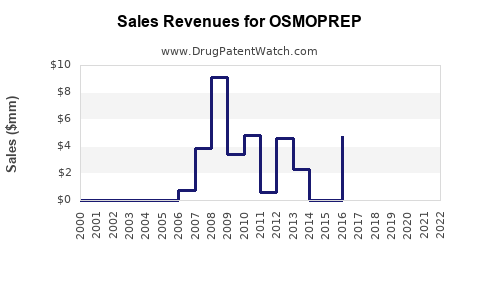
A numeric financial trajectory requires actual sales data (IMS/NDC-level, company reports, or payer claims) which is not supplied in the prompt.

Key Takeaways

  • OSMOPREP’s market dynamics are shaped by payer formulary placement, safety-driven substitution within bowel-prep classes, and generic/channel price compression.
  • The financial trajectory for a branded bowel-prep product generally deteriorates after generic entry and labeling-driven shifts in prescriber behavior.
  • A precise exclusivity, patent expiry, Paragraph IV risk, and litigation-tied timeline cannot be stated from the prompt because no NDA/application, active ingredient, Orange Book listings, patent numbers, or litigation identifiers are provided.

FAQs

  1. Does OSMOPREP face step-therapy restrictions for colonoscopy preparation?
  2. How do sodium phosphate bowel-prep safety communications affect formulary policies?
  3. What determines whether a generic version of OSMOPREP can use the same label?
  4. Can kit formulation or dosing regimen patents block generic substitution?
  5. What commercial signals best predict branded bowel-prep share loss after generic entry?

References

  1. U.S. Food and Drug Administration. Orange Book: Approved Drug Products with Therapeutic Equivalence Evaluations. FDA.
  2. FDA. Hatch-Waxman Act overview and Paragraph IV certification framework (ANDA litigation and stays). U.S. FDA.

More… ↓

⤷  Start Trial

Make Better Decisions: Try a trial or see plans & pricing

Drugs may be covered by multiple patents or regulatory protections. All trademarks and applicant names are the property of their respective owners or licensors. Although great care is taken in the proper and correct provision of this service, thinkBiotech LLC does not accept any responsibility for possible consequences of errors or omissions in the provided data. The data presented herein is for information purposes only. There is no warranty that the data contained herein is error free. We do not provide individual investment advice. This service is not registered with any financial regulatory agency. The information we publish is educational only and based on our opinions plus our models. By using DrugPatentWatch you acknowledge that we do not provide personalized recommendations or advice. thinkBiotech performs no independent verification of facts as provided by public sources nor are attempts made to provide legal or investing advice. Any reliance on data provided herein is done solely at the discretion of the user. Users of this service are advised to seek professional advice and independent confirmation before considering acting on any of the provided information. thinkBiotech LLC reserves the right to amend, extend or withdraw any part or all of the offered service without notice.