MINOXIDIL Drug Patent Profile
✉ Email this page to a colleague
Which patents cover Minoxidil, and what generic alternatives are available?
Minoxidil is a drug marketed by Perrigo Pharma Intl, Ph Health, Royce Labs, Sun Pharm Industries, Usl Pharma, Watson Labs, Aurobindo Pharma, P And L, Taro, Apotex Inc, Aurobindo Pharma Ltd, Bausch And Lomb, Copley Pharm, Hikma, L Perrigo Co, Sight Pharms, Teva, Avacor Prods, Perrigo, and Perrigo New York. and is included in twenty-nine NDAs.
The generic ingredient in MINOXIDIL is minoxidil. There are eight drug master file entries for this compound. Eighty-one suppliers are listed for this compound. Additional details are available on the minoxidil profile page.
DrugPatentWatch® Litigation and Generic Entry Outlook for Minoxidil
A generic version of MINOXIDIL was approved as minoxidil by WATSON LABS on March 3rd, 1987.
AI Deep Research
Questions you can ask:
- What is the 5 year forecast for MINOXIDIL?
- What are the global sales for MINOXIDIL?
- What is Average Wholesale Price for MINOXIDIL?
Summary for MINOXIDIL
| US Patents: | 0 |
| Applicants: | 20 |
| NDAs: | 29 |
| Finished Product Suppliers / Packagers: | 23 |
| Raw Ingredient (Bulk) Api Vendors: | 1 |
| Clinical Trials: | 81 |
| Patent Applications: | 4,226 |
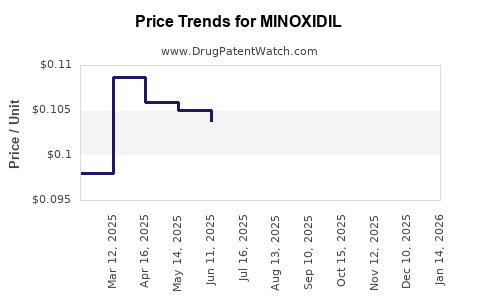
| Drug Prices: | Drug price information for MINOXIDIL |
| DailyMed Link: | MINOXIDIL at DailyMed |
Recent Clinical Trials for MINOXIDIL
Identify potential brand extensions & 505(b)(2) entrants
| Sponsor | Phase |
|---|---|
| Eurofarma Laboratorios S.A. | PHASE3 |
| Sheikh Zayed Federal Postgraduate Medical Institute | PHASE3 |
| Duke University | PHASE1 |
Pharmacology for MINOXIDIL
| Drug Class | Arteriolar Vasodilator |
| Physiological Effect | Arteriolar Vasodilation |
Medical Subject Heading (MeSH) Categories for MINOXIDIL
Anatomical Therapeutic Chemical (ATC) Classes for MINOXIDIL
Paragraph IV (Patent) Challenges for MINOXIDIL
| Tradename | Dosage | Ingredient | Strength | NDA | ANDAs Submitted | Submissiondate |
|---|---|---|---|---|---|---|
| WOMEN'S ROGAINE | Topical Aerosol Foam | minoxidil | 5% | 021812 | 1 | 2015-02-04 |
| WOMEN'S ROGAINE | Topical Aerosol Foam | minoxidil | 5% | 021812 | 1 | 2009-04-06 |
US Patents and Regulatory Information for MINOXIDIL
| Applicant | Tradename | Generic Name | Dosage | NDA | Approval Date | TE | Type | RLD | RS | Patent No. | Patent Expiration | Product | Substance | Delist Req. | Exclusivity Expiration |
|---|---|---|---|---|---|---|---|---|---|---|---|---|---|---|---|
| Apotex Inc | MINOXIDIL EXTRA STRENGTH (FOR MEN) | minoxidil | SOLUTION;TOPICAL | 075839-001 | Oct 1, 2001 | DISCN | No | No | ⤷ Start Trial | ⤷ Start Trial | ⤷ Start Trial | ||||
| Hikma | MINOXIDIL (FOR WOMEN) | minoxidil | SOLUTION;TOPICAL | 074731-002 | May 11, 2005 | DISCN | No | No | ⤷ Start Trial | ⤷ Start Trial | ⤷ Start Trial | ||||
| Aurobindo Pharma Ltd | MINOXIDIL EXTRA STRENGTH (FOR MEN) | minoxidil | SOLUTION;TOPICAL | 075438-001 | Feb 27, 2003 | OTC | No | No | ⤷ Start Trial | ⤷ Start Trial | ⤷ Start Trial | ||||
| L Perrigo Co | MINOXIDIL (FOR WOMEN) | minoxidil | SOLUTION;TOPICAL | 075357-002 | Jul 30, 1999 | OTC | No | No | ⤷ Start Trial | ⤷ Start Trial | ⤷ Start Trial | ||||
| Perrigo Pharma Intl | MINOXIDIL | minoxidil | AEROSOL, FOAM;TOPICAL | 091344-001 | Apr 28, 2011 | OTC | No | No | ⤷ Start Trial | ⤷ Start Trial | ⤷ Start Trial | ||||
| Hikma | MINOXIDIL (FOR MEN) | minoxidil | SOLUTION;TOPICAL | 074731-001 | Dec 24, 1996 | DISCN | No | No | ⤷ Start Trial | ⤷ Start Trial | ⤷ Start Trial | ||||
| P And L | MINOXIDIL (FOR WOMEN) | minoxidil | AEROSOL, FOAM;TOPICAL | 208092-002 | Jul 27, 2017 | OTC | No | No | ⤷ Start Trial | ⤷ Start Trial | ⤷ Start Trial | ||||
| >Applicant | >Tradename | >Generic Name | >Dosage | >NDA | >Approval Date | >TE | >Type | >RLD | >RS | >Patent No. | >Patent Expiration | >Product | >Substance | >Delist Req. | >Exclusivity Expiration |
Minoxidil: Market Dynamics and Financial Trajectory
More… ↓
