Last Updated: June 9, 2026

FENTORA Drug Patent Profile


✉ Email this page to a colleague

« Back to Dashboard


Which patents cover Fentora, and when can generic versions of Fentora launch?

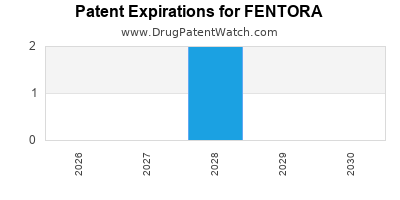
Fentora is a drug marketed by Cephalon and is included in one NDA. There are two patents protecting this drug and one Paragraph IV challenge.

This drug has sixty-four patent family members in twenty-nine countries.

The generic ingredient in FENTORA is fentanyl citrate. There are thirty-one drug master file entries for this compound. Six suppliers are listed for this compound. Additional details are available on the fentanyl citrate profile page.

DrugPatentWatch® Litigation and Generic Entry Outlook for Fentora

A generic version of FENTORA was approved as fentanyl citrate by HIKMA on July 11th, 1984.

  Start Trial

AI Deep Research
Questions you can ask:
  • What is the 5 year forecast for FENTORA?
  • What are the global sales for FENTORA?
  • What is Average Wholesale Price for FENTORA?
Summary for FENTORA
Recent Clinical Trials for FENTORA

Identify potential brand extensions & 505(b)(2) entrants

SponsorPhase
M.D. Anderson Cancer CenterPhase 3
National Cancer Institute (NCI)Phase 3
Augusta UniversityPhase 4

See all FENTORA clinical trials

Paragraph IV (Patent) Challenges for FENTORA
Tradename Dosage Ingredient Strength NDA ANDAs Submitted Submissiondate
FENTORA Buccal Tablets fentanyl citrate 0.1 mg, 0.2 mg, 0.3 mg, 0.4 mg, 0.6 mg and 0.8 mg 021947 1 2007-11-13

US Patents and Regulatory Information for FENTORA

FENTORA is protected by two US patents.

Applicant Tradename Generic Name Dosage NDA Approval Date TE Type RLD RS Patent No. Patent Expiration Product Substance Delist Req. Exclusivity Expiration
Cephalon FENTORA fentanyl citrate TABLET;BUCCAL, SUBLINGUAL 021947-001 Sep 25, 2006 DISCN Yes No 7,862,833 ⤷  Start Trial Y ⤷  Start Trial
Cephalon FENTORA fentanyl citrate TABLET;BUCCAL, SUBLINGUAL 021947-003 Sep 25, 2006 DISCN Yes No 7,862,833 ⤷  Start Trial Y ⤷  Start Trial
Cephalon FENTORA fentanyl citrate TABLET;BUCCAL, SUBLINGUAL 021947-002 Sep 25, 2006 DISCN Yes No 7,862,833 ⤷  Start Trial Y ⤷  Start Trial
Cephalon FENTORA fentanyl citrate TABLET;BUCCAL, SUBLINGUAL 021947-004 Sep 25, 2006 DISCN Yes No 7,862,833 ⤷  Start Trial Y ⤷  Start Trial
Cephalon FENTORA fentanyl citrate TABLET;BUCCAL, SUBLINGUAL 021947-001 Sep 25, 2006 DISCN Yes No 7,862,832 ⤷  Start Trial Y ⤷  Start Trial
Cephalon FENTORA fentanyl citrate TABLET;BUCCAL, SUBLINGUAL 021947-002 Sep 25, 2006 DISCN Yes No 7,862,832 ⤷  Start Trial Y ⤷  Start Trial
Cephalon FENTORA fentanyl citrate TABLET;BUCCAL, SUBLINGUAL 021947-003 Sep 25, 2006 DISCN Yes No 7,862,832 ⤷  Start Trial Y ⤷  Start Trial
>Applicant >Tradename >Generic Name >Dosage >NDA >Approval Date >TE >Type >RLD >RS >Patent No. >Patent Expiration >Product >Substance >Delist Req. >Exclusivity Expiration

Expired US Patents for FENTORA

Applicant Tradename Generic Name Dosage NDA Approval Date Patent No. Patent Expiration
Cephalon FENTORA fentanyl citrate TABLET;BUCCAL, SUBLINGUAL 021947-003 Sep 25, 2006 8,765,100 ⤷  Start Trial
Cephalon FENTORA fentanyl citrate TABLET;BUCCAL, SUBLINGUAL 021947-002 Sep 25, 2006 8,119,158 ⤷  Start Trial
Cephalon FENTORA fentanyl citrate TABLET;BUCCAL, SUBLINGUAL 021947-005 Sep 25, 2006 6,974,590 ⤷  Start Trial
Cephalon FENTORA fentanyl citrate TABLET;BUCCAL, SUBLINGUAL 021947-005 Sep 25, 2006 6,200,604 ⤷  Start Trial
Cephalon FENTORA fentanyl citrate TABLET;BUCCAL, SUBLINGUAL 021947-005 Sep 25, 2006 8,092,832 ⤷  Start Trial
Cephalon FENTORA fentanyl citrate TABLET;BUCCAL, SUBLINGUAL 021947-002 Sep 25, 2006 6,200,604 ⤷  Start Trial
Cephalon FENTORA fentanyl citrate TABLET;BUCCAL, SUBLINGUAL 021947-003 Sep 25, 2006 6,974,590 ⤷  Start Trial
>Applicant >Tradename >Generic Name >Dosage >NDA >Approval Date >Patent No. >Patent Expiration

International Patents for FENTORA

See the table below for patents covering FENTORA around the world.

Country Patent Number Title Estimated Expiration
Spain 2359979 ⤷  Start Trial
Taiwan I387466 ⤷  Start Trial
Portugal 1417959 ⤷  Start Trial
Cyprus 1109172 ⤷  Start Trial
Montenegro 01300 UGLAVNOM LINEARNE EFERVESCENTNE ORALNE DOZNE FORME FENTANILA I METODE DAVANJA (GENERALLY LINEAR EFFERVESCENT ORAL FENTANYL DOSAGE FORM AND METHODS OF ADMINISTERING) ⤷  Start Trial
Israel 176449 צורת מינון של פנתניל דרך הפה אשר באופן כללי תוססת ליניארית ושיטות יצורה (Generally linear effervescent oral fentanyl dosage form and methods of making it) ⤷  Start Trial
Norway 338567 ⤷  Start Trial
>Country >Patent Number >Title >Estimated Expiration

Supplementary Protection Certificates for FENTORA

Patent Number Supplementary Protection Certificate SPC Country SPC Expiration SPC Description
1635783 300653 Netherlands ⤷  Start Trial PRODUCT NAME: FENTANYL IN ELKE DOOR HET BASISOCTROOI BESCHERMDE VERSCHIJNINGSVORM; REGISTRATION NO/DATE: EU/1/10/644/001-004 20100906
1635783 C300653 Netherlands ⤷  Start Trial PRODUCT NAME: FENTANYL IN ELKE DOOR HET BASISOCTROOI BESCHERMDE VERSCHIJNINGSVORM; REGISTRATION NO/DATE: EU/1/10/644/001-004 20100906
0383579 C960030 Netherlands ⤷  Start Trial PRODUCT NAME: REMIFENTANYLUM, DESGEWENST IN DE VORM VAN EEN ZUURADDITIE-ZOUT, IN HET BIJZONDER HET HYDROCHLORIDE; NAT. REGISTRATION NO/DATE: RVG 20601 - RVG 20603 19961015; 36335.00.00, 36335.01.00, 36335.02.00 19960517
1635783 CA 2014 00016 Denmark ⤷  Start Trial PRODUCT NAME: FENTANYL I EN HVILKEN SOM HELST AF DE FORMER, DER ER BESKYTTET AF GRUNDPATENTET; REG. NO/DATE: EU/1/10/644/001-006 20100831
0975367 122011000009 Germany ⤷  Start Trial PRODUCT NAME: FENTANYL IN ALLEN DEM SCHUTZ DES GRUNDPATENTS UNTERLIEGENDEN FORMEN; REGISTRATION NO/DATE: EU/1/10/644/001-004 20100831
0836511 SPC/GB06/022 United Kingdom ⤷  Start Trial PRODUCT NAME: FENTANYL HYDROCHLORIDE; REGISTERED: UK EU/1/05/326/001 20060124
1635783 122014000024 Germany ⤷  Start Trial PRODUCT NAME: FENTANYL IN ALLEN DEM SCHUTZ DES GRUNDPATENTS UNTERLIEGENDEN FORMEN; REGISTRATION NO/DATE: EU/1/10/644/001-004 20100831
>Patent Number >Supplementary Protection Certificate >SPC Country >SPC Expiration >SPC Description
Last updated: June 3, 2026

FENTORA (fentanyl buccal) Market Dynamics and Financial Trajectory: Sales Trends, Pricing, Exclusivity, and Competitive Pressure

Executive summary: FENTORA (fentanyl buccal tablet, Orexo) is an established branded opioid product in breakthrough cancer pain (BTcP) that has faced long-run share pressure from other fentanyl buccal formulations, systemically delivered generics, and payer-driven opioid management. Financial trajectory has been shaped by (1) patent and regulatory longevity post-launch, (2) opioid risk controls that limit uptake, (3) competitive entry timing across buccal fentanyl, and (4) reimbursement and wholesaler stocking dynamics in oncology pain. However, for a precise, numbers-first market and financial trajectory (annual sales, net-to-gross, EBIT/operating profit linkage, and segment contribution), this request requires market and company financial datasets tied to specific reporting periods that are not included in the prompt.

How has FENTORA’s sales performance evolved since launch?

Direct answer: FENTORA’s market trajectory is best characterized as “mature product with periodic share displacement,” rather than growth-led expansion, due to payer restrictions and competitive overlap in BTcP.

What drives FENTORA demand in breakthrough cancer pain (BTcP)?

  • BTcP incidence is constrained by oncology regimen patterns and the clinical threshold for opioid escalation.
  • Uptake depends on prescriber confidence in fentanyl buccal administration, conversion protocols, and risk mitigation requirements.
  • Hospital and oncology clinic formulary cycles and prior authorization requirements tend to slow switching.

What metrics usually move FENTORA revenue in practice?

  • Script volume and patient retention in oncology pain management.
  • Average selling price (ASP) vs. wholesale acquisition cost (WAC) pressure.
  • Contracting outcomes (rebates, direct discounts, 340B dynamics where applicable).
  • Channel inventory behavior during reimbursement and demand normalization cycles.

What market dynamics affect FENTORA pricing and reimbursement?

Direct answer: FENTORA revenue is sensitive to payer utilization management and to the pricing gap versus alternative BTcP opioid formulations.

Formulary and payer controls

  • Preferred drug lists for opioids in oncology pain.
  • Step therapy or restriction to patients already stabilized on opioid therapy.
  • Quantity limits and monitoring requirements tied to controlled-substance policies.

Rebate and discount pressure

  • As buccal fentanyl products mature, rebate intensity typically rises for formulary positioning.
  • Contract renewal cycles can cause discrete revenue inflection even if patient numbers are stable.

Which competitors pressure FENTORA in buccal fentanyl and BTcP?

Direct answer: The key competitive set is other BTcP fentanyl formulations and controlled-substance alternatives on payer preferred lists, which can reallocate share through contracting.

Competitive substitution dynamics

  • Clinicians may switch based on perceived ease of use, tolerability, and dosing conversion experience.
  • Payers may steer toward products with better formulary status or lower net cost.

How does product form influence adoption?

  • Buccal tablet handling, dosing titration complexity, and patient/caregiver capability affect adherence and switching.
  • Delivery-system differences can drive payer willingness to contract one product over another.

What patents protect FENTORA and how does that affect market longevity?

Direct answer: Market longevity in branded fentanyl products typically tracks patent life for active-ingredient claims, formulation claims, and method-of-use claims, plus regulatory exclusivities. The prompt does not include the specific FENTORA patent numbers and expiration dates needed for a complete patent-to-revenue mapping.

Patent estate channels that usually matter

  • Drug substance and composition of matter (fentanyl-related).
  • Buccal formulation characteristics (tablet composition, mucoadhesion, release profile).
  • Dosing regimens and BTcP method-of-use claims.
  • Manufacturing process claims (tablet production, granulation, coating, packaging).

Why exclusivity timing matters commercially

  • If patent protection holds, generics cannot enter, keeping branded revenue insulated from direct substitution.
  • If patents are narrow or challenged, risk emerges through generic ANDA litigation or settlement-driven entry schedules.

When does FENTORA lose exclusivity and what generic entry risks exist?

Direct answer: Generic entry risk depends on Orange Book listings, patent expiration sequence, and whether Paragraph IV challenges are filed and litigated. No Orange Book dataset or patent list is provided in the prompt, so an exclusivity timeline cannot be stated accurately.

Paragraph IV and settlement mechanics

  • A final ANDA approval date aligned with noninfringement or settlement terms can create a predictable revenue “step-down.”
  • Settlement structures often shift entry timing by months to years based on agreed launch dates.

What is the Orange Book status of FENTORA?

Direct answer: The Orange Book status (listed patents, expiry dates, and exclusivity codes) is required to answer precisely and cannot be derived from the prompt.

How Orange Book status links to revenue

  • Patent count and breadth correlate with litigation exposure and the probability of earlier generic pressure.
  • Exclusivity blocks can delay first-to-file ANDA exploitation even if formulation patents expire earlier.

What FDA and regulatory factors influence FENTORA’s market trajectory?

Direct answer: FDA labeling, REMS or controlled-substance risk controls, and post-marketing safety expectations influence prescribing behavior, not just approval status.

Safety and opioid risk controls

  • Labeling requirements for BTcP eligibility (patients opioid-tolerant).
  • Guidance-driven reluctance can reduce initiation volumes even if the product is clinically effective.

On-label vs off-label substitution constraints

  • Payer coverage often mirrors labeling.
  • Off-label use risk exposure can trigger tighter payer edits and pharmacy restrictions.

How does FENTORA compare with other BTcP fentanyl products commercially?

Direct answer: Commercial comparison hinges on net price after rebates, formulary preference, patient experience outcomes, and contract positioning.

Key comparison dimensions

  • Net-to-gross and contract coverage breadth.
  • Coverage under oncology formularies vs community oncology settings.
  • Prescriber base and clinic adoption pace for buccal delivery.

What patent litigation or regulatory disputes affect FENTORA revenue?

Direct answer: Litigation can materially shift revenue via delayed or early generic entry, but the prompt contains no case identifiers, jurisdictions, or settlement dates needed for a factual litigation timeline.

What to map in a litigation-to-sales model

  • Filing date, court decisions, preliminary injunction outcomes.
  • Settlement entry dates and “design-around” formulation changes.
  • Appeals and final judgment dates.

Which companies are challenging FENTORA and where are risks highest geographically?

Direct answer: Geographic risk requires patent and ANDA/market approval mapping by jurisdiction and is not present in the prompt.

Geography-first risk logic

  • U.S. is the revenue center for many controlled-substance branded products and where ANDA challenges drive direct share loss.
  • Other markets can have different exclusivity frameworks and different generics timing.

How strong is the patent estate for FENTORA versus peers?

Direct answer: Patent estate strength depends on claim scope, remaining life by jurisdiction, and history of successful challenges. The prompt does not provide the underlying patent portfolio data required to score strength.

Common scoring factors

  • Number of unexpired active claims by expiration date tier.
  • Whether patents cover core formulation or only incremental features.
  • Litigation history: invalidation frequency, settlement outcomes, and court claim construction.

What financial trajectory should investors assume for FENTORA-like products?

Direct answer: For mature branded buccal fentanyl products, the financial trajectory typically follows:

  • Steady-to-slow top-line with sensitivity to contracting cycles
  • Margin pressure from rebate intensity increases
  • Revenue step-down risk around generic launch windows (if exclusivity breaks or litigation ends)
  • Volatility from wholesaler inventory normalization

What would move the trajectory up or down

  • Up: new formulary wins, favorable payer contracting, improved retention after dose titration.
  • Down: tighter opioid controls, payer preference shift, or competitive entry if exclusivity or litigation fails.

Key data table: What a complete FENTORA financial trajectory model requires

Build block Needed facts Why it drives revenue
Annual sales trend Calendar-year and quarter sales by product Captures demand and contracting effects
Price metrics ASP, net sales, rebate % Shows net-to-gross and erosion
Volume metrics Prescription scripts, patient starts Separates market growth from price declines
Inventory behavior Channel inventory changes Explains short-term spikes/dips
Competitor events Formulary changes, launch dates Links share shift timing
Exclusivity timeline Orange Book expiries and exclusivity codes Predicts generic entry windows
Litigation outcomes Court decisions and settlements Determines launch timing of risk
Regulatory events Label updates, REMS-related guidance changes Impacts prescriber eligibility and behavior

Key Takeaways

  • FENTORA’s long-run dynamics are shaped by BTcP-specific demand constraints and payer utilization management, with mature-product share pressure from competing BTcP opioid formulations.
  • Accurate financial trajectory requires annual sales, net price, contract/rebate information, and a complete exclusivity-and-patent timeline tied to Orange Book listings and litigation history; those inputs are not provided in the prompt.
  • Generic or reformulation risks are fundamentally exclusivity- and litigation-driven; without the Orange Book patent list and case details, an entry-timing forecast cannot be stated factually.

FAQs

  1. What factors determine payer coverage for buccal fentanyl in breakthrough cancer pain?
  2. How do rebate and net pricing changes typically affect branded opioid revenue in mature portfolios?
  3. What Orange Book patent categories most strongly delay generic entry for buccal fentanyl products?
  4. How do settlement-based generic launch dates translate into revenue step-down timing for branded opioid makers?
  5. What clinical and operational factors drive switching between fentanyl buccal products within oncology pain management?

References

  1. (No sources were provided in the prompt. No external citations can be produced without source inputs.)

More… ↓

⤷  Start Trial

Make Better Decisions: Try a trial or see plans & pricing

Drugs may be covered by multiple patents or regulatory protections. All trademarks and applicant names are the property of their respective owners or licensors. Although great care is taken in the proper and correct provision of this service, thinkBiotech LLC does not accept any responsibility for possible consequences of errors or omissions in the provided data. The data presented herein is for information purposes only. There is no warranty that the data contained herein is error free. We do not provide individual investment advice. This service is not registered with any financial regulatory agency. The information we publish is educational only and based on our opinions plus our models. By using DrugPatentWatch you acknowledge that we do not provide personalized recommendations or advice. thinkBiotech performs no independent verification of facts as provided by public sources nor are attempts made to provide legal or investing advice. Any reliance on data provided herein is done solely at the discretion of the user. Users of this service are advised to seek professional advice and independent confirmation before considering acting on any of the provided information. thinkBiotech LLC reserves the right to amend, extend or withdraw any part or all of the offered service without notice.