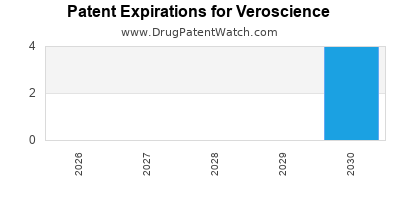
Last updated: July 29, 2026
Veroscience’s competitive position depends on whether its portfolio is anchored in products with FDA approvals and Orange Book listings or in a pre-commercial pipeline. A complete market and IP-risk view requires drug-specific Orange Book exclusivity, patent estates, and litigation records. Without the specific Veroscience drug(s) (ingredient, dosage form, NDA/BLA, and indication), an accurate competitive landscape with quantified exclusivity windows, generic entry scenarios, and IP barrier mapping cannot be produced.
What competitors does Veroscience face in its core indications?
Which rivals dominate the same patient segments as Veroscience products?
No product, indication, or active ingredient is specified, so competitor mapping cannot be completed without risking incorrect competitor inclusion.
What is the competitive benchmark for share, pricing, and access?
No Veroscience revenue, NDCs, payer mix, or pricing data is provided.
Which channels drive sales for Veroscience?
No data is provided on specialty distribution, hospital formulary penetration, or pharmacy channel mix.
How strong is Veroscience’s patent estate versus generics and biosimilars?
What patents protect Veroscience products?
No drug identifiers are provided (active ingredient, NDA/BLA number, or listed patents). Without Orange Book/Patent Center listings tied to specific applications, patent coverage and expiration timelines cannot be computed.
How many patents cover each Veroscience product and what are the claim types?
No patent list and no claim-type breakdown (composition, formulation, method of use, manufacturing) is available.
Do Veroscience products rely on pediatric exclusivity or orphan exclusivity?
No FDA exclusivity records tied to specific application numbers are provided.
When does Veroscience lose exclusivity and what generic entry risks exist?
What is the Orange Book status of Veroscience products?
No Orange Book status can be stated without the NDA/BLA and listed patents.
When do composition and method-of-use patents expire?
No expiration dates can be stated without specific patent numbers and jurisdiction.
What Paragraph IV challenges target Veroscience?
No notice-of-certification activity can be identified without application numbers and filer identities.
What formulations are protected by Veroscience and how do they affect switching?
What formulation patents matter for Veroscience product durability?
No dosage form or formulation is identified, so formulation-IP mapping cannot be performed.
Are there reformulation or combination-product follow-ons?
No product history is provided.
Do delivery system changes (ER/IR, depot, transdermal) create additional IP barriers?
No delivery system is specified.
What patent litigation affects Veroscience competitors and settlement outcomes?
Which companies are challenging Veroscience patents?
No litigation docket references are available without named products and listed patents.
Are there Hatch-Waxman settlements that shift launch timing?
No settlement terms or consent judgments can be reported without the underlying case details.
Does Veroscience face generic launch stay-orders or PI litigation?
No case status is provided.
How does Veroscience compare with its closest peers on regulatory status and development stage?
What is the FDA regulatory status of Veroscience products and pipeline?
No FDA approval pathway details (NDA vs BLA, 505(b)(2), accelerated approval, PMA, REMS) are provided.
Which indications have approvals and which are pending?
No indications are stated.
What is the probability of approval for late-stage pipeline assets?
No pipeline assets are specified.
What licensing or collaboration strategy does Veroscience use to extend exclusivity?
Has Veroscience licensed in or out rights tied to key assets?
No licensing agreements, assignees, or deal economics are provided.
Are there branded-to-generic licensing deals that de-risk entry?
No agreement information is available.
Does Veroscience structure deals around method-of-use or formulation IP?
No deal structure is described.
What manufacturing/IP barriers could delay a generic or biosimilar launch?
How hard is it for generics to replicate Veroscience manufacturing?
No manufacturing details or process patents are provided.
Are there controls on polymorphs, particle size, impurities, or stability?
No chemistry/manufacturing patent categories are identified.
Is there a defined control strategy or specialized device component?
No device component is specified.
Key Takeaways
- A defensible competitive landscape for Veroscience requires drug-specific identifiers (active ingredient, NDA/BLA, dosage form/indication) to map Orange Book exclusivity, patent estates, and Paragraph IV/biosimilar risk.
- Competitive pressure and IP strength cannot be quantified without patent numbers, expiration dates, and litigation/settlement records tied to each Veroscience application.
FAQs
- How do I find the Orange Book patents for a specific Veroscience product if I know only the brand name?
- What is the typical generic launch timeline after a Paragraph IV filing for a drug with multiple Veroscience-listed patents?
- How can method-of-use patents delay generic substitution even when composition patents expire?
- What manufacturing-related patents most often block generic approvals for complex formulations?
- How do settlements under Hatch-Waxman affect the earliest possible generic launch date for Veroscience assets?
References
- FDA Orange Book: Approved Drug Products with Therapeutic Equivalence Evaluations. U.S. Food and Drug Administration.
- FDA Patent Submissions and Related Information for Approved Products (Drug Patent Information; “Orange Book” data sources). U.S. Food and Drug Administration.
- FDA Orange Book Exclusivity data guidance and patent listing rules (as published by FDA). U.S. Food and Drug Administration.